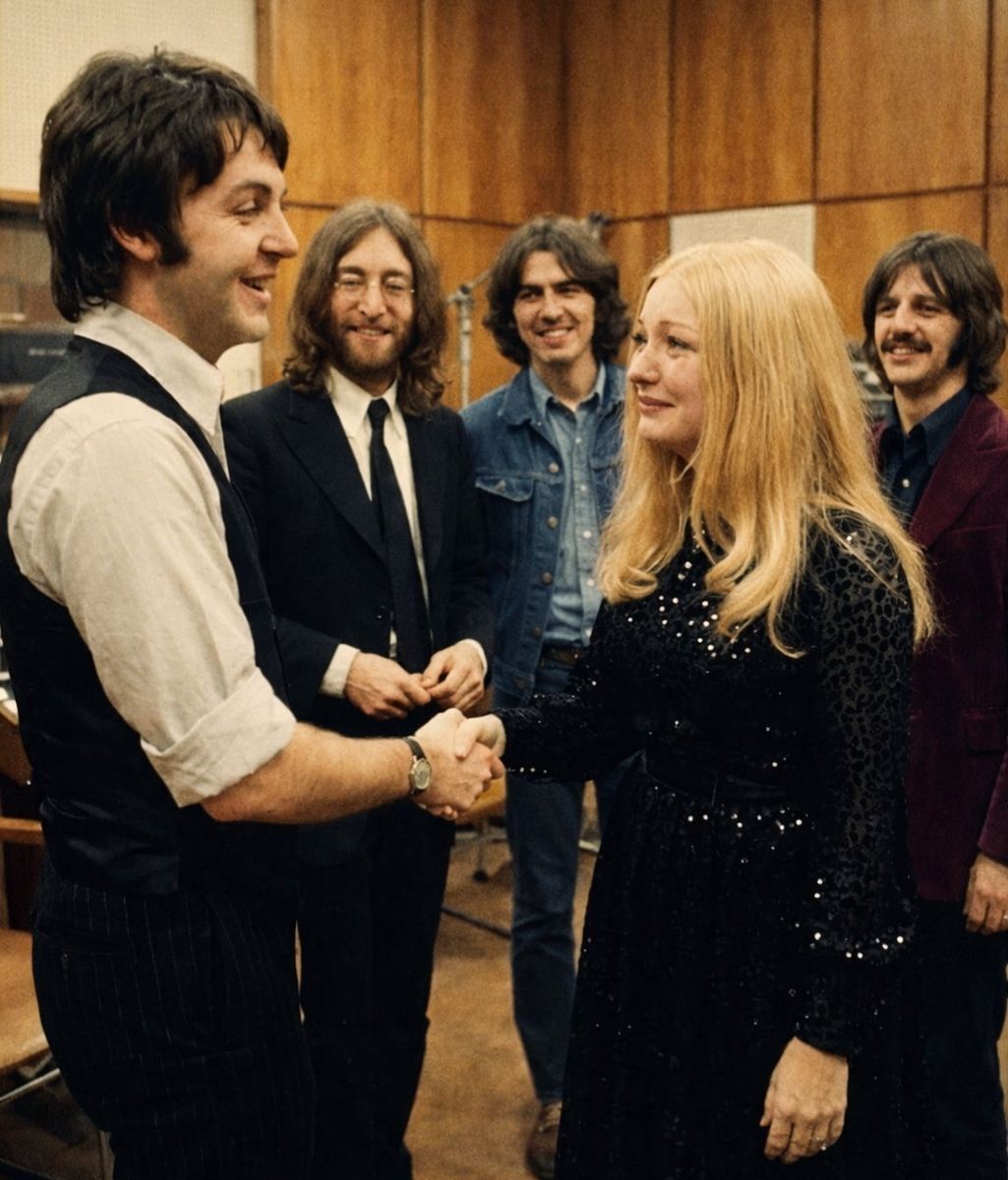
Fear arrived before confidence ever had a chance. In August 1968, inside the offices of Apple Records, Mary Hopkinwaited, certain she did not belong.
She was eighteen years old, newly discovered, carrying a voice that felt fragile in her own ears. Around her were names already etched into history. They were The Beatles. She was still deciding whether she deserved to be there at all.
The room felt larger than it was. Every sound seemed amplified by doubt. Mary later recalled feeling small, overwhelmed by the weight of reputation and expectation. Talent alone did not quiet that fear. At that age, belief from others mattered more than belief in oneself.
Then Paul McCartney walked in.
There was no dramatic entrance. No distance created by status. He smiled easily, spoke warmly, and closed the invisible gap she had built in her mind. He listened, not like a producer searching for a sound, but like a person meeting another person. The atmosphere shifted almost immediately.
 “You’re wonderful. I want to work with you.”
The sentence was simple. It carried no conditions, no warning, no test attached. Yet it rewrote everything. Fear did not argue. It dissolved. In its place, something steadier took hold. Paul did not only hear a voice worth recording. He saw a future worth trusting. Confidence entered the room quietly, without announcement, and stayed.
In the days that followed, the song Those Were the Days was recorded. Its melody felt timeless even then, carried by innocence rather than ambition. When it reached the public, the response was immediate. It rose to number one. Fame arrived swiftly, bright and overwhelming, just as it often does.
And then, as fame tends to do, it softened.
Charts changed. Attention moved elsewhere. But something far more durable remained. Mary’s sense of worth no longer depended on success or applause. It rested on a moment when someone she respected spoke belief into her life without hesitation.
Years later, Mary Hopkin would reflect that success came and went, as all careers do. What never faded was the value Paul McCartney gave her in that first meeting. It became a quiet foundation beneath every step she took afterward.
This story endures not because it produced a hit record, but because it revealed something essential about greatness. True influence does not always announce itself through sound or spectacle. Sometimes it appears in a single sentence, spoken at the right moment, to the right person, by someone willing to see potential before it proves itself.
In that Apple Records office, history did not begin with a song. It began with belief. And for Mary Hopkin, that belief lasted longer than any number-one record ever could.
Video