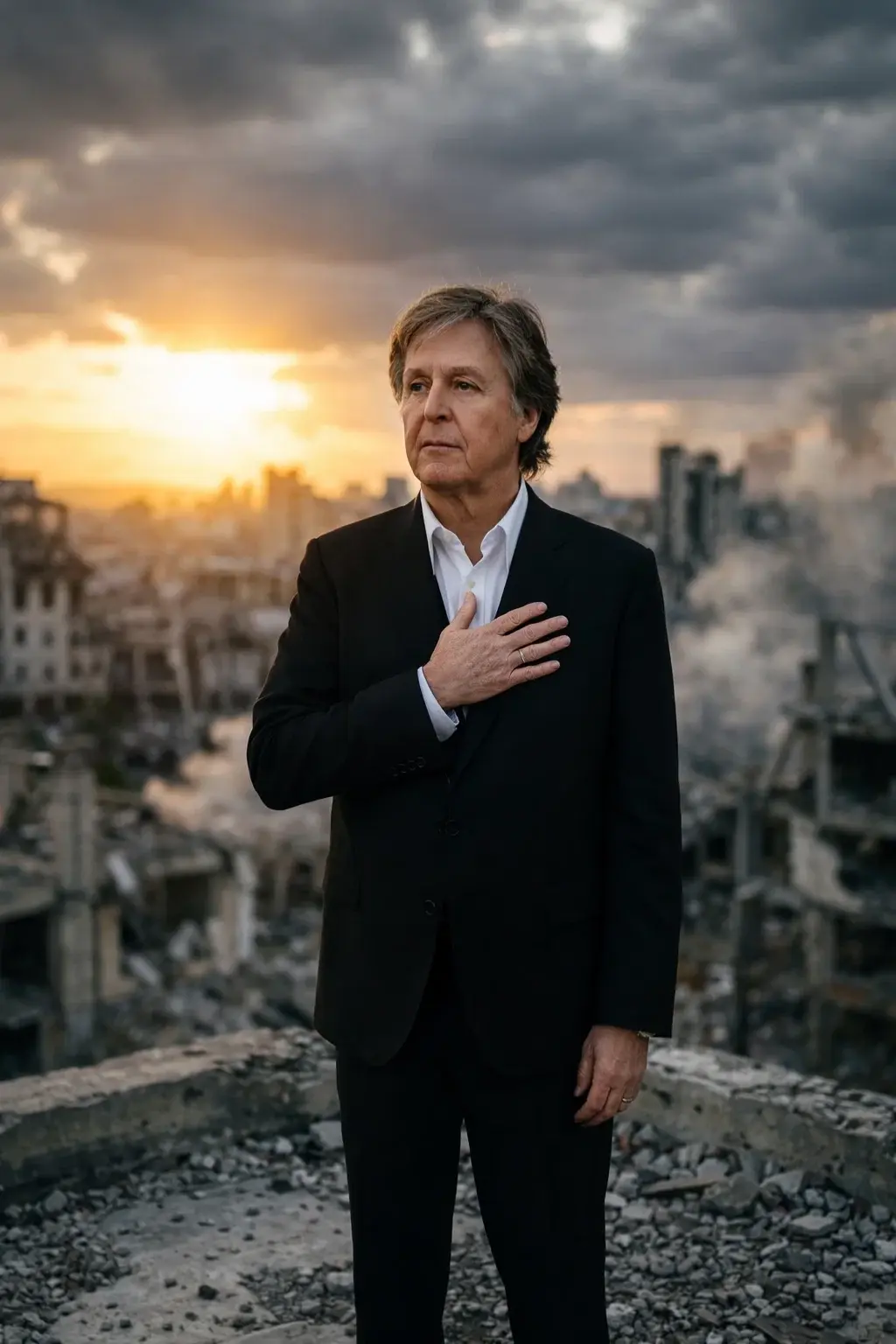

In an emotional and unexpected moment that quickly reverberated across social media, Paul McCartney used his global platform to honor the victims affected by the recent tensions and violence surrounding the United States–Iran conflict. The legendary musician, known for decades not only as a defining voice in modern music but also as an advocate for humanitarian causes, shared a message that shifted the conversation away from politics and toward people — the ordinary families caught in extraordinary turmoil.
The post appeared without warning. There was no promotional lead-up, no carefully timed campaign, no accompanying single or tour announcement. Instead, it was a simple, solemn statement. Within minutes, it began spreading across platforms, shared by fans, commentators, and fellow artists alike. The tone was reflective rather than accusatory, compassionate rather than partisan.
“War takes faces we never see,” McCartney wrote. “Behind every statistic is a family, a story, a life that matters.”
The words struck a deep chord. At a time when headlines often focus on strategy, retaliation, and geopolitical positioning, McCartney redirected attention to the human cost. His message did not name leaders or assign blame. Instead, it acknowledged grief — the quiet, personal grief that exists far from press briefings and televised debates.
For many followers, that restraint made the statement even more powerful. Social media quickly filled with responses describing the message as “necessary,” “grounded,” and “a reminder of what truly matters.” Supporters praised the singer for centering compassion rather than division.
The recent escalation of tensions between the United States and Iran has generated anxiety far beyond the borders of the two nations. Communities connected by heritage, military service, and diplomatic ties have all felt the ripple effects. Families with loved ones deployed overseas wait anxiously for updates. Civilians in affected regions face uncertainty, disruption, and fear. In such moments, public figures often find themselves navigating a delicate line between speaking out and avoiding political entanglement.
McCartney’s statement carefully walked that line. “Where there is blood, let there also be compassion. Where there is fear, let there be understanding,” he continued. “Today I stand with every mother who has lost a child, every father whose home has been shattered, and every young soul robbed of their tomorrow.”
Observers noted that the language echoed themes long present in his songwriting — empathy, shared humanity, and hope in the face of darkness. Throughout his career, McCartney has often used music as a vehicle for unity. From songs that became anthems of peace to benefit concerts supporting humanitarian relief, he has maintained a consistent message: that ordinary people deserve safety, dignity, and the chance to live without fear.
Industry analysts say the timing of the post may have amplified its impact. In a media cycle dominated by sharp political rhetoric, an appeal centered purely on compassion stood out. Rather than framing the conflict as a clash of governments, McCartney framed it as a crisis of human consequence.
Within hours, the hashtag #StandForPeace began trending in multiple countries. Fans translated the message into different languages, sharing it across regions with varying perspectives on the conflict. Some wrote about relatives living near military installations. Others shared stories of displacement, recalling past wars that had shaped their own families’ histories.
One commenter wrote, “It’s not about sides. It’s about people.” Another added, “Thank you for reminding us that empathy is stronger than anger.”
Public figures entering conversations about international conflict often face polarized reactions. Yet in this case, responses were overwhelmingly supportive. Commentators suggested that the absence of political finger-pointing made the statement accessible to a broader audience. By focusing on universal experiences — grief, fear, hope — McCartney avoided alienating segments of his diverse global fanbase.
Cultural historians have long observed that musicians can play a unique role during times of crisis. Unlike elected officials or policy analysts, artists speak through emotion and symbolism. Their influence does not derive from authority but from connection. For generations, songs have offered solace during wars, protests, and social upheavals. In this instance, McCartney used prose instead of melody, yet the effect felt similarly lyrical.
The broader entertainment community also responded. Fellow artists shared the post, adding messages of solidarity. Some echoed the call for compassion; others highlighted humanitarian organizations working to provide aid in affected regions. A few noted that cultural voices can help maintain space for dialogue when political channels grow tense.
At the same time, experts caution that symbolic gestures, while meaningful, must be paired with tangible support to create lasting impact. Advocacy groups emphasized the importance of humanitarian funding, diplomatic engagement, and community-level assistance. Still, many acknowledged that public empathy can shape public pressure — and that pressure can influence policy conversations.
For McCartney, the moment reflects a continuation of a lifetime pattern rather than a sudden shift. He has previously supported campaigns related to landmine removal, animal rights, and disaster relief. His advocacy has often emphasized compassion as a starting point for action. In interviews over the years, he has described music as a bridge — a way to reach across cultural and national divides.
Fans pointed out that his message resonated particularly strongly with younger audiences discovering his legacy through streaming platforms and viral clips. In a digital era where celebrity statements are frequently scrutinized and dissected, clarity and sincerity carry significant weight. The brevity of McCartney’s words may have contributed to their authenticity. They felt less like a press release and more like a personal reflection.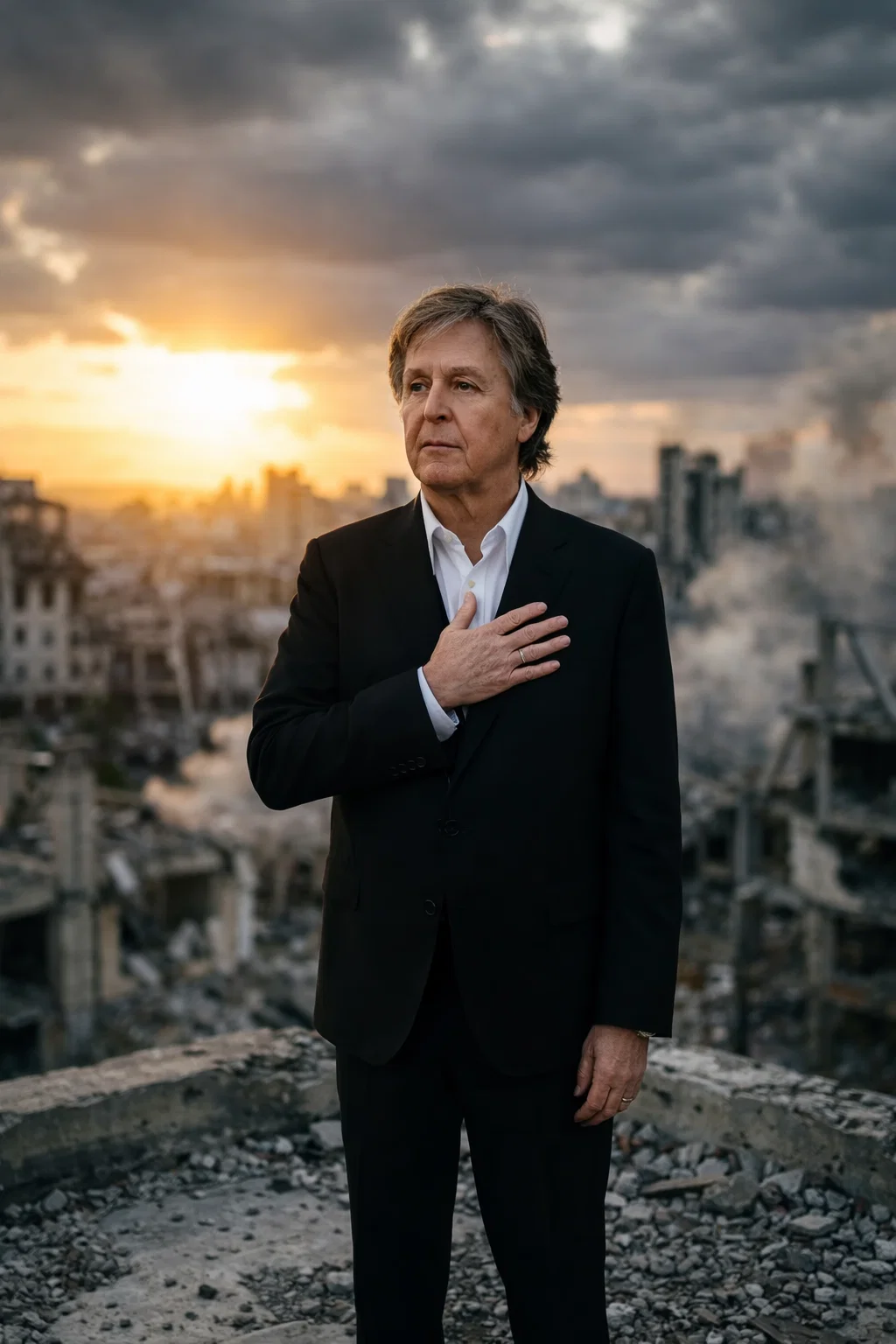
Political analysts note that celebrity interventions rarely alter diplomatic trajectories on their own. However, they can influence public discourse by reframing narratives. When high-profile figures emphasize the human cost of conflict, they challenge audiences to think beyond abstract strategy. That shift in framing can reduce dehumanization — a key factor that often fuels prolonged hostilities.
As the hashtag #StandForPeace continues to circulate, its meaning remains intentionally broad. It does not prescribe policy. It does not endorse one government over another. Instead, it asks participants to acknowledge shared vulnerability. In a time defined by fragmentation — ideological, cultural, and digital — that simplicity may explain its rapid spread.
Some commentators have suggested that the message also reflects fatigue with constant outrage cycles. Many social media users expressed appreciation for a post that neither sensationalized nor simplified the conflict. “It’s rare to see something that isn’t trying to win an argument,” one user wrote. “It’s just trying to remind us to care.”
Whether the statement will have lasting influence is impossible to predict. International tensions evolve through complex networks of diplomacy, security considerations, and historical grievances. Yet cultural moments can leave subtle imprints. They can remind audiences of shared humanity at moments when fear threatens to narrow perspective.
For now, Paul McCartney’s message stands as a quiet intervention in a loud conversation. It did not attempt to solve geopolitical disputes. It did not claim moral superiority. Instead, it asked readers to pause — to see beyond headlines and statistics, and to imagine the families behind them.
In doing so, it reaffirmed a belief that has shaped much of his artistic legacy: that compassion is not weakness, but strength. That empathy is not naive, but necessary. And that even amid the complexities of international conflict, there remains space for voices calling for peace.
As the world continues to grapple with uncertainty, the enduring resonance of those words — “Behind every statistic is a family, a story, a life that matters” — may serve as both reminder and challenge. In times of division, the simplest appeals can sometimes carry the furthest reach.