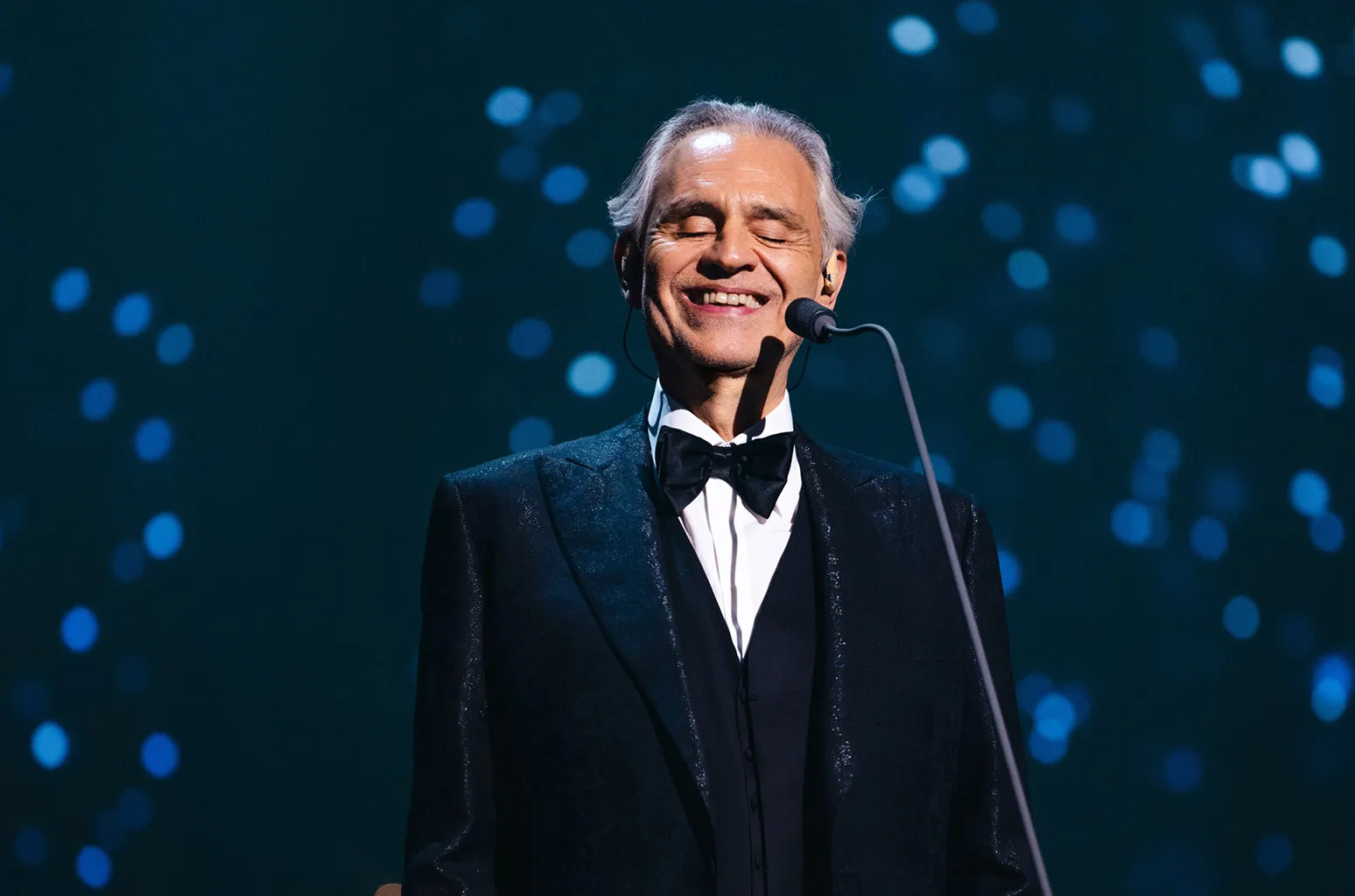
When Silence Took Over the Stage: Andrea Bocelli’s Unscripted Test of Focus

andrea bocelli

Live performances carry a unique kind of unpredictability. No matter how carefully rehearsed, there is always the possibility that something might go wrong. For Andrea Bocelli, a recent sold-out concert became a powerful reminder of that reality—turning an unexpected technical failure into a moment audiences would never forget.

The setting was grand, as expected. Thousands had gathered, filling the venue with anticipation. Bocelli, known for his commanding yet deeply emotional presence, had already drawn listeners into the performance. Then, without warning, something changed.

A technical issue disrupted the flow of the concert. In an instant, the structure that supports any live performance—lighting, cues, coordination—was no longer reliable. For most performers, it would be a disorienting interruption. For Bocelli, who navigates the stage without sight, the sudden loss of cues created an even greater challenge.

From the audience’s perspective, what followed appeared almost intentional. The music stopped. Bocelli stood still. The silence stretched on, filling the space where sound had been just moments before. Some may have assumed it was a dramatic pause, a deliberate artistic choice.

But behind that stillness was a moment of intense concentration.

Without clear signals to guide him, Bocelli had to rely entirely on his internal sense of timing, spatial awareness, and composure. In live performance, even a few seconds of uncertainty can feel much longer. Here, nearly a full minute passed—an eternity on stage.

Yet what defines great performers is not the absence of difficulty, but the way they respond to it.

Gradually, something shifted. There was no dramatic gesture, no visible signal to mark the change. Instead, it was subtle—a quiet regaining of control. Bocelli reoriented himself, reconnecting with the rhythm of the performance and the presence of the audience.

When the music resumed, it carried a different weight. What had been interrupted now felt more fragile, more immediate. The audience, whether fully aware of what had happened or not, responded with a renewed attentiveness. The performance moved forward, but the moment of silence lingered in the background, giving everything that followed a deeper resonance.

For fans, the story has become more than just an anecdote about a technical glitch. It highlights something essential about Bocelli’s artistry: his ability to remain grounded under pressure. His performances are often described as emotional and powerful, but moments like this reveal another layer—resilience.

Live music is, at its core, about connection. Not just when everything goes perfectly, but also when the unexpected occurs. In that brief silence, there was a shared experience between performer and audience—one defined not by sound, but by presence.

As the concert continued, what could have been remembered as a disruption instead became one of its most memorable elements. The pause, the stillness, and the recovery all contributed to a performance that felt uniquely human.

In the end, it wasn’t just about how Bocelli sang that night. It was about how he stood, waited, and found his way forward when everything momentarily fell away.

And sometimes, it’s in those unscripted moments that the true strength of an artist is revealed.

0 Shares:
Leave a Reply

Your email address will not be published. Required fields are marked *

You May Also Like
Paul McCartney
Read More

The world leaned in when Paul McCartney reflected on Ob-La-Di, Ob-La-Da, and instead of the bitterness or worship some expected, he spoke of John Lennon with a grace that stunned even longtime critics, recalling his old friend with honesty, warmth, and just enough edge to make it real, and fans whispered that Paul had finally found the balance between memory and myth, refusing to deify John but never diminishing him either, leaving audiences with the rare sense that they weren’t just hearing about a song, but witnessing a Beatle heal history one word at a time.

A song that divided the Beatles Few tracks in the Beatles’ catalogue stir as much debate as Ob-La-Di, Ob-La-Da. Written…
celine
Read More

THE STADIUM ERUPTS THE MOMENT CELINE DION SINGS — but it isn’t just the roar of thousands that hits you. It’s the way time seems to stop the exact second those first trembling notes of My Heart Will Go On float into the air. One heartbeat… then another… and suddenly an arena full of strangers is transported back to 1997, to icy water and trembling hands, to a love story the world never recovered from. Celine stands there — luminous, fragile, unbreakable — and with one breath she turns a song everyone knows into a memory everyone feels. Phones rise, tears fall, and a quiet miracle happens: thousands breathe at the same rhythm, as if the whole stadium becomes a single living thing. By the final chorus, people aren’t just listening — they’re holding onto someone, wiping their cheeks, whispering ‘She still has it… she still is it.’ And when she lifts her hand toward the lights, every heart lifts with her, proof that after all these years, this song doesn’t just live… it still heals.

Celine Dion has many hits, but My Heart Will Go On is considered her signature song. This is…
John Lennon
Read More

Under the blue wash of the Grammy lights, Julian stepped up to the microphone and whispered: “I once said I’d only sing this if the world truly needed it… maybe the world does.” Julian and Sean Lennon didn’t just perform ‘Imagine’ — they turned it into a message for their father, and one lyric cut straight through the room. The first chords floated out, soft and familiar. Sean stood beside Julian — not as a featured guest, but as his brother.

IMAGINE… JOHN LENNON’S SONS TURN ICONIC ANTHEM INTO A HEART-STOPPING TRIBUTE: JULIAN AND SEAN DELIVER EMOTIONAL PERFORMANCE THAT…
carrie
Read More

With one trembling line, Carrie Underwood didn’t just sing — she transformed Bridgestone Arena into something sacred. Midway through her Denim & Rhinestones tour, she stunned the crowd by calling her husband, former NHL star Mike Fisher, onto the stage. What followed was an unexpected duet of “Look At Me,” their voices blending like a vow whispered in public. Mike’s unpolished tone carried something stronger than technique: devotion. Carrie leaned toward him, eyes shining, as if borrowing strength from his presence. But the moment didn’t end under the spotlight. From the wings, their young son watched — and what he shouted next turned a concert into a memory no one was ready for.

The Heartfelt Story Behind Carrie Underwood’s “Mama’s Song” Known for her powerful vocals and emotionally rich storytelling, Carrie…