Few bands in history have inspired as much discussion, admiration, and speculation as The Beatles. Among the many “what if” questions that surround their legacy, one idea has always stood out: could there have been a fifth Beatle?
A newly restored studio moment from 1969, reconstructed with the help of producer Rick Rubin, offers a rare glimpse into that possibility. The footage doesn’t show a grand announcement or a formal decision. Instead, it captures something far more subtle—a quiet exchange between band members during a session, where the idea is briefly considered.
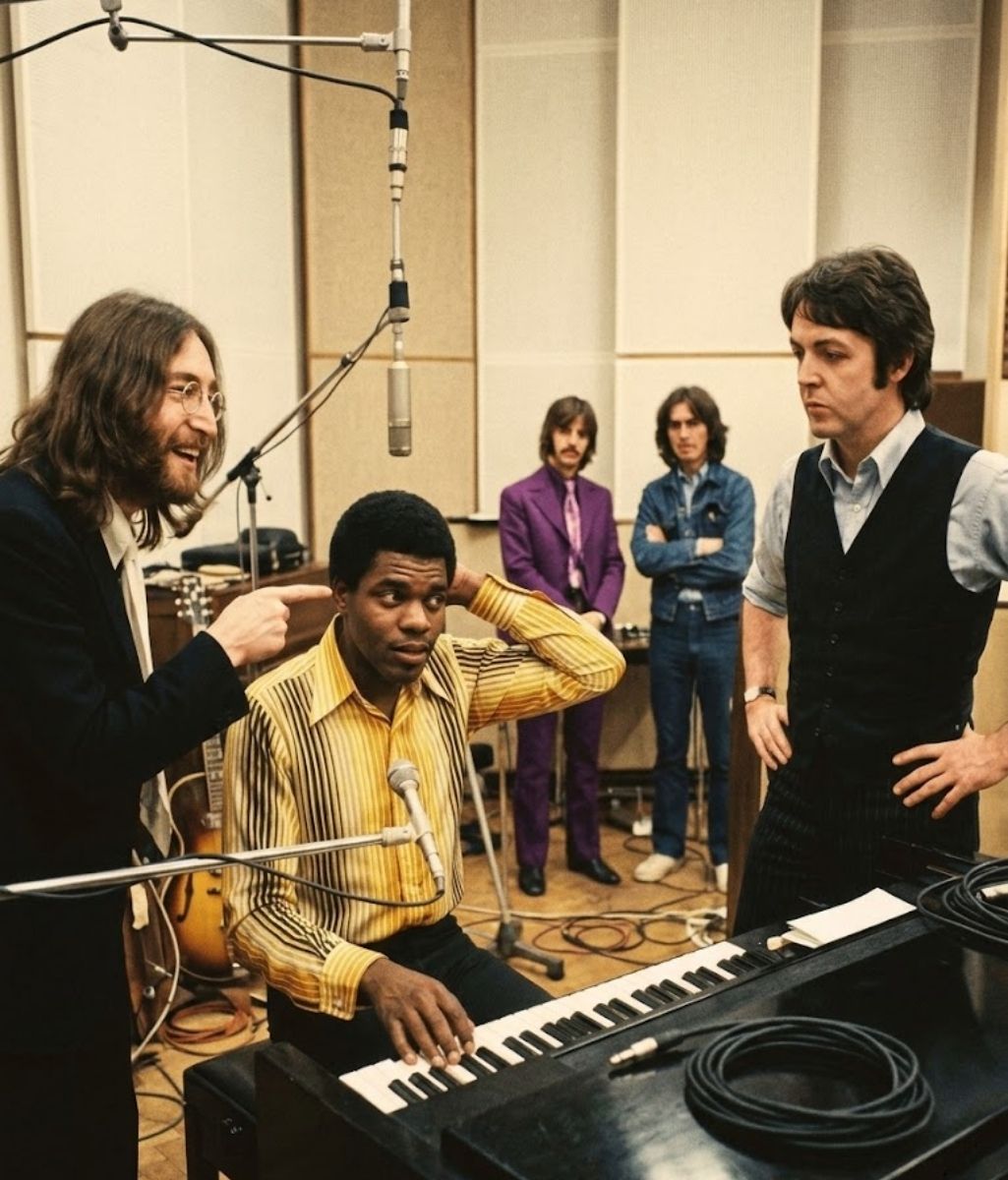
At the center of this moment is John Lennon, who suggests that Billy Preston might join the group as a full member. For fans, the suggestion isn’t entirely surprising. Preston had already been working closely with the band during their later sessions, bringing a distinctive keyboard style that added new depth to their sound.
His presence was also known to have a calming effect. At a time when tensions within the band were becoming more visible, Preston’s involvement seemed to shift the dynamic, even if only temporarily. He wasn’t just another session musician—he was someone the group respected and enjoyed working with.
The idea of officially bringing him into the band, however, was a different matter.
That’s where Paul McCartney enters the conversation. His response, captured in the restored footage, reflects the complexity of the moment. By 1969, The Beatles were no longer the unified force they once had been. Creative differences, business concerns, and personal changes had begun to pull them in different directions.
Adding a new member—even one as talented and well-liked as Preston—was not a simple decision. It wasn’t just about music; it was about identity. The Beatles had always been defined as a group of four, and changing that structure would have meant redefining something that had already become iconic.
What makes this moment so compelling isn’t just the idea itself, but the timing. These sessions were taking place during a period when the band was already on the edge of breaking apart. In that context, the suggestion feels less like a long-term plan and more like a fleeting possibility—one that briefly opened a door before quietly closing it again.
For fans, the footage adds a new layer to an already well-documented era. It shows how even in their final chapter, the band was still experimenting—not just with their sound, but with the way they worked together.
Billy Preston’s role in their story remains significant, regardless of whether he officially became a member. His contributions can be heard in some of their later recordings, and his presence during those sessions left a lasting impression.
In the end, The Beatles remained four. But moments like this remind us how close things can come to changing—and how different music history might have looked if one quiet conversation had gone another way.