There are concerts, and then there are moments that seem to exist outside of time. At Glastonbury Festival, one such moment unfolded as Paul McCartney celebrated his 80th birthday with a set that stretched across decades, genres, and generations. Fans expected something special. What they experienced instead was something far more personal.
Midway through the night, the energy shifted—not with spectacle, but with presence. Dave Grohl stepped onto the stage. It marked his first appearance since the passing of his Foo Fighters bandmate, Taylor Hawkins, and the weight of that loss seemed to follow him into the spotlight. His greeting was simple—just a soft “Hi Paul…”—but it landed with a quiet gravity that rippled through the massive crowd.

As the band moved into “I Saw Her Standing There,” Grohl found his place beside McCartney, not as a headliner but as a fellow musician sharing something unspoken. There was no grand speech, no overt tribute. Instead, it came through the music. Each lyric carried a sense of purpose, as though the act of performing itself was a way of processing grief. When they continued with “Band on the Run,” the mood remained reflective, grounded in the understanding that music often says what words cannot.
Then, just as the audience settled into that emotional undercurrent, the night opened up again. Bruce Springsteen joined them onstage, bringing a different kind of energy—one that didn’t erase the solemnity but expanded it. With “Glory Days,” the tone shifted toward celebration, a reminder of the joy that lives alongside loss. The trio moved effortlessly through “I Wanna Be Your Man,” bridging eras of rock history, before launching into a driving finale with “The End.”
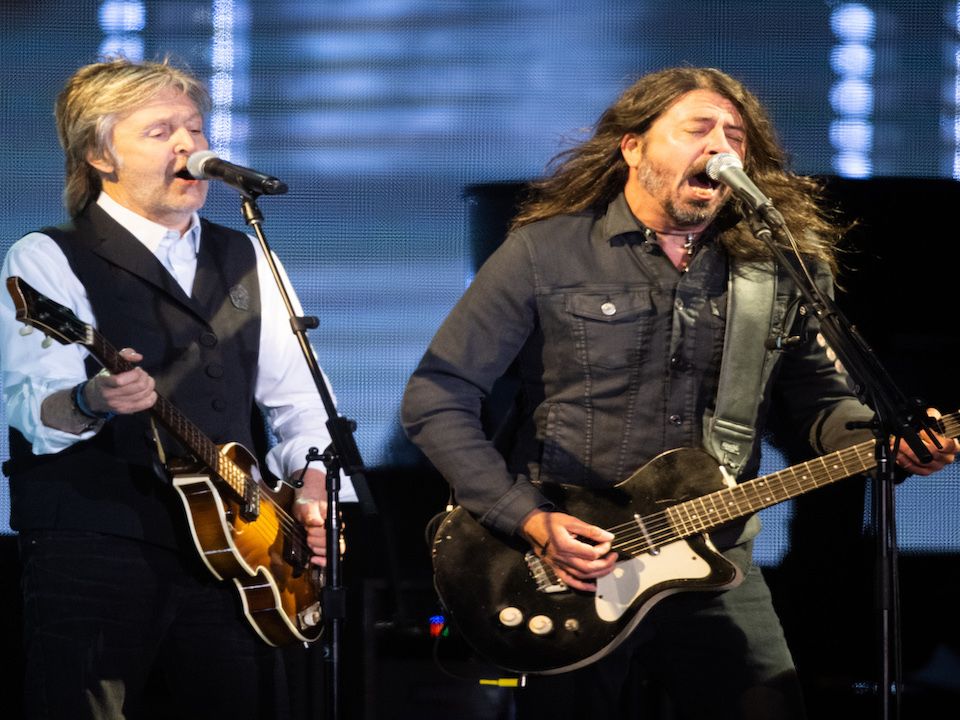
What made the moment stand out wasn’t just the lineup, though that alone was remarkable. It was the way the performance balanced emotion and connection. Three artists, each carrying their own legacy, stood together not to showcase greatness, but to share something human. The audience felt it too. Voices rose, not just in excitement but in recognition—of the songs, the history, and the shared experience unfolding in real time.
For longtime fans, it was a convergence that seemed almost impossible. McCartney, whose catalog helped shape modern music. Grohl, representing a generation that grew up on that influence while forging its own path. Springsteen, a storyteller who has long bridged the personal and the universal. Together, they created a moment that didn’t rely on nostalgia alone—it felt present, immediate, and deeply felt.
As the final notes rang out across the field, there was no sense of finality. Instead, there was a quiet understanding among those watching: they had witnessed something rare. Not just a collaboration, but a moment where music became a vessel for remembrance, resilience, and connection.
And in a festival known for unforgettable performances, this one found its place among the most meaningful.