For decades, the story of The Beatles has been told in sweeping terms—unmatched success, cultural transformation, and, inevitably, tension. Like many creative partnerships, the bond between its members evolved over time, shaped by both collaboration and conflict. Among those relationships, the connection between Paul McCartney and George Harrison carried its own quiet complexity.
By the time Harrison entered the final stage of his life in 2001, much had changed. The noise of fame had long since faded into history, replaced by reflection and distance. Yet when McCartney traveled to see him, the moment was not defined by what had come between them—but by what had always been there.
The setting was simple: a private room, far removed from the stages and studios that once defined their lives. There were no reporters, no performances, no sense of spectacle. Instead, there was stillness. Machines hummed softly, marking time in a way that felt both clinical and deeply human.

In that space, the past seemed to return in fragments. Before the global fame, before the pressures that reshaped their bond, they had simply been two young musicians from Liverpool. One showing the other a new chord. One listening, learning, building something that would eventually reach the world.
That history did not need to be spoken aloud. It existed in the silence between them, in the familiarity that remained even after years of change. Whatever disagreements had once stood between them seemed smaller in the presence of something more enduring.
Stories have often hinted at a guitar being present during that final meeting—a quiet symbol of everything they had shared. Whether or not any music was actually played matters less than what it represents: a return to the language that first brought them together.
For McCartney, the visit was not just a farewell to a former bandmate, but to someone who had been part of his life since adolescence. Their journey had not always been easy, but it had been deeply intertwined. In moments like this, the complexity of that relationship becomes something softer, shaped more by memory than by conflict.
What happened after the visit has often been described in restrained terms. McCartney left and returned home soon afterward, carrying with him whatever emotions the moment had stirred. He has rarely spoken in detail about those final hours, choosing instead to let them remain private.
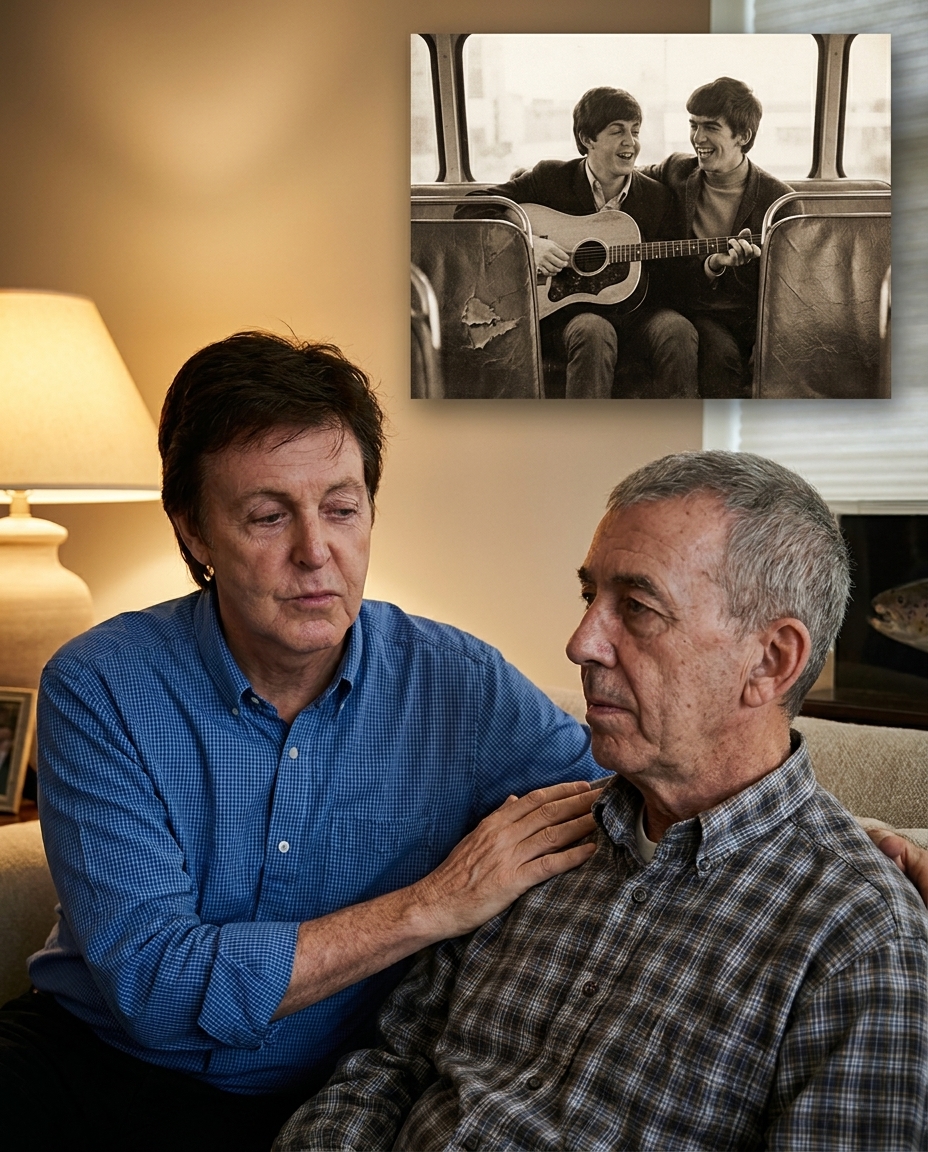
That silence has, in many ways, defined the story. In a world where so much of The Beatles’ history has been analyzed, documented, and revisited, this final chapter resists full explanation. It exists not as a headline, but as a personal memory—one that belongs more to the people who lived it than to those who observe it from afar.
For fans, the idea of a quiet reconciliation carries its own meaning. It suggests that even after years of distance, something essential remained intact. Not perfection, not resolution in a dramatic sense, but a shared understanding that did not need to be spoken.
In the end, the story of that meeting is not about erasing the past. It is about acknowledging it, and then, for a brief moment, setting it aside. Two friends, in a quiet room, remembering where it all began.
And sometimes, that is enough.