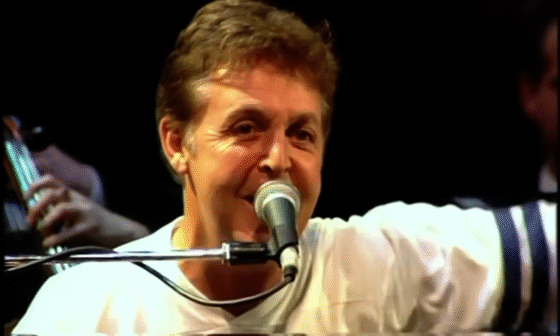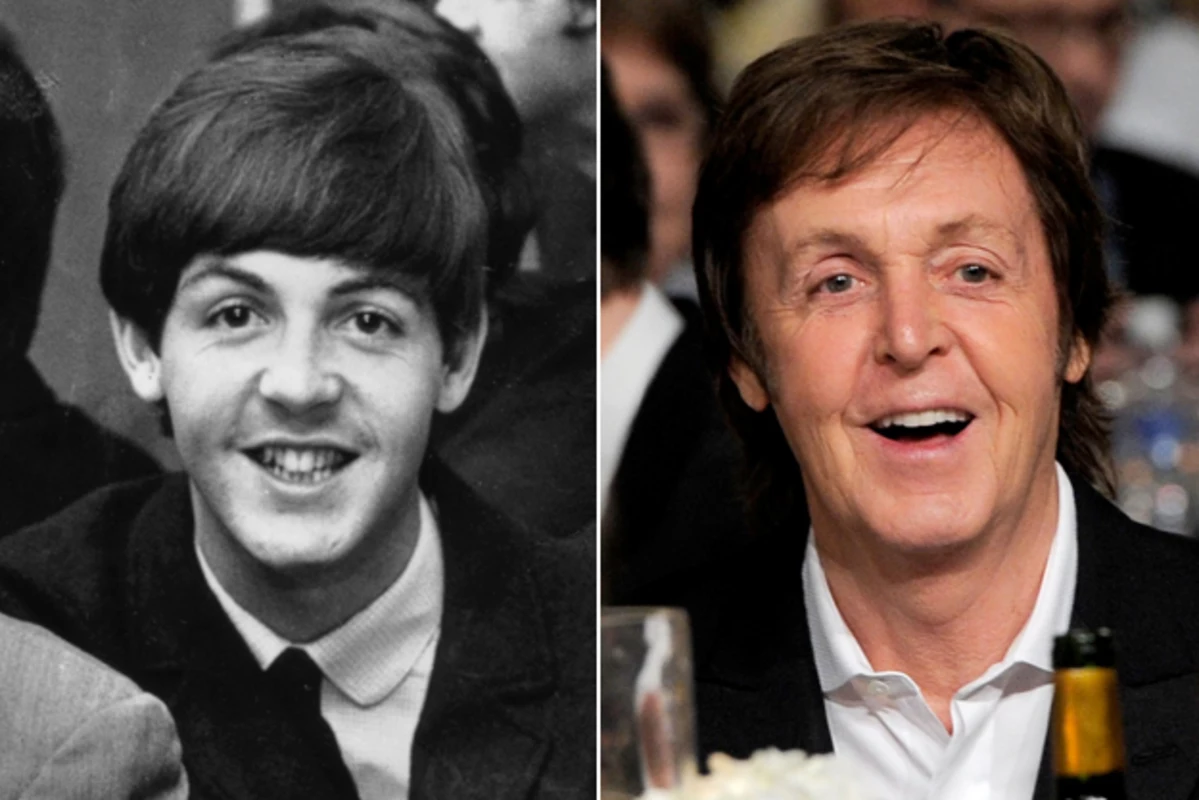
When two artists share a stage, the result is often measured in sound—harmonies, lyrics, and performance. But when those two artists are Paul McCartney and his son James McCartney, the moment carries something deeper, something that extends far beyond music itself.
Their recent collaboration has drawn attention not because of spectacle or scale, but because of its intimacy. It feels less like a carefully staged event and more like an organic meeting of two creative paths that have developed independently over time. For years, both father and son have followed their own directions—Paul as one of the most influential figures in modern music history, and James as an artist carving out a quieter, more introspective identity.

Bringing those worlds together was never going to be just about creating a song.
From the first notes, there is a sense of familiarity in Paul McCartney’s voice. Decades of music have shaped its character, making it instantly recognizable to listeners around the world. It carries with it a sense of history—echoes of earlier eras, of songs that defined generations. Yet in this collaboration, that voice feels softer, more reflective, as if stepping into a more personal space.

James McCartney’s presence adds a different dimension. His tone is measured and thoughtful, less about commanding attention and more about drawing the listener inward. Where his father’s voice carries legacy, his brings perspective—something shaped by growing up close to music history, yet choosing to interpret it in his own way.

Together, they create a balance that feels natural rather than constructed. The song unfolds like a conversation, each voice responding to the other without overshadowing it. There is no sense of competition, no attempt to prove anything. Instead, there is space—space for the music to breathe, and for the relationship between them to quietly come through.
What makes this collaboration particularly compelling is the idea of continuity. Music, in this case, becomes a bridge between generations. It connects past and present, not by repeating what has already been done, but by allowing it to evolve. The influence is there, but it is not imposed—it flows naturally, shaping the sound without defining it completely.
For listeners, the experience is both familiar and new. There is comfort in hearing a voice that has been part of so many lives, paired with the curiosity of discovering how that legacy continues through a different lens. It invites reflection, not just on the music itself, but on the passage of time and the way creativity can be shared across generations.

In the end, this moment is not about headlines or milestones. It is about connection. It shows how music can carry more than melody—it can hold memory, identity, and relationships that extend beyond the stage.
And in that sense, what Paul and James McCartney have created is not just a collaboration. It is a reminder that some of the most meaningful moments in music are the ones that feel closest to home.