Il Volo Revives Gladiator’s Legacy With a Powerful TODAY Show Performance

Il Volo

Some songs don’t fade with time—they evolve. They gather new meaning as they pass from one generation to the next, shaped by the voices that reinterpret them. That idea was at the heart of a recent performance by Il Volo on the TODAY Show, where the trio brought new life to one of cinema’s most iconic musical themes.

The original piece, widely known as Now We Are Free from the film Gladiator, has remained one of the most emotionally resonant compositions in modern film history. Its blend of sorrow, hope, and transcendence has allowed it to endure long after the film’s release, becoming a standalone piece cherished by audiences around the world.
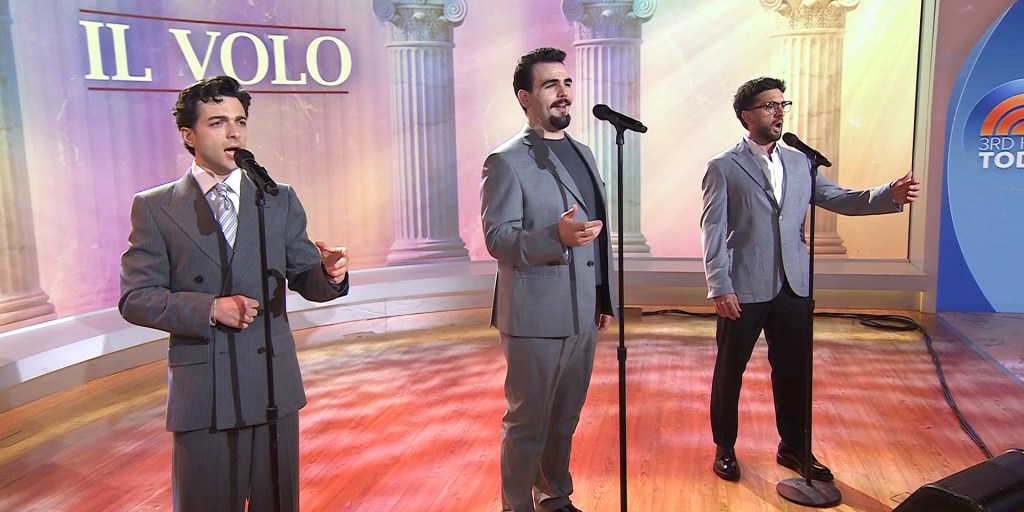
See Il Volo Perform Song 'Now We Are Free' Live on TODAY

Rather than presenting one of their own well-known hits, Il Volo chose to perform Nelle tue mani, their Italian interpretation inspired by the same musical universe. It was a decision that immediately set the tone for a performance focused not on spectacle, but on emotional storytelling.

The TODAY Show stage, typically associated with fast-paced interviews and short promotional performances, was transformed into something more intimate. With minimal staging and no visual distractions, the focus remained entirely on the voices of Piero Barone, Ignazio Boschetto, and Gianluca Ginoble.

Each member contributed to a layered vocal arrangement that emphasized harmony, control, and emotional intensity. The absence of elaborate production allowed the purity of the performance to take center stage, highlighting the trio’s classical training and signature operatic-pop style.

For many viewers, the performance carried a sense of nostalgia paired with rediscovery. While the melody is closely tied to Gladiator, Il Volo’s interpretation brought forward a different emotional lens—one shaped by Italian lyrical expression and contemporary classical influence. The result was a version that felt both familiar and newly reimagined.
The response online reflected that impact. Many fans described the performance as deeply moving, praising the trio for their ability to maintain the emotional core of the original composition while still making it their own. Others noted how rare it is for a television appearance to create such a strong emotional reaction in such a short span of time.

What stood out most was not technical complexity alone, but restraint. Without relying on visual effects or staging tricks, Il Volo demonstrated how powerful simplicity can be when paired with vocal precision and emotional authenticity.

In an era where performances are often designed for instant viral impact, this moment served as a reminder of something more enduring: that music does not need reinvention to remain relevant—it only needs sincerity to remain alive.

And as the final notes faded, one idea lingered strongly among viewers: some songs never truly grow old. They simply find new voices to carry them forward.

0 Shares:
Leave a Reply

Your email address will not be published. Required fields are marked *

You May Also Like
Gianluca Ginoble
Read More

“THE POWER OF LOVE” WAS WRITTEN IN 1985 — BUT TONIGHT, IT FELT BRAND NEW. When Il Volo stepped into “The Power of Love,” nothing felt rushed. The lights were soft. The air felt still. Gianluca Ginoble didn’t overpower the song — he leaned into it. His voice rose slowly, steady and full, like he trusted every word to land on its own. You could see it in his face. Calm. Focused. Honest. The other voices wrapped around him, not competing, just holding the moment together. For a few minutes, it didn’t feel like a cover or a performance. It felt like a memory you didn’t know you had, suddenly coming back. That’s when love songs work best.

When Gianluca Ginoble Channels “The Power of Love” When Il Volo comes together to perform a song as…
Barry-Gibb
Read More

At 79, The Tragedy Of Barry Gibb Is Beyond Heartbreaking. At 78, Barry Gibb is still the voice that gave the world “Stayin’ Alive”—famous for harmonies that defined generations, a falsetto that became legendary, and over 220 million records sold. But behind the timeless hits and global legacy is a story far darker than the music ever revealed: a childhood shaped by poverty and forced emigration that made survival the only option, a vicious backlash that turned him from hero to zero overnight and nearly destroyed everything he built, the devastating addiction battles of two brothers that he watched helplessly spiral beyond救, and three unbearable losses that left him as the last man standing, singing alone on stages that once held four voices. How did the man who brought joy to the entire world through music survive the cost of becoming the sole survivor of a family tragedy? Stay with us as we uncover the hidden scars, defining moments, and reinvention that reshaped Barry Gibb.

Introduction: Barry Gibb: The Last Voice Standing in a Harmony That Time Broke Barry Gibb gave the world…
CLIFF Richard
Read More

When Cliff Richard and The Shadows appeared on The Cliff Richard Show on March 19, 1960, they delivered more than a performance — they helped spark the rise of British rock & roll. With its fierce energy and bold attitude, Move It captured the restless spirit of a generation ready for something new. Cliff’s powerful, confident vocals combined with The Shadows’ sharp, driving sound created a moment that still feels electric today. Even more than sixty years later, the performance carries the same excitement, revealing the early spark that would go on to influence British pop and rock for decades. Watching it now, you can hear the birth of a movement — raw, rebellious, and unforgettable. ✨ Relive this iconic performance — listen in the first comment

Cliff Richard & The Shadows: “Move It” and the Moment That Sparked British Rock & Roll On March…