Introduction
The lights don’t rise.
The crowd doesn’t scream.
There’s no cape, no karate kick, no Vegas fanfare.
Only a man.
A piano.
And silence sharp enough to cut through bone.
That’s how the now-viral reconstruction of Elvis Presley’s final era performing “Suspicious Minds” opens — not as a concert, but as a confession. A visual autopsy of a legend who rose too fast, loved too deeply, and fell under the weight of a world that demanded far more than any human could give.
This is not a tribute video.
This is the King’s subconscious cracking open on screen.
THE QUIET BEFORE THE COLLAPSE
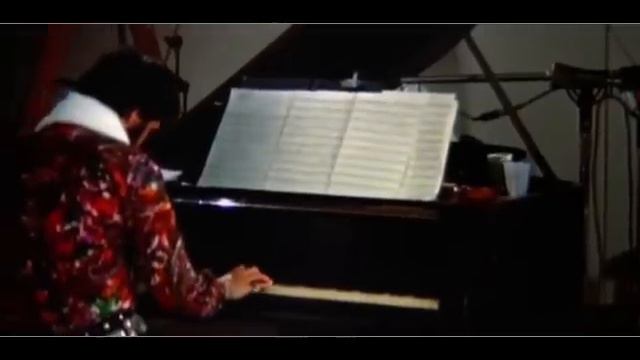
The footage starts with Elvis alone at a piano, illuminated by a thin band of pale studio light. He isn’t the rhinestone monarch of Vegas. He isn’t the leather-clad rebel of the 1968 Comeback. He is the boy from Tupelo — wide-eyed, fragile, trembling with a song he hasn’t yet learned will become the prophecy of his own undoing.
His fingers press the keys like he’s searching for a pulse. His own.
And then the crescendo hits — horns exploding, guitars snarling, drums galloping — the storm swallowing the stillness whole.
A life flashing before our eyes.
A kingdom rising.
A man breaking.
“HE WAS LOVED… BUT HE WAS ALONE.” — Jerry Schilling
As the montage shifts from 1956 insanity to 1968 resurrection to 1970s exhaustion, a haunting quote from Jerry Schilling — Elvis’s closest confidant — suddenly makes brutal sense:
“Elvis had a hard time making friends… He was very lonely. But when he stepped on stage, he ruled. He was loved.”
Loved so loudly.
Lonely so quietly.
The video captures this duality mercilessly.
Women crying.
Security guards losing control of the barricades.
Hands clawing just to touch the hem of his jumpsuit.
Yet side-by-side with that frenzy:
Elvis gasping for breath.
Elvis pushing through fatigue.
Elvis wiping sweat with the desperation of a man trying to keep pace with a body that stopped cooperating years too soon.
And all the while, that line loops beneath his burning gaze:
“We’re caught in a trap… I can’t walk out.”
Tell us, Elvis.
Were you singing about love?
Or were you singing about them — the audience, the managers, the Colonel, the machine?
THE 1969 RESURRECTION THAT SAVED HIM — AND DAMNED HIM
In 1969, the world was changing faster than Elvis could breathe.
The Beatles were fracturing.
Woodstock was rewriting the rulebook of culture.
Rock was moving on without its crowned king.
But then American Sound Studio happened.
He walked into the building with everything to prove and nothing left to lose. When he recorded “Suspicious Minds,” he wasn’t just cutting a track — he was screaming for relevance, resurrection, and release.
A desperate man sings differently.
You can hear it.
You can feel it.
And in the footage, as the camera slices through decades of stage lights and heartbreak, the desperation only grows sharper.
THE TRAP: FAME, PARKER, AND THE GOLDEN CAGE
The reconstructed footage refuses to sanitize the truth: the 1970s were killing him softly.
The jumpsuits got heavier.
The tours got longer.
The Colonel squeezed tighter.
The schedule — brutal.
The demands — endless.
The man — buckling.
When Elvis kneels on stage, arms spread wide, head thrown back like a warrior surrendering to heaven, the moment is electric… and tragic. This wasn’t choreography. It was collapse turned into performance.
A king kneeling before his kingdom — and his own exhaustion.
“HE WAS HUMAN… HE FELT EVERYTHING.” — Priscilla Presley
To understand the heartbreak in this footage, you only need to hear Priscilla Presley reflect on what fame carved out of him:
“He was human… He had a heart, a soul, and he felt deeply. He was a father, a husband, and a friend.”
A father.
A husband.
A friend.
Roles nearly erased by the crown welded to his shoulders.
Throughout the montage, small moments of tenderness fight their way through the spectacle:
A wink at a bandmate.
A smile at a fan in the front row.
A rare unguarded laugh.
These flickers of humanity are bombs in slow motion — reminders that this was not a myth.
This was a man.
A man drowning in an empire built on his own myth.
ALOHA FROM HAWAII: THE GOD ON TELEVISION
The video cuts sharply to Aloha from Hawaii, where Elvis appears carved from marble — godlike, untouchable, luminous.
But the brilliance is blinding.
The close-ups show what the world refused to see in 1973: stress etched into his eyes, pain tightening his jawline, fatigue hiding behind the perfect hair and flawless voice.
He wasn’t soaring.
He was burning.
THE FINAL CHORUS — AND THE FINAL CRACK
When the horns erupt in the climax of “Suspicious Minds,” Elvis throws his entire being into the performance: torso bending, knees buckling, veins pulsing, sweat flying like baptismal water.
It is magnificent.
It is devastating.
The man is giving everything — because he has nothing left.
And when he hits that final kneel, arms wide, voice trembling with all the ghosts that have followed him since Tupelo, it no longer feels like a climax.
It feels like goodbye.
A GHOST IN THE DARK
The screen fades to black.
No final smile.
No last bow.
Only the echo of his voice — raw, wounded, reaching through time.
You don’t hear a performer.
You hear a plea.
Not “love me.”
Not “remember me.”
But — “see me.”
And for the first time in decades, through the brutal honesty of this reconstruction, we finally do.
The King wasn’t trapped by love.
He was trapped by legend.
And the legend won.
Video