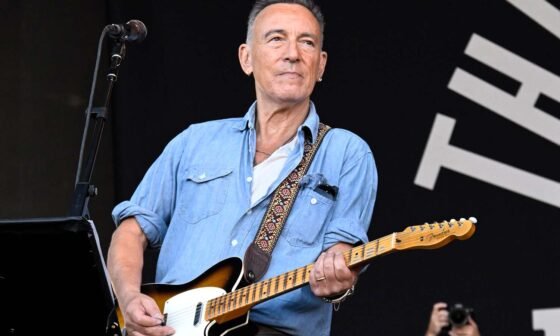
Bruce Springsteen stands just outside the makeshift diner built for the film set, hands tucked into the pockets of his denim jacket, his gaze fixed on a monitor glowing in the cool New Jersey morning. It’s subtle, almost unnoticed by the small crew bustling around him, but there’s a softness in his eyes—a look that blends pride, vulnerability, and a history only he fully knows. Few icons ever get to witness their own life reconstructed before them. Even fewer dare to stand quietly behind the camera as that life unfolds in real time. But Springsteen, “The Boss,” has never been one to follow rules that weren’t his. And so, on the set of Deliver Me From Nowhere, the first authorized biopic of his career, he has become a quiet guardian of the story unfolding—one that means more to him than any chart-topping record or roaring stadium encore.
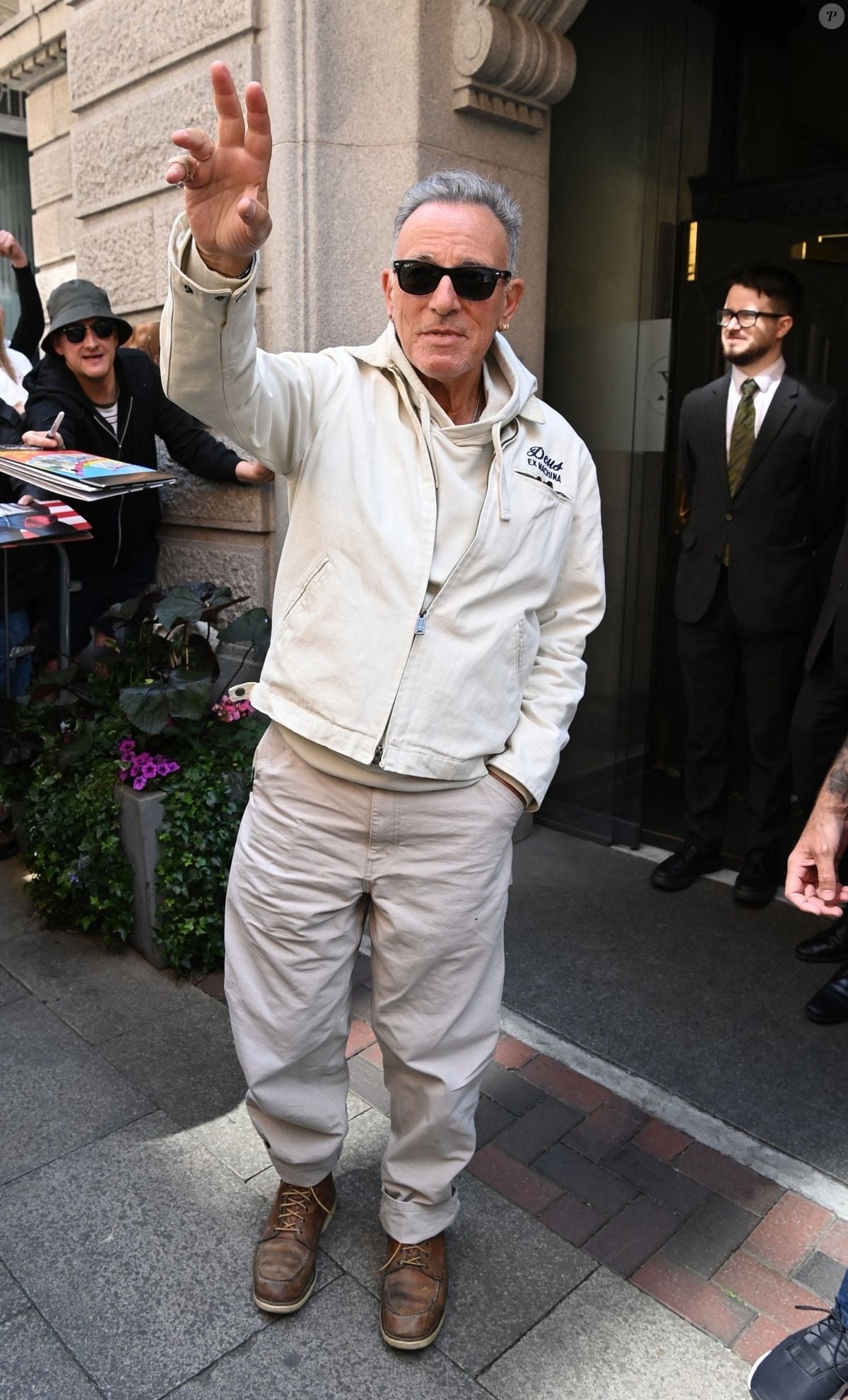
Set against the industrial backdrops and faded skylines of New Jersey, the film—centered around the making of his 1982 album Nebraska—has transformed Springsteen’s home state into a living museum of his past. Cast and crew say his presence on set isn’t ceremonial. It’s personal. He arrives not with an entourage but with an understated familiarity, walking over the gravel that crunches beneath his boots like memories being stepped back into. For many of the actors, seeing him appear without announcement has become a near-mythical moment—like watching a legend step out of his own mythology and into their workspace.
Production insiders say Springsteen visits the set often, slipping in with minimal fanfare, staying long enough to watch key scenes, share a quiet word with director Scott Cooper, or offer a nod of approval before stepping back into the periphery. It is an unusual level of involvement for a star of his stature, especially for a biopic. Typically, artists distance themselves for the sake of objectivity or self-protection. But this project, sources emphasize, is different. Springsteen’s fingerprints—emotional, historical, musical—are part of the film’s DNA.
The choice of Nebraska as the film’s focus is striking in itself. The album, recorded on a four-track cassette in Springsteen’s bedroom, remains one of his most haunting works—a stark, introspective departure from the arena rock that defined his early fame. It was a moment in his career where silence spoke louder than guitars, where storytelling became confession, and where the myth of “The Boss” collided with the man underneath. Translating that moment to film requires precision, trust, and a willingness to revisit shadows as much as triumphs.
Cooper, known for character-driven dramas like Crazy Heart and Hostiles, is said to have approached Springsteen with the sensitivity and focus required for such a project. On-set photos show the two conferring quietly, sometimes smiling, sometimes sharing a solemn stillness. Crew members describe them as collaborators—two artists engaged in a kind of creative archaeology, digging through the emotional sediment of the past to reconstruct something honest and cinematic.

For Jeremy Allen White, the actor taking on the towering challenge of portraying Springsteen, the presence of the real Boss is both surreal and grounding. White, known for his breakout role in The Bear, has immersed himself in Springsteen’s vocal cadences, posture, and emotional rhythm. According to one crew member, White spent weeks studying grainy rehearsal footage, vintage interviews, and concert recordings to replicate not just Springsteen’s voice, but the internal weight behind it. When Springsteen first saw White on set—hair tousled, guitar slung low, shoulders pulled in that familiar inward intensity—there was a long pause before he smiled and said quietly, “Yeah. That’s him.”
Moments like that have electrified the atmosphere around production. Social media has erupted with photos and whispers from locals who spotted Springsteen near filming locations across New Jersey. One resident described seeing him standing in the doorway of a retro gas station constructed for the film, hands clasped behind him as he watched the crew recreate a memory that, decades earlier, had simply been his life. “It was like watching someone walk into their own past,” the resident wrote in a community Facebook group. “He didn’t interrupt. He didn’t pose. He just… watched.”
The weight of that witnessing seems to shape every part of this project. As the film retraces the solitude and anguish woven into Nebraska, crew members say Springsteen occasionally shares small insights—details not written in memoirs or revealed in interviews. A certain street corner. A certain night. A certain silence that had settled over him when he first pressed record on that now-famous cassette machine. These reflections help anchor the film in the emotional truth that defined the album.
But it isn’t melancholy alone that fills the set. There is also a sense of gratitude—an unspoken acknowledgment that stories, even painful ones, only deepen when revisited with time. Springsteen, now in his 70s, stands at the intersection of legacy and reflection. Watching someone else embody his younger self is no small thing, cast and crew say. But he embraces it with humility, often reminding those around him that Nebraska wasn’t made to impress, but to understand.
The community response has been nothing short of exhilarating. Fans gather behind barricades, hoping for a glimpse of White in full Springsteen transformation—or, if luck allows, the real Boss stepping out from behind the monitors. Local diners have begun serving “Nebraska Specials,” and small businesses near filming sites proudly display handwritten signs: WELCOME HOME, BOSS. For a state whose cultural identity is entwined with Springsteen’s mythology, the production feels like a homecoming celebration disguised as a film shoot.
Film analysts have already begun to speculate about the cultural impact of Deliver Me From Nowhere. Biopics about musicians often lean heavily on spectacle—the roar of a stadium, the glitter of fame, the rise-and-fall narrative. But Nebraska is different. It is quiet. Internal. Psychological. A story steeped in working-class anxieties, small-town ghosts, and the unresolved ache of the American dream. Translating that into film could redefine the genre entirely.
And with Springsteen’s direct involvement, authenticity becomes not just a goal, but a mandate.

One particularly striking moment, according to a set insider, occurred during the filming of a scene that reimagines Springsteen recording “Atlantic City.” As White sat on the edge of a narrow bed, the room dimly lit with the same kind of 40-watt lamp Springsteen had once used, the playback of an early demo filled the air. Crew members noticed Springsteen standing at the back of the room, eyes lowered, arms folded tightly across his chest. When the scene ended, he quietly wiped his face, nodded to White, and stepped outside. No one followed. Some moments belong only to the man who lived them.
But it’s not all solemnity. The set has seen bursts of laughter, spontaneous applause, and moments where Springsteen unmistakably enjoys seeing the craft of filmmaking bring his memories into cinematic form. One photo captured him grinning beside a classic car used for the shoot, joking with the crew about how many times he’d broken down in one just like it. Another shows him leaning over a microphone with White, demonstrating a subtle rhythmic nuance while the actor listens intently. These images have already begun circulating online, fueling excitement and stirring emotions among fans who never expected Springsteen to participate so directly in the retelling of his own story.
For the filmmakers, the stakes are high not because of celebrity pressures, but because of what this story represents. Nebraska was born in a moment when Springsteen confronted the distance between who he was and who the world believed him to be. It was an album about honesty—the kind that strips away noise and ego until only the truth remains. To do justice to that story requires the same courage, the same vulnerability, the same willingness to let things be raw.
The production is still ongoing, and those involved say months of filming remain. But already, Deliver Me From Nowhere carries an electricity that few biopics manage so early in their creation. It is not merely a project. It is a pilgrimage—one taken by filmmakers, actors, fans, and Springsteen himself.

As the sun dips behind the brick buildings of New Jersey, Springsteen often lingers after the crew has wrapped for the day. He’ll stand alone for a moment, watching the set go quiet, listening to the echo of a story that began decades ago in a small, dim room with nothing but a guitar, a cassette recorder, and a man trying to make sense of the world around him. Now, that story is being reborn—frame by frame, note by note, memory by memory.
For Springsteen, this film isn’t just a tribute. It’s a conversation with his younger self. A reminder of where the road began and how far it has carried him. And as the cameras continue rolling, one truth becomes unmistakably clear: Deliver Me From Nowhere is more than a biopic. It is an act of preservation, a bridge between past and present, and a cinematic love letter to the quiet courage that shaped one of America’s defining voices.
What emerges from this project may reshape how audiences understand Springsteen—not as the mythic figure commanding stadiums, but as the man alone in the dark, searching for something true. And as production moves forward, one thing is certain: this story, infused with Springsteen’s own heartbeat, is poised to resonate long after the final scene fades to black.