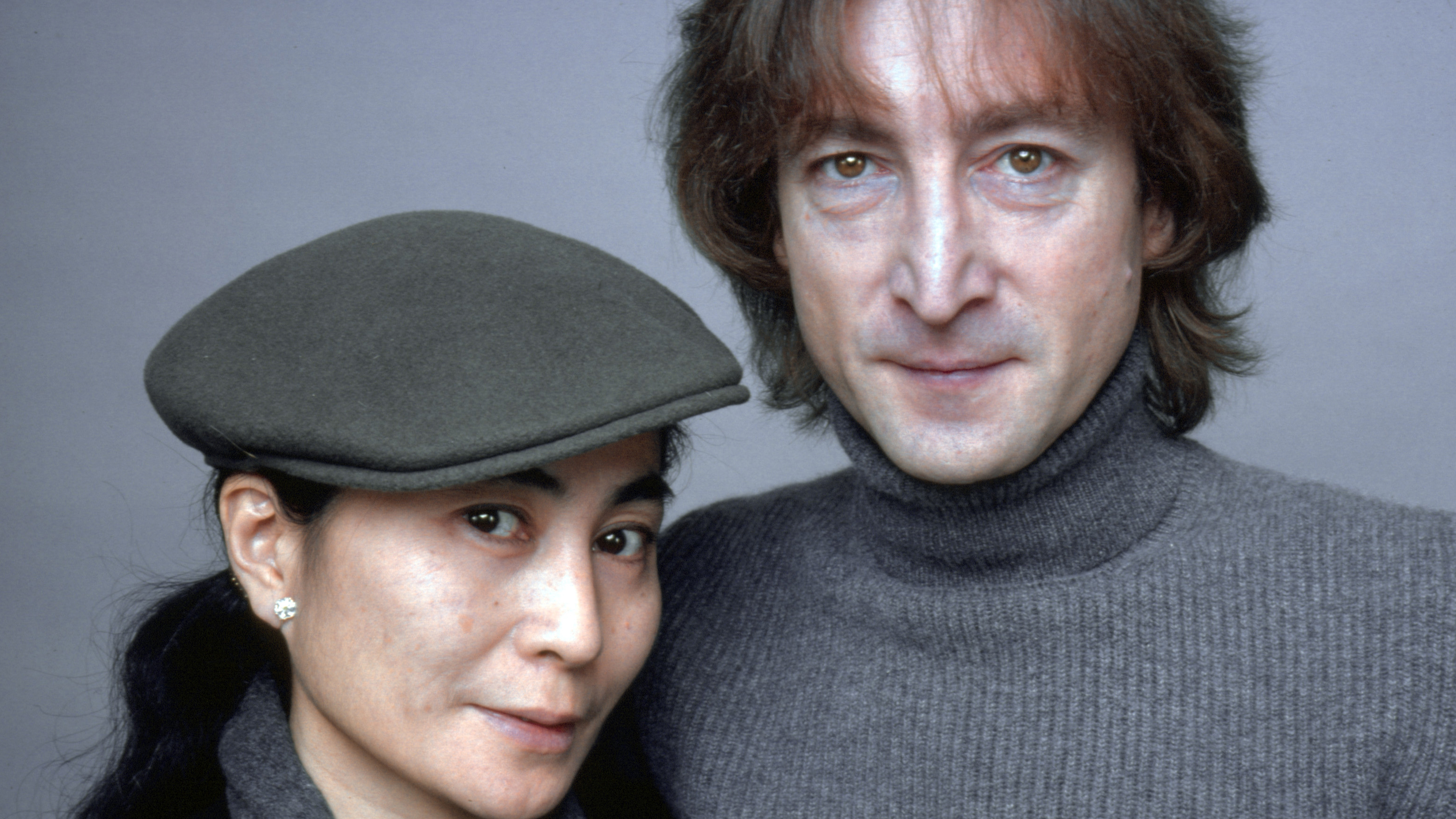
At 10:30pm on 8 December 1980, John Lennon and Yoko Ono left the Record Plant studio, a 10th floor facility at 321 West 44th Street in Midtown Manhattan.
The studio was renowned for having an unfinished room with high ceilings, which many bands used for rehearsals. But it was best known as the studio where Bruce Springsteen and the E Street Band concluded the recording and mixing of the 1975 album Born To Run.
Ono, Lennon and producer Jack Douglas had spent the previous four days recording and mixing Walking On Thin Ice, a song written and recorded by Ono.
As Lennon listened to the mix, he became evermore ecstatic about its potential.
“From now on,” he told Ono excitedly, “we’re just going to do this, this is the direction”, as writer Ken Sharp noted in his 2010 book Starting Over: The Making Of John Lennon And Yoko Ono’s Double Fantasy.
Lennon was clutching the tape of the final mix from this session as he and Ono stepped into a limo on the street outside the Record Plant. They had planned to go and eat at the Stage Deli, a well-known delicatessen just two blocks from Carnegie Hall, but decided instead to head home.
As they arrived at the Dakota Building around 10.45pm, Ono stepped out first and headed towards the entrance.

As Lennon emerged from the limo and walked towards the Dakota, 25-year-old Mark David Chapman stepped forward and fired five shots at close range from a .38 revolver.
Four of the shots hit Lennon in the back and shoulders. Police arrived at the scene within minutes and Lennon was rushed to Roosevelt Hospital, but he was pronounced dead 30 minutes later.
In the hours and days that followed news of Lennon’s death triggered an overwhelming outpouring of grief.
The lyrics to Walking On Thin Ice would prove tragically prophetic, with their focus on the unpredictability of life and death – of “throwing the dice in the air” – and reach the conclusion: “When our hearts return to ashes, it will be just a story”.
Walking On Thin Ice was also the song that featured the last recording John Lennon ever made – a sizzling, visceral guitar solo that was unlike anything he had ever done.
In November 1980, the pair had released the Double Fantasy album, which was steadily ascending the US Top 10 when Lennon was killed.
But as Paul Zollo of American Songwriter noted in April 2020: “Nothing matched the pure electric fury” of Walking On Thin Ice.
The song is widely considered to be Yoko Ono’s finest composition, hailed for its haunting lyrics and propulsive post-punk sound.
45 years on from its conception, it stands as Yoko and John’s final, deeply poignant collaboration, a song that continues to excite and inspire.
The idea for Walking On Thin Ice came to Yoko Ono during one of the Lennons’ car trips between their Dakota Building apartment and their estate in Cold Spring Harbour on Long Island. They lived in a waterfront property in the community of Laurel Hollow and it was here that John Lennon learned to sail.
In an interview with American Songwriter magazine in 2020, Ono explained how Walking On Thin Ice sprang from her imagination almost fully formed.
“It’s a song that came to me music, notes and lyrics together,” she said. “I was thinking of Lake Michigan. I went to Chicago and Lake Michigan is so big that you don’t know the end of it when you look at it…
“I was just thinking of this woman [who] is walking Lake Michigan when it is totally frozen, and is walking and walking but not knowing that it’s that huge. I’m like one of those people. ‘Oh, it’s ice but I can walk on it.’ I walk like that in life.”
Clocking in at an epic six minutes, Walking On Thin Ice is a jagged left-field disco-infused track, with a real sense of urgency and edge. It sounds lean and post-punk yet defiantly rooted in the new ’80s decade.
The song was first recorded in August 1980 as part of the sessions for Double Fantasy at the Hit Factory at 353 West 48th Street.
Tony Levin’s raw, galloping bass anchors the track. Earl Slick delivers some inspiring ambient guitar flourishes, while Hugh McCracken contributes angular stabs of rhythm guitar.
After one of the takes John Lennon allegedly suggested that McCracken only play on the backbeats. “That’s great, really funky,” Ono said.
While the basis of the track was recorded from August 1980, it wasn’t until early December when Lennon, Ono and Jack Douglas resumed work on the song.
“We only had a germ of that record, so we made a loop of I think eight bars,” Douglas told Ben Yakas for a piece in Gothamist in July 2016. “It’s just loop-based. And a loop then was just a tape machine, I had it on a two-track spinning back to a multitrack, cutting bars together.”
Once the tape loop was in place, Douglas and Lennon were able to start overdubbing voices and instruments onto the song.
That first evening back in the studio, on 4 December 1980, Yoko Ono remade her lead vocal from the previous sessions months earlier. Everything about her vocal performance is impeccably well judged, from the soft half-spoken phrases to the warm textures and whispered vibrato.
There is a cool detachment to her vocal performance here, but it’s also strangely intimate.
On 4 December 1980, John Lennon laid down his guitar solo on the track, which kicks in at 1:18. It’s a searing, dynamic performance, a succession of twisted, guttural half-discordant squalls.
His solo is daring and cathartic, and it’s easy to see why Lennon was so enthralled by the song and his contribution.
It was rumoured that Lennon played the solo on a new red Stratocaster but producer Jack Douglas soon blew that theory out of the water.
“It was the Capri,” Douglas told writer Kenneth Womack in an interview published on Salon.com in January 2021. Douglas was referencing Lennon’s iconic 1958 Rickenbacker 325, the same instrument he bought in Hamburg in 1960 and played consistently until 1964 when he received a new model during The Beatles’ US tour.
“For the solo, John simply wailed on the guitar,” wrote Womack, “executing a series of power chords as Douglas, sitting nearby, reached over and worked the instrument’s Bigsby tailpiece. As with a whammy bar, the Bigsby tremolo arm allowed the producer to manipulate the vibrato sound and heighten the eerie ambience they had been creating for Walking On Thin Ice.”
From there, the song shifts to the bridge: “I may cry some day/But the tears will dry whichever way/And when our hearts return to ashes/It’ll be just a story”.
At 2:30, Ono lurches into a monotone vocal syllable “ai, ai, ai…”, which is the Japanese word for love, pronounced ‘ah-ee’. Ono repeats the word over and over for more than a minute. This is gradually immersed within other instrumentation such as the drums and percussion of Arthur Jenkins Jnr.
A section with a series of emotive gasps and grunts follows, before one of the most effective parts of the song – the spoken word vocal on the second bridge. “I knew a girl who tried to walk across the lake/Course it was winter when all this was ice/That’s a hell of a thing to do, you know/They say the lake is as big as the ocean/I wonder if she knew about it?”
“I was still sitting in the chair by the mic, waiting for them to change the tape,” Ono told Paul Zollo of American Songwriter magazine. “That’s when it just came. So I just wrote it down quickly. I said, ‘I got it!’ And I told them I was just going to do something after the singing, and I just did it.”
In many ways, this was the creative turning point of the song.
“Yoko was great,” Jack Douglas told writer Ben Yakas in a piece for Gothamist in July 2016. “John knew that Yoko was onto something with that one, especially with that spoken-word.”
By then Lennon was obsessed with Walking On Thin Ice – and with the whole new direction it signalled.
“It was as if we were both haunted by the song,” Yoko wrote in the liner notes for the single. “I remember I woke up in the morning and found John watching the sunrise and still listening to the song. He said I had to put it out right away as a single.”
Tragically, Lennon never lived to see Walking On Thin Ice released as a single. The song was released on 6 February, 1981 and reached No.35 in the UK Singles Chart and No.58 in the US Billboard 100.
“When Walking On Thin Ice came out, I played it non-stop,” recalled Nile Rogers, as reported on the JohnLennon.com website. “Whenever anyone would get in my car, I would blast the song and say, ‘This shit is incredible!’ When I think of Yoko I think of Thin Ice. It’s a great piece of work, and to this day it remains one of my favourite songs.”
Back in August 1980, in the early stages of the song’s recording, when Earl Slick had just laid down his inspiring guitar parts, Lennon excitedly asked Ono to come into the control room to hear the emerging song.
“I think you just cut your first number one, Yoko,” he reportedly said, echoing an almost identical phrase George Martin relayed to The Beatles after they recorded Please Please Me 18 years earlier.
And so it proved to be, although not in the mainstream pop chart. In 2003, following the emergence of several club mixes of the song, Walking On Thin Ice was released as a maxi-single with remixes by artists such as Pet Shop Boys, Danny Tenagli and Felix Da Housecat.
It spent weeks on the US Dance Club Songs chart before reaching No.1, eclipsing Madonna and Justin Timberlake.
In the liner notes of the original release on 4 February 1981, Yoko Ono wrote about the song’s release against the background of her tragic loss.
“Getting this together after what happened was hard,” she wrote. “But I knew John would not rest his mind if I hadn’t. I hope you like it, John. I did my best.”