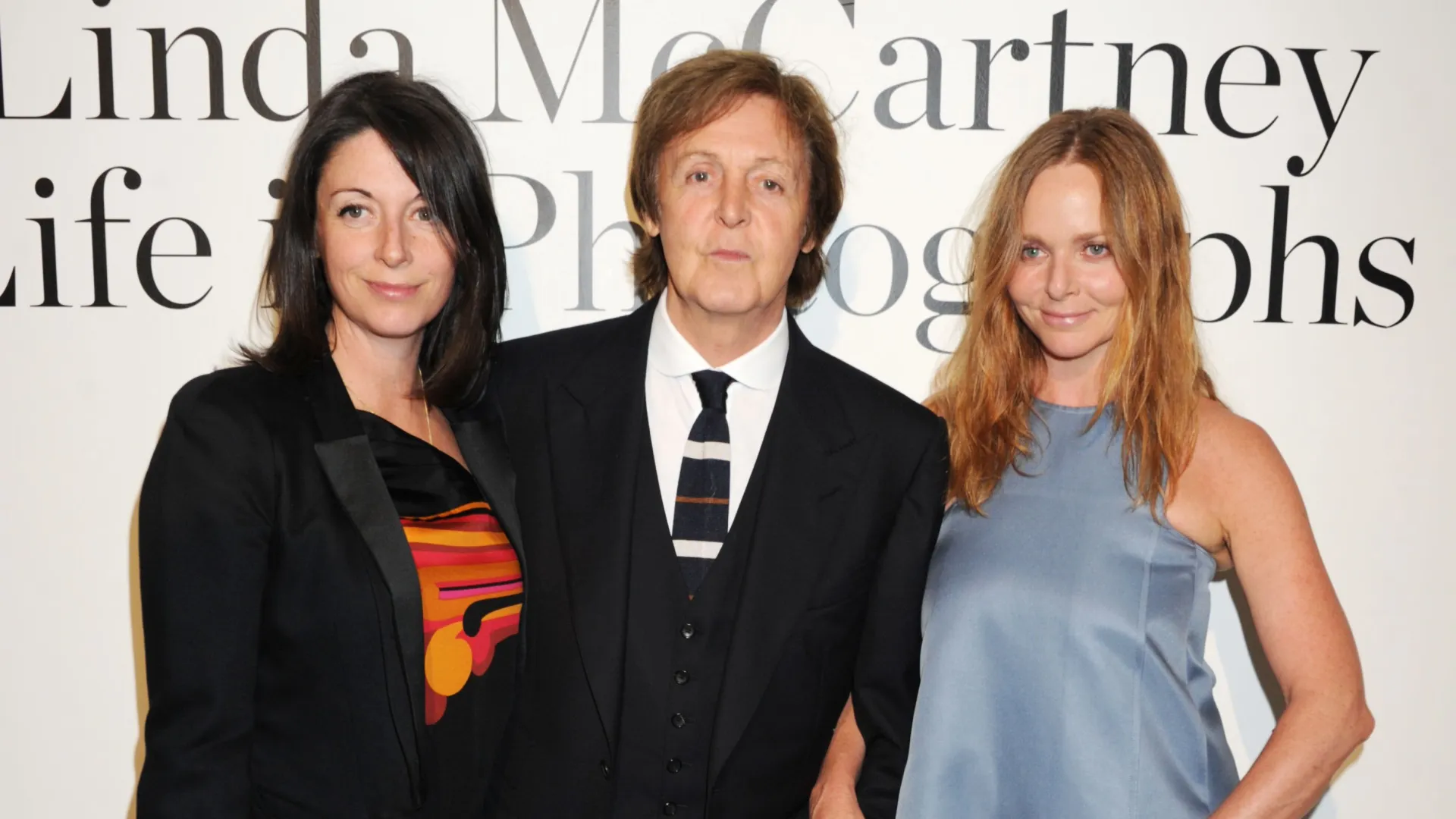
So will Stella McCartney’s £5million grand design be dashed by otters
It is known as Commando Rock, a place where elite troops were trained for critical missions in the Second World War.
At its peak, a vision in steel, glass and natural stone hugs the outline of this striking outcrop as it soars dramatically above the waters of Loch Ailort.
With its ‘green’ roof seeded with grasses and heather, the low-slung building has been camouflaged to blend in with its surroundings so that, from some angles, one wouldn’t even know it was there.
Which, for now, it isn’t.
In fact, this £5million ‘eco-home’ has only ever existed in the form of architect’s drawings submitted in support of one of the most controversial proposals to reach the desks of local planning officers for some years.
Indeed, so contentious have they become that the plans for this ‘unashamedly contemporary’ five-bedroomed home have been languishing with Highland Council for getting on for three years with little sign of a decision being reached on whether to grant permission.
And while the delay may be partly due to the environmentally sensitive nature of this wildly romantic clifftop location high on a spotless stretch of the Moidart coastline above Roshven Bay, might it also have something to do with the identities of the would-be housebuilders – renowned fashion designer Stella McCartney and her style guru husband, Alasdhair Willis?
Since lodging their plans, the daughter of Beatle Sir Paul McCartney and her family have become embroiled in their own war at Commando Rock after dozens of objectors accused Ms McCartney, the famously pro-green activist from famously pro-green stock, of hypocrisy in her approach to the build, which some have labelled an act of environmental vandalism.


As battle lines are drawn, those queueing up to take potshots include near neighbours as well as, rather bafflingly, others who live hundreds of miles away.
Among the protesters are a niece of Princess Diana and a Fulham-based aristocrat, while criticisms of the design have variously described it as a ‘monstrosity’ and a ‘carbuncle on the bluff’.
More than 60 letters of objection have been lodged voicing fears it will threaten local wildlife, including otters, pine martens and declining species of birds, such as ring ouzels, wood warblers and redstarts and even damage the distinctive row of mature Corsican pines growing along the ridge.
The complaints also touched on the growing prevalence of holiday homes nearby, and the design – likened by some to a Bond villain’s lair – being ‘out of keeping’ with the landscape in its prominent position above Roshven beach.
Now the stakes have been raised further by a wildlife expert who has condemned the project as typical of ‘private escapes for the wealthy’ in such wild land.
Imogen Furlong, who is countryside ranger service manager for High Life Highland, has lodged a ‘strong objection’ with the council, claiming that the ‘proposal goes far beyond what is appropriate or sustainable for such an environmentally sensitive and culturally important landscape’.
She wrote: ‘This place is one of the last undeveloped coastal areas in this part of Loch Ailort, valued not only for its natural beauty but for its ecological significance and contribution to local identity.’
What adds spice is that High Life Highland, it turns out, is the council’s own arm’s-length body responsible for fostering appreciation of the scenery, wildlife and heritage of the Highlands.
In the face of such opposition, Mr Willis, 55, the chief creative officer with global shoe brand Adidas, and his 54-year-old wife have launched a counter-offensive against what they called the ‘falsehoods and factual inaccuracies’ about their planned home.
In a statement, the couple, who have four children, said: ‘[We] have sought to deliver a highly sustainable home that has been sympathetically designed and sits comfortably within the wider area.’
They added: ‘Allegations have been made that the proposed house will be visible from all directions. This is symptomatic of the persistent falsehoods from objectors to this application, which are deeply disappointing and, in some cases, intentionally inaccurate.’
In a recent newspaper interview, Mr Willis went further and said: ‘This is where we want to be.
‘It is not a case of waking up one day and thinking this was what we wanted on a whim. This has been our life plan.’
Even the best life plans cannot avoid being bogged down in planning bureaucracy, however, and the long and winding road that might one day lead them to their new front door currently has no end in sight.
Many objectors have latched onto concerns about the fate of local otters, which are a legally protected species, and, specifically, a report the couple commissioned for the site which concluded that while the area offered a suitable habitat for the semi-aquatic mammals, none had been detected.
Locals dismissed this, offering photographic evidence of otter activity immediately below the rock.
An ecologist, Dr Leon Durbin, submitted a video which he claimed showed repeated evidence of otter activity including spraint (poo), worn runs, and signs consistent with long-term use of a holt.
They argued that heavy construction work would lead to the illegal disturbance of otters living and breeding there.
Arisaig & District Community Council has written to the planners, warning that the impact on wildlife at ‘one of the last undeveloped parts of the Roshven coastline, should this development be allowed to go ahead, will be irreversible’.
Ms McCartney has been accused of hypocrisy in her approach to the environmental impact of the build. She has a CBE for services to fashion and sustainability and has long championed ethical and sustainable approaches in the fashion industry.
Objections to the plan are being headed up by semi-retired ecologist Jean Langhorne, who told The Telegraph: ‘It’s ironic that the landscape is being put at risk by the inappropriate and inconsiderate plans of someone whose entire professional image is built around concern for the environment.
‘This is not mean-spirited Highlands nimbyism directed against a high-profile individual. We would be objecting to development on this site no matter who wanted to build here. But at the same time, it’s hilarious that these plans have been submitted by someone who is talking about saving what you love.

‘People here want to save what we love: one of the last undeveloped parts of this coastline.’
Another neighbour, Michie MacDonald, wife of the local Lib Dem MP Angus MacDonald, whose family owns the surrounding Roshven estate, said question marks remained over drainage issues and securing a reliable water supply.
She added that the access track to the rocky mount would prove too steep for construction trucks and, later, for lorries needing to service the home’s septic tanks.
The reason she knew this, she said, was because of the trouble firefighters had getting their tenders in when ‘a severe hill fire in June 2021 burnt the whole of this plot’.
Could this have been the same fire that was inadvertently started by a certain local ecologist and bushcraft skills expert named Leon Durbin?
Dr Durbin admitted he was left ‘mortified’ after allowing a garden bonfire to burn out of control in early June that year and described his calamitous blunder, which ravaged a sizeable area, destroying wildlife and reducing thousands of young trees and heather to ash, as ‘the biggest regret of my life’.
While no one should doubt the sincerity of Dr Durbin’s contrition, it is perhaps also an irony that an ecologist who caused such extensive damage is now so exercised about Ms McCartney’s plans. She and her husband certainly feel their intentions have been misrepresented.
Like her father before her, Ms McCartney and her husband have a long-standing connection with Scotland.
Her father bought High Peak Farm, near Campbeltown on the Kintyre peninsula, in 1966, at the height of The Beatles’ fame, and chose to flee there in the wake of The Beatles’ implosion in the early 1970s for the sanctuary and seclusion it offered his young family.
From her birth in September 1971, young Stella would enjoy regular holidays at the farm, all captured on film by her photographer mother, Linda, whose own vegetarian views heavily influenced her daughter’s own outlook.
Her love of Scotland is shared with her husband, whom she married in 2003 in a private ceremony at Mount Stuart House, family seat of the late Johnny Dumfries, on the Isle of Bute.
The Gaelic spelling of Mr Willis’s name comes from great-grandparents who grew up speaking the language, although he was born near Middlesbrough and attended London’s Slade School of Art before moving into design consultancy.
The couple, who went on to have four children – sons Miller and Beckett, and daughters Bailey and Reiley – purchased the Commando Rock site in 2021. Agents Knight Frank listed the site as ‘a spectacular private peninsula with house site and 270-degree coastal views, including foreshore and beach access’, asking for offers over £450,000.
Permission to build a home there had already been granted as long ago as 2000 and the foundations laid for a large four-bedroomed two-storey house with two turrets and a garage at the top of the hill.
Yet, oddly, their application to vary the permission to allow an admittedly larger – but far more inconspicuous – brownish-grey façade blending into the
heathery hills has triggered an often-personal backlash, including some unpleasant ‘white settler’ jibes.
Speaking about their plans, Mr Willis told The Press & Journal: ‘We are fortunate to have been able to buy this land and to be able to come and live here.
‘It is the most incredible place. We want a house that is in tune with the landscape, not working against it. But if it does come to it, and our application is not permitted, then we will build the house the permission exists for.
‘We want to live here and be part of the community. We love this place and our commitment to living here has never wavered.’
He added that they wanted to work to find solutions to the concerns and said he had the ‘greatest respect’ for planners who were ‘dealing sensitively with every concern raised with due diligence to protect this incredible landscape’.
They are clearly irritated about having to correct what they regard as misinformation about the project, not least that this is intended as a holiday home.
The spokesman pointed out: ‘However, unlike many of the homes in the area, this is not a holiday home; it is a house that the applicant’s family will live in, their forever home.’
He added: ‘Extensive ecological surveys have been, and continue to be, undertaken to ensure that the application has minimum environmental impact, and this will be in full accordance with the regulatory requirements of Highland Council and other statutory consultees.
‘The applicant has wanted to ensure all these are correctly undertaken, and has put this ahead of expediency, as these things do take time when done properly.’
The couple insist that the Corsican pines, originally to be removed as a non-native species, will now be saved and a ‘significant number of native trees’ will also be planted.
They have guaranteed to maintain public access to the beach and to maintain the current path and countered suggestions that the land is ‘untouched by the hand of man’ as the access road was built years ago, while a neighbouring plot is already used by at least a dozen homes in the area.

The spokesman said: ‘This highly sustainable home will be almost completely hidden from public view, delivering a dwelling that is considerably better than the existing permission, and the applicant looks forward, should the application be granted, to making it their new home and engaging with their new community and neighbours.’
More galling still, perhaps, the couple are having to address the sensitivities of people who live nowhere near their planned new home.
Such as the aristocratic Lady Marie-Sophie Law de Lauriston, of Fulham, who has told Highland Council she is ‘simply horrified’ by the thought that a new build might be visible from an ‘important B-listed historic’ home in the area, namely Roshven House.
She feels qualified to comment because she visits the Highlands every summer.
Her horror is shared by Celia Woodhouse, daughter of Lady Sarah McCorquodale and niece to the late Princess Diana, who complained the design was ‘an eyesore in a stunning and untouched area’ and lamented the use of concrete rather than Scottish stone in construction. In fact, it has both.
Mrs Woodhouse’s late grandmother, Frances Shand Kydd, spent her later years largely in seclusion on the Isle of Seil, near Oban in Argyll and Bute.
Such tenuous links do raise a serious question of whether these planning matters really ought to remain the business of neighbours, locals and the owners.
Analysis suggests that is not the case here, where only around a third (22) of the 60-plus objections came from the local Glenuig postcode. The rest came from as far afield as Inverness and Perth, Cleethorpes and Chipping Norton in England, and Ballymena in Northern Ireland.
Some locals view developments with a wry detachment. Eoghan Carmichael, who has lived in nearby Glenuig for 48 years, said that like most people in the area, he didn’t object to the application.
‘There are a boisterous few who are objecting quite strongly, but a lot of people are just sitting back to see what happens; they don’t object and actually feel the family might be an asset to the community if they did want to get involved.’
There is no date set for the case to be heard by the planning committee and the council says it does not comment on the progress of individual applications.
High Peak Farm proved a place of inspiration for Ms McCartney’s father. He wrote The Long and Winding Road there, which he once described as ‘a sad song about the unattainable’: ‘The door you never quite reach.
‘This is the road that you never get to the end of.’
The owners of Commando Rock will hope their fight ends on a more upbeat note.