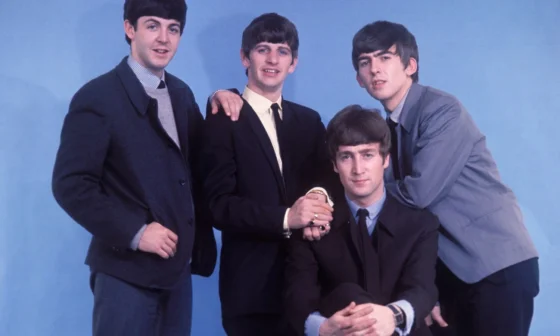
They already had wit. They already had melody. They already carried a sharp intelligence that cut through every room they entered.
The Beatles were not beginners searching for identity. They were experienced, hardened by long nights and louder crowds. Yet something essential remained just out of reach. The songs existed. The ambition was clear. What they lacked was the quiet force that could bind everything together and make it breathe as one.
In Hamburg, the truth revealed itself without announcement. In a dim club thick with smoke and fatigue, a man sat behind another band’s drum kit. Ringo Starr did not command the room with volume or display. He did not play to impress. He waited, listening first, understanding the space before touching it. When the sticks finally met skin, the change was immediate and unmistakable.
The music stopped pushing forward and began to settle inward. Time loosened. The beat did not dominate—it supported. Every note suddenly had somewhere to land. What had once sounded restless now felt anchored. This was not about speed or precision. It was about feel. About trust. About a rhythm that understood the song instead of forcing it along.
💬 “That’s it. That’s the sound.”
The realization did not arrive as excitement, but as relief. Songs stood upright in that moment. Grooves deepened. The noise found balance. What had appeared ordinary revealed itself as rare. Ringo’s playing carried patience, humor, and empathy. His rhythm listened back. It made space. It allowed others to shine without losing its own identity.
This was not a search for the best drummer in a technical sense. It was a recognition of the right one. Someone whose presence unified rather than competed. Someone whose timing held the band together not just musically, but emotionally. In his restraint lived strength. In his steadiness lived freedom.
The decision that followed was not easy. Loyalty weighed heavily. History already shared could not be dismissed lightly. But music does not negotiate with comfort. It insists on honesty. Choosing Ringo meant choosing wholeness, even at the cost of pain. It meant trusting the sound over sentiment.
Once complete, the transformation became undeniable. The band no longer felt like separate talents moving in parallel. They moved as a single body. The rhythm carried them forward, grounding every leap and every risk. What followed would reshape music, culture, and memory—but none of it would have held without that foundation.
History often celebrates voices and faces. Rhythm rarely stands at the center of the story. Yet on that night in Hamburg, rhythm found its heart. Four young men became one band not through ambition, but through alignment. Not through noise, but through understanding.
Legends do not begin with certainty. They begin with listening. And when the sticks came down, quietly and without ceremony, the future finally knew where to stand.