
Introduction
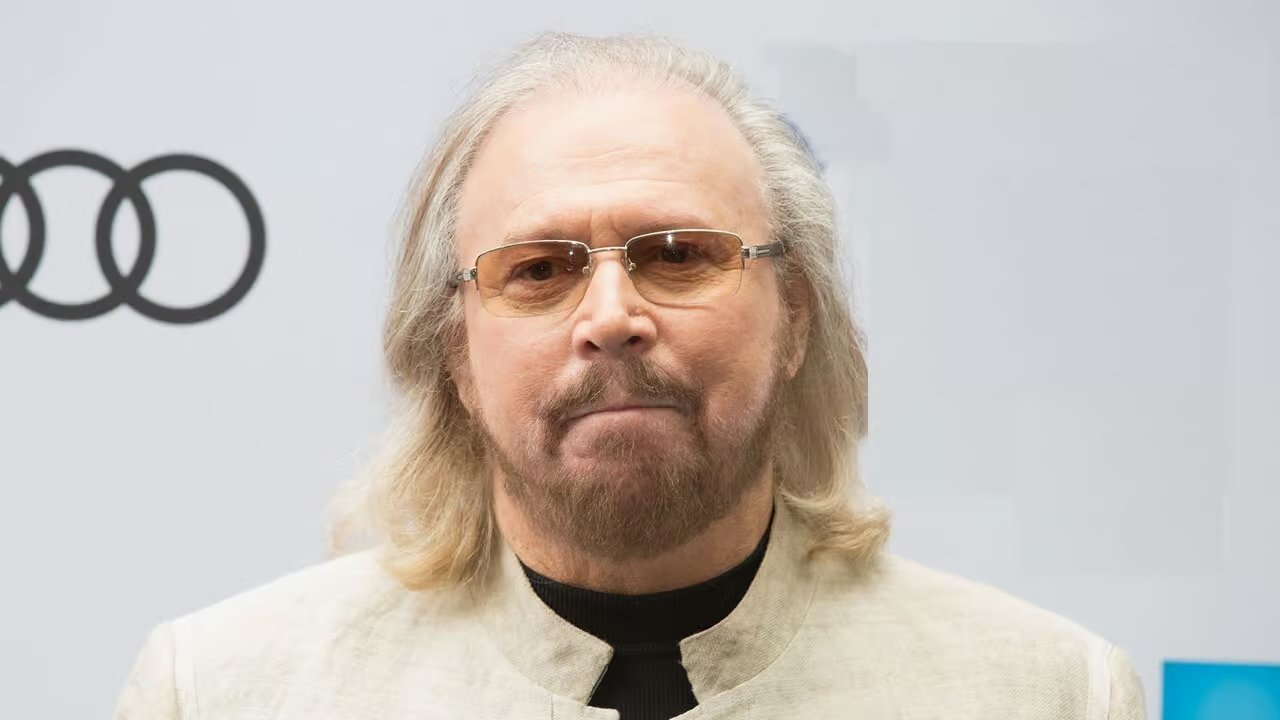
NEW YORK — To the world, he’s the last man standing — the silver-haired falsetto whose voice helped define an era. Barry Gibb, the sole surviving member of the legendary Bee Gees, is still adored as the smiling patriarch of one of music’s greatest dynasties.
But behind that gentle grin and timeless stage charm lies a darker, quieter burden — a lifetime of regret, family rivalry, and the haunting guilt of survival.
For decades, whispers have followed the eldest Gibb brother. Tabloids once screamed, “Barry’s Ego Tore the Bee Gees Apart.”
Fans wondered if fame had inflated him into a tyrant, pushing his brothers — Robin and Maurice Gibb — into the shadows.
Yet those close to the family tell a different story. One longtime friend, who spoke on condition of anonymity to protect the family’s privacy, insists Barry’s heart has always carried the opposite of arrogance.
“People saw the leader, the perfectionist,” the insider revealed. “What they didn’t see was the weight on his shoulders. From the very start, Barry felt it was his duty to protect them, to steer the ship. That protection got mistaken for control — but all he ever wanted was to keep his brothers safe.”
Brothers Torn Apart
Tension had simmered from the early days. Robin Gibb, with his tremulous and emotional tenor, often felt overshadowed, leading to a painful split from the band in the late 1960s.
Maurice, the easygoing peacemaker, was left trapped between two fiercely creative forces.
“The pressure was unbearable,” the family friend continued. “Barry carried everything — the success, the criticism, and the guilt. He once told me the biggest mistake of his life was trying to be their boss when all he wanted was to be their brother. But he didn’t know how to be both.”
That conflict ran deeper than fame. It was built on a promise — one made long before the world ever knew their name. As teenagers, the three brothers swore they would “always stay together.” It was a vow born of love, but one destiny and superstardom would cruelly force Barry to break.
The First Loss
In 2003, tragedy struck when Maurice Gibb died suddenly following surgery complications. The world mourned; Barry went silent.
He cancelled appearances, retreated from the spotlight, and withdrew into a grief few could understand.
“He couldn’t recover,” the friend said softly. “When Robin begged him to carry on as a duo, Barry refused. The press painted him as arrogant, unwilling to share the stage. But the truth was simpler — he couldn’t imagine the Bee Gees without all three of them. Continuing felt like betraying Maurice’s memory — betraying that sacred promise.”
But what tortured him most was something far smaller — and far more personal.
According to a confidant who spent time with Barry during those dark days, the brothers had argued only a week before Maurice’s death. It was a trivial fight — one they never resolved.
“Barry told me once, ‘I said I’d call him back … but I never did.’” the source recalled. “He was gone before I got the chance. That missed call haunts Barry more than any headline ever could.”
The Last Brother Falls
Nine years later, in 2012, Robin Gibb succumbed to cancer. In an instant, Barry became the last Bee Gee alive — the final keeper of their shared legacy.
His grief, raw and unfiltered, poured out during a concert soon after.
“I never thought I’d be the last one left,” Barry confessed tearfully on stage. “I can’t find comfort in it. It’s not triumph — it’s torment.”
From that night forward, the stage was never the same. Every song — “Words,” “To Love Somebody,” “How Deep Is Your Love” — became an act of remembrance, a whispered apology carried on melody.
A Kindness Mistaken for Calm
Those who know him best say that Barry’s kindness today is not just a virtue — it’s penance.
“People don’t see kindness the same way anymore,” said Michael Rhodes, a longtime session musician who toured with him in the 1990s. “When Barry smiles at fans, when he stays gentle no matter what, it’s not a performance. It’s a message to his brothers. It’s him saying, I’m sorry.”
That apology, friends say, is woven into every lyric he sings. Each harmony carries the echo of what was lost — and what can never be made right again. Fame made him a star, but guilt made him human.
Haunted by the Promise
In a rare, unguarded interview years ago, a journalist asked Barry what he would say if he could speak to his brothers one more time.
His reply revealed the entire tragedy in a single, fragile breath.
“I’d tell them I’m sorry,” he whispered.
“Sorry for being the one who stayed.”
Those eight words have since defined the man who once defined pop music. Behind the glittering Grammys and Hall of Fame honors lies a broken vow — a promise made between boys that no amount of fame could ever keep.
Today, as he performs alone beneath the spotlight, fans see a legend. But in Barry’s mind, every show is a séance — a way to keep Robin and Maurice alive for one more song.
And when the lights fade, and the crowd roars, somewhere in the silence between the notes, the last Bee Gee is still whispering to his brothers — the words he waited too long to say.
Is forgiveness possible for a man who never stopped singing to ghosts?
That’s a question only Barry Gibb himself can answer.
Video