Introduction
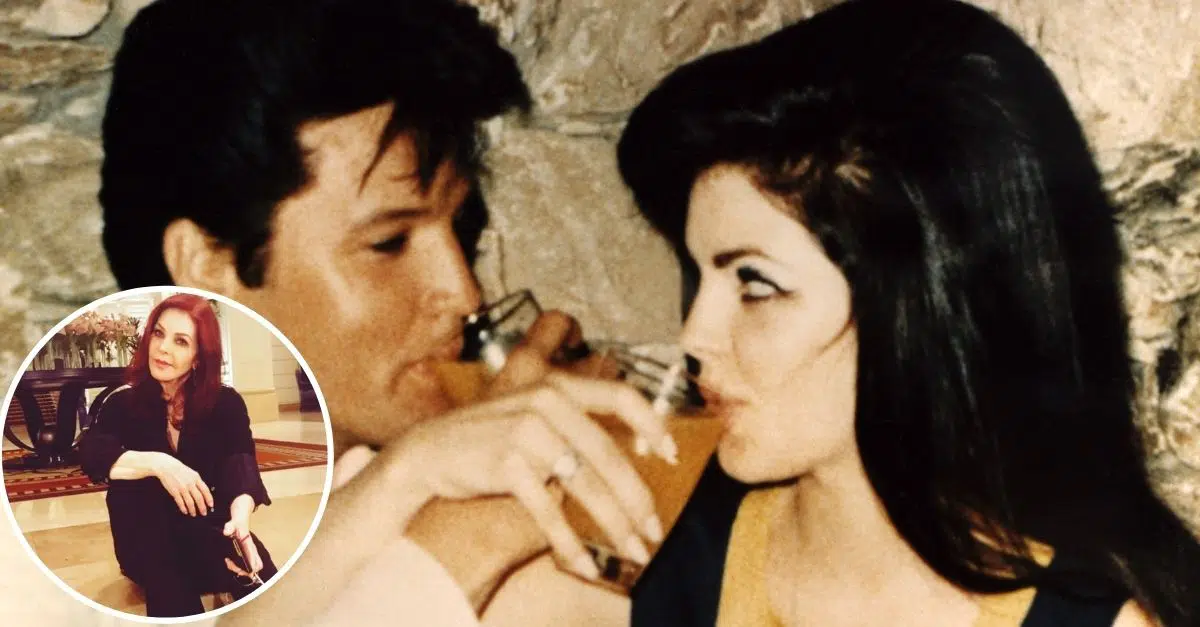
For decades, the world has been fed a carefully preserved myth: Elvis Presley and Priscilla Presley, the doomed fairytale couple, forever bound by love, fame, and tragedy. It is a story polished by Hollywood, repeated by documentaries, and accepted by millions of fans as gospel.
But behind the iron gates of Graceland, the people who share Elvis’s blood tell a far more uncomfortable story—one of displacement, broken loyalty, and a line in the sand drawn over the most sacred soil on the estate: the Meditation Garden.
Now, that story has erupted into public view.
At the center of the storm is Priscilla Presley’s reported wish to be buried beside Elvis Presley, in the Meditation Garden where his body rests alongside Gladys, Vernon, and Minnie Mae Presley. To casual observers, it sounds poetic—storybook even. The final closing of a love story that never truly ended.
But to the Presley family, it feels like something else entirely.
A violation.
And Donna Presley, Elvis’s first cousin, is done staying quiet.
“THIS WAS OUR HOME—UNTIL IT WASN’T”
Graceland is often described as a mansion, a museum, or a brand. But for those who lived there long before the ticket booths and velvet ropes, it was something simpler—and more fragile.
A home.
Donna Presley grew up within those walls. She remembers a Graceland that smelled like cooking oil and cigarette smoke, echoed with laughter, arguments, gospel music, and exhaustion. A place where family members didn’t clock in—they belonged.
“Elvis didn’t want a palace,” Donna says. “He wanted family around him. That’s what Graceland was built for.”
After Elvis’s death on August 16, 1977, that fragile ecosystem cracked—but it did not immediately collapse. Vernon Presley, already broken by grief, stayed. So did Minnie Mae, cousins, aunts, uncles—people who had given their entire adult lives to keeping Elvis grounded while the world pulled him apart.
But when Vernon died in 1979, and Minnie Mae followed in 1980, everything changed.
Suddenly, the family that had lived in trailers behind the main house—who cooked meals, maintained the grounds, watched the gates—found themselves reclassified.
From family… to inconvenience.
“We became employees first,” Donna recalls. “Then we became invisible.”
WHEN GRACELAND BECAME A BUSINESS
Donna is careful not to deny Priscilla Presley’s role in saving Graceland financially. The estate was hemorrhaging money after Elvis’s death, and turning it into a public attraction ensured its survival.
But survival came with a cost.
A house that had once absorbed grief now repackaged it. Intimacy was replaced with efficiency. Love with logistics. And the people who had stayed through Elvis’s decline were slowly erased from the picture.
In Donna’s telling, the transformation was not just administrative—it was emotional.
“That house went cold,” she says. “Not because Elvis was gone. Because the soul of the family was pushed out.”
This is where the burial issue becomes combustible. To the Presley bloodline, the Meditation Garden is not symbolic—it is personal territory. Sacred ground reserved for those who lived with Graceland, not those who left it.
MEMPHIS VS. HOLLYWOOD
At the heart of the family’s refusal lies one word: loyalty.
Donna describes Priscilla as someone who never truly belonged to Memphis, never embraced the life Elvis built there. In her version of history, Priscilla endured Graceland rather than cherished it.
California, Donna insists, was always the real destination.
“Memphis was never home to her,” Donna says flatly. “It was something to escape.”
When Priscilla left Elvis in 1972, the split wasn’t only marital—it was cultural. Elvis stayed. Priscilla didn’t. And to the Presley family, that decision matters.
“You don’t leave a life behind, build another one for decades, and then come back to claim the ending,” Donna says. “That’s not how real families work.”
For more than 20 years, Priscilla lived with Marco Garibaldi, raising their son Navarone Garibaldi in California—far from Graceland, far from the Presley relatives who remained rooted in Memphis.
To Donna and her family, rewriting that timeline—placing Priscilla eternally beside Elvis—feels less like closure and more like branding.
THE LISA MARIE WOUND THAT NEVER HEALED
No part of this story cuts deeper than Lisa Marie Presley.
Donna speaks of Lisa Marie not as a celebrity, but as a lost child—one taken from the family network that could have steadied her after Elvis’s death.
“She needed family,” Donna says. “Not handlers. Not Hollywood. Family.”
The Presleys believe Lisa Marie was severed from her Southern roots, raised in a world that magnified her trauma rather than healing it. Cousins, aunts, uncles—the quiet stabilizers—were sidelined.
“We were there,” Donna insists. “And we weren’t allowed to help.”
Lisa Marie’s burial in the Meditation Garden was understood by the family as non-negotiable: a daughter returning to her father. But extending that logic to Priscilla is, in Donna’s eyes, a distortion of meaning.
WHAT THE MEDITATION GARDEN REALLY MEANS
To tourists, the Meditation Garden is a photo stop. To fans, a pilgrimage. To the Presley family, it is a cemetery earned through loyalty, endurance, and shared suffering.
Gladys Presley. Vernon Presley. Minnie Mae Presley. Elvis Presley.
They lived and died with Graceland in their blood.
Donna does not deny Priscilla’s significance in Elvis’s life—but she refuses to equate managerial stewardship with moral ownership.
“Running the estate isn’t the same as living the life,” she says. “Those are two very different things.”
For the Presley bloodline, allowing Priscilla’s burial there would collapse that distinction forever.
WHO OWNS ELVIS’S STORY?
At its core, this conflict isn’t about burial logistics.
It’s about narrative power.
Does Elvis Presley’s legacy belong to those who manage his image—or those who remember him when the cameras were gone? To business decisions—or kitchen-table memories?
Donna is asking fans to consider a harder truth: that history is being curated, simplified, and sold.
“The real Elvis lived when the gates were closed,” she says. “That’s the Elvis we’re protecting.”
And so the line remains unyielding.
Some doors, once closed, do not reopen.
Not even for a fairytale ending.
Video