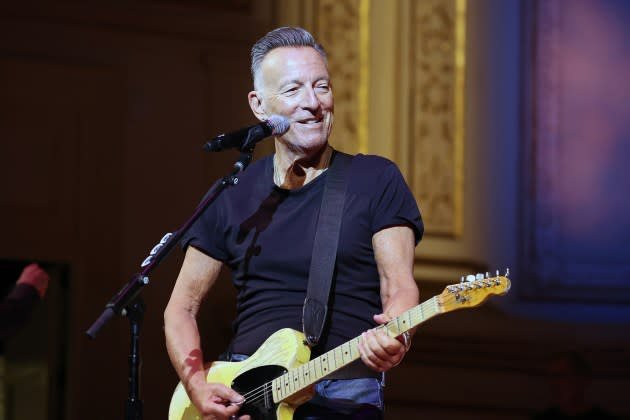
A wave of online posts has recently drawn attention to an alleged emotional moment during a live performance by Bruce Springsteen in Minneapolis. According to these circulating accounts, the concert — originally described as part of a larger tour stop — briefly shifted in tone after Springsteen paused to address the audience in a more personal and reflective way.
The claims, which have not been independently verified, suggest that Springsteen referenced two individuals named Renee Good and Alex Pretti, reportedly connected to a recent tragedy in the local community. Online narratives describe the moment as unexpected and emotionally charged, with the artist allegedly stepping away from the planned setlist to acknowledge their passing.

It is important to note that, as of now, there are no confirmed reports from official sources, venue statements, or verified concert recordings that substantiate these specific details. The story appears to be circulating primarily through social media posts and reshared content, which often amplify emotionally compelling narratives before verification occurs.
In the version of events being shared, the atmosphere inside the venue reportedly shifted immediately following the tribute. Audience members are described as falling into silence, with some later joining in a soft, collective singalong as the performance continued. These descriptions emphasize a transition from entertainment to reflection, a dynamic not uncommon in live music settings where artists respond to emotional moments in real time.
:max_bytes(150000):strip_icc():focal(749x0:751x2)/Bruce-Springsteen-minneapolis-2-040126-975f4a24bccc4eb39a9ae6f2436ccd7d.jpg)
Springsteen, throughout his career, has been widely recognized for performances that emphasize storytelling and human connection. His work often focuses on themes of memory, loss, resilience, and shared experience, which is part of why stories like this spread quickly online — they align with the emotional expectations audiences associate with his concerts.
However, without verified documentation, it remains unclear what specifically occurred during the referenced performance, or whether the details circulating online accurately reflect reality. In the digital age, concert moments — especially those involving high emotion — can be easily reinterpreted, exaggerated, or entirely fabricated as they are shared across platforms.
This is not the first time that emotionally charged narratives involving major artists have gained traction online without confirmation. Viral posts often rely on vivid storytelling elements: a quiet stage, a meaningful pause, an audience brought to silence, and a symbolic act of remembrance. While these elements make for compelling reading, they do not always reflect confirmed events.
For now, the only reliable conclusion is that the story remains unverified. No official statements have been released regarding the alleged tribute, and no confirmed setlist or recording has validated the specific claims being shared.
Still, the rapid spread of the narrative highlights the strong emotional connection audiences feel toward live music experiences — particularly those involving artists like Bruce Springsteen, whose concerts are often associated with communal feeling and storytelling.
Until further information emerges, the situation should be viewed as a circulating account rather than established fact, underscoring once again how quickly sentiment and speculation can blend in the online information space.
:max_bytes(150000):strip_icc():focal(749x0:751x2)/Bruce-Springsteen-minneapolis-1-040126-cead4320f0774c61b642389d5fbc9615.jpg)