Did John and Yoko split because of Richard Nixon? The making of revelatory music film One to One
The director of One to One: John & Yoko reveals how he was given access to a trove of intimate and family archive material that changes how we see the star couple
People are usually at their most interesting when they are in flux – uncertain of the way forward, of what life they ought to build. That was the case with John Lennon and Yoko Ono when they arrived in New York in 1971. They were both fleeing England – the recriminations around the Beatles breakup; the terrible misogyny and racism levelled at Ono – but also running towards the optimism and creative excitement of the New York art scene.
This is the period I have tried to recreate in my film One to One: John & Yoko – using a plethora of previously unheard phone recordings, home movies and archive. It’s an unconventional film in many ways, pitching the viewer headfirst into the life, politics and music of the time without the usual music documentary guardrails. At its heart is the One to One concert that the couple gave at Madison Square Garden in the summer of 1972 – a concert that turned out to be Lennon’s only full-length concert after leaving the Beatles.
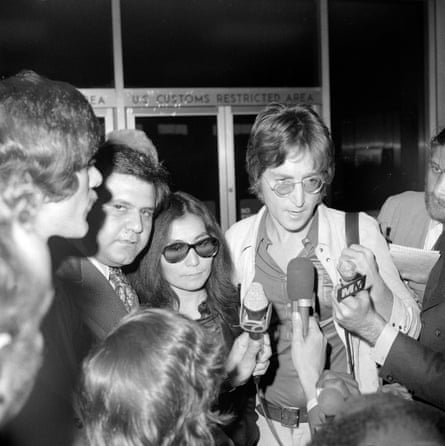
During this time, Lennon became obsessed with a set of questions: what happened to flower power? Why hadn’t it worked? Why were the youth so apathetic? As an ex-Beatle, how could he use his celebrity to make the world a better place? How could he ever reclaim a private life when most of the world still seemed to think of him as a Beatle?
Out of these questions and his interactions with the counterculture figure Jerry Rubin, the Yippies (Youth International party), and a host of activists who were in New York at the time, Lennon and Ono became a regular fixture at marches and political gatherings. He began to see himself as a troubadour – reporting in song from the streets – and for the only time in his life, briefly embraced the idea of violent revolution as the sole response to the continued bombing of civilians in Vietnam.

At times you feel that Lennon is unsure of himself. He is searching for answers, trying on different personas. He seems willing to talk to anybody and to find interest and inspiration everywhere he looks. There’s an astonishing openness about him that sometimes borders on naivety and makes him deeply sympathetic as a character.
When I was first approached about making this film – by the producers Peter Worsley and Alice Webb – I felt unsure whether I should do it. How do you say anything new and interesting about the Beatles? But something changed when I read a quote where Lennon talked about his first impression of America; how he spent most of his time watching TV, and that his image of the country was formed through this medium.
I wanted to try to reproduce this impression for an audience using contemporary TV clips. That then fed into a desire to make a formally different film, and I was reminded of one of my favourite films, a documentary about Marlene Dietrich by Maximilian Schell, in which he reconstructed her apartment in a film studio. I thought doing something like that was an interesting way to approach it. Necessity really can be the mother of invention. I think we have ended up making something that is truly sui generis and makes you view Lennon and the Beatles’ legacy differently.
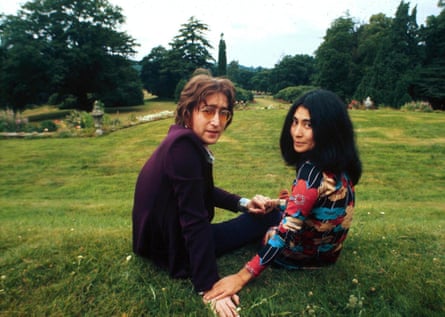
We had to seek the approval of the Lennon estate – in the form of Sean Ono Lennon. I explained what I wanted to do, how this would be an experiential film, not something literal and educational, and he really responded to that. I think as a musician he understands the creative process in the way a lot of estate gatekeepers don’t. He just said: “That sounds like a film my mum would love.”
Perhaps the most interesting thing to emerge from the film is Ono, appearing as a much more human, vulnerable character than we usually see. She talks movingly about missing her daughter, Kyoko, who she didn’t see between the ages of eight and 31. The sense of loss permeates the film.
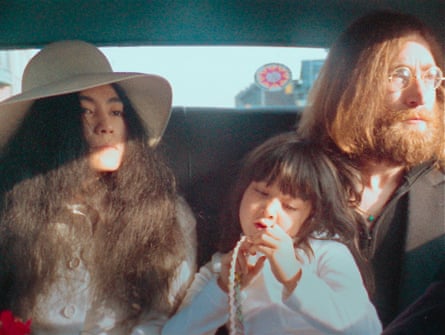
It’s not surprising that when Lennon and Ono saw the shocking news report by Geraldo Rivera about the Willowbrook school on Staten Island for disabled children that they were deeply affected by the sight of these youngsters living in barbaric, almost medieval conditions. The One to One concert was put on for the benefit of these children. Lennon and Ono moved from trying (and largely failing) to change the world through big-P politics and instead effected real, local change in the lives of these forgotten children.
Sean’s blessing opened the Lennon/Ono archives for us. What a feast they were. Amazing home movies shot on Portapak – the original home video camera – plus Super 8 family footage and art films they had commissioned.

Halfway through the edit, the film-maker Simon Hilton, who works intimately with the estate, told me they had found a box of phone recordings from the period I was interested in. I listened to those for hours, transfixed by the intimacy of the conversations; by how different (and yet somehow the same) these two icons were in private from their interviews.
You’re listening to them talking to someone at an art gallery or Lennon’s manager Allen Klein, or to their neighbour – just their everyday life at that moment. It’s not seen from a film-maker or music journalist’s point of view. I think even the most hardened and knowledgeable Beatles fan will be bowled over.
In the period covered by the film, you don’t sense any trouble in Lennon and Ono’s relationship. They seem totally devoted, even co-dependent. But we know from books and interviews that trouble was brewing. Their separation in summer 1973 came about indirectly because of Nixon’s re-election the previous November (the pair reconciled in 1975). This was a devastating moment for progressives in the US. Everything Lennon, Ono and their friends had done to try to sway public opinion had totally failed.
Nixon achieved a landslide, winning 49 of 50 states, and Lennon was left bereft. What had it all been for? In the end, it seems it was this post-election depression that led to him splitting from Ono. The political had become personal.