When a Rock Anthem Became a Message of Healing — Aerosmith and a Children’s Chorus Reimagined “Dream On” for a Boston Tribute

There are songs that define a generation — not just because they were hits, but because they carry something deeper: memory, resilience, and the unspoken stories we share. “Dream On” by Aerosmith is one of those songs. But on a night dedicated to honoring the victims and survivors of the Boston Marathon bombing, it became something even more profound: a statement of collective healing.
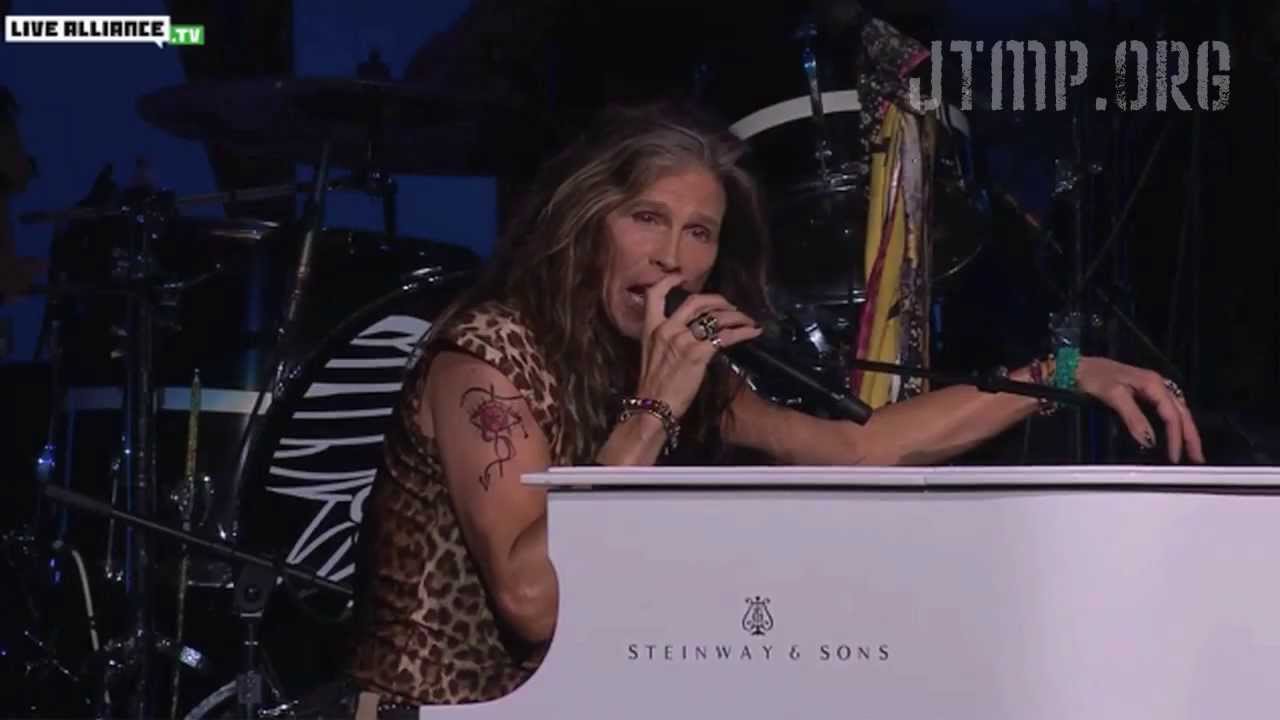
The setting wasn’t an arena filled with screaming fans. Instead, the stage was a tribute — a night where the focus wasn’t on spectacle, but on presence. On the front line stood Steven Tyler, his voice unmistakable even as the years have deepened its texture. But he wasn’t alone.
Behind him, the Southern California Children’s Chorus — a group of young voices brimming with clarity and hope — provided harmonies that transformed the familiar rock anthem into something transcendent. Their presence shifted the song’s gravity: from a rock ballad about ambition and introspection to a communal declaration of strength in the face of pain.
From the first note, there was a collective intake of breath. Tyler’s opening line, once a personal plea, landed differently this time, echoing across the room like a question asked by a community: “Sing with me, if just for today…” And the children’s chorus responded without hesitation — their voices rising in harmony, carrying a purity that made every line feel urgent and alive.

As the song built toward its soaring chorus, the contrast became powerful. There was Tyler’s seasoned, gritty voice — shaped by decades of life on the road — and over his shoulder, dozens of youthful vibratos, clear and unguarded, weaving through the melody like threads of light. Watching them perform together was like seeing the past and future of music — and life itself — in conversation.
It wasn’t lost on anyone that a song about holding on to dreams took on new meaning in this context. For those in the audience who had been directly touched by the events in Boston — survivors, families, first responders — the lyrics became personal. They weren’t just words anymore. They were testimony.
At one point, as the chorus swelled, you could see people in the crowd wiping tears, instinctively instinctively bowing their heads, or closing their eyes to simply feel the moment. The children’s voices didn’t just support the anthem; they elevated it — reminding everyone that healing isn’t linear, and that hope is often carried by the young, by innocence, by voices that have never known despair.
After the performance, applause didn’t come as a sudden eruption. It came as a slow, sustained wave — not just of appreciation, but of shared emotion. People weren’t clapping because the performance was good. They were clapping because the performance understood them.
In a world where music often serves as entertainment first, this version of “Dream On” did something rarer: it listened back.
It felt like comfort. Like acknowledgment. Like someone finally putting into sound what many had felt for years but never had the language to express.
For Aerosmith, the song has always been iconic. But on this night, with the Southern California Children’s Chorus behind him, Steven Tyler’s voice wasn’t just singing an anthem — it was holding space for a community. And in that shared space, there was not just tribute, but truth.
Long after the lights dimmed and the stage emptied, that performance lingered in the hearts of those who heard it — a reminder that while dreams may be tested, they are never truly gone.
VIDEO BELOW