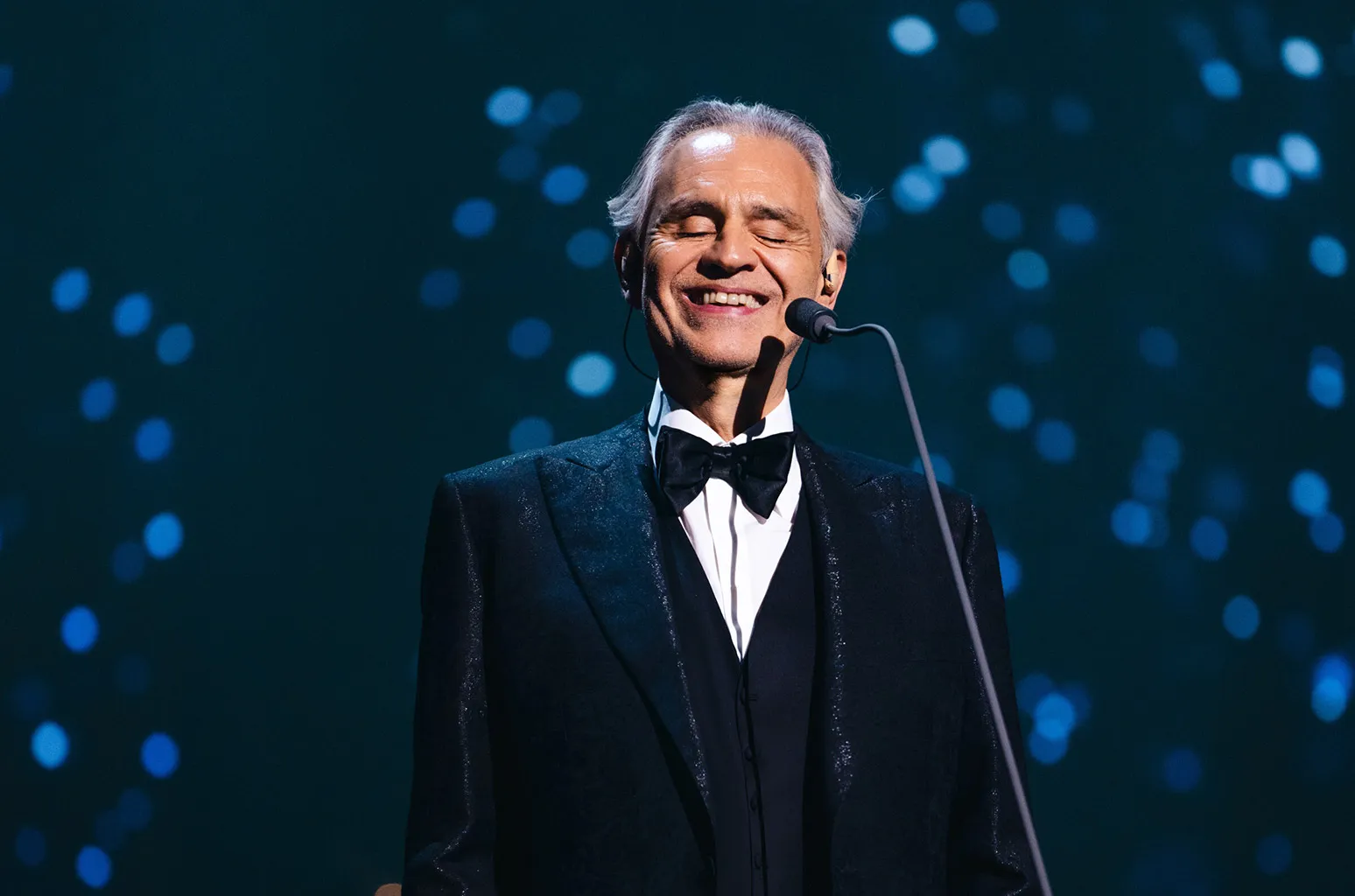
“BOCELLI SAVES THE NIGHT” — AFTER MARIAH CAREY FLOATS IN LIKE A MERINGUE, ONE VOICE BRINGS THE OLYMPICS BACK TO EARTH 🎭🎶 The opening ceremony was drifting — glossy, theatrical, and dangerously close to spectacle overload — until Andrea Bocelli stepped in and reminded the world what weight sounds like. Moments after Mariah Carey appeared in a cloud of feathers and excess that drew more chatter than chills, Bocelli’s voice cut clean through the noise. No theatrics. No gimmicks. Just presence, control, and emotion that finally grounded the 2026 Winter Olympics opening in something real. It was the contrast no one expected — froth versus force, spectacle versus soul. And when the echoes faded, there was no question who truly owned the moment.

andrea bocelli

Review: Bocelli rescues opening ceremony after Carey dresses like a meringue

According to Kirsty Coventry, what we are about to see over the next fortnight of going downhill very fast at the Winter Olympics, is “what it means to care for each other, respect one another, we will see that strength is about empathy and heart.”

We will see demonstrated, the head of the International Olympic Committee insisted as she addressed the opening ceremony of the Milan-Cortina iteration, that “our strength comes from how we treat each other. That is the magic of the Olympic Games.”

Incidentally, this is the same Coventry who has just declared that Russia, currently engaged in the process of murderous infiltration of another land, should be invited back into the Olympic fold. Still, at least, as heads of sporting institutions go, she is not Gianni Infantino.

In many ways, though, that is typical of the Olympic way: pretending it is all about harmony and love when we really know it is all about money and the projection of power. And in Milan, the BBC was more than happy to embrace such fallacy.

“What a scene setter,” Clare Balding said about Zlatan Ibrahimovic’s short film that introduced the corporation’s broadcast. It was perhaps a brave choice of the Beeb to choose someone to set the tone for their view of the Italian Winter Olympics who is neither Italian nor an Olympian. The geezer can’t even ski.

Meanwhile in the Cortina studio from where the coverage over the next fortnight will come, were stationed a presentational trio of Balding, and former Olympians Lizzy Yarnold and Chemmy Alcott. This suggested that, at least as far as the BBC is concerned, there are seemingly no men involved in these Games.

Though, to be fair, there was a bloke to the helm for the ceremony itself. Indeed the BBC had chosen more than wisely in its commentary team. Joining Hazel Irvine behind the microphone was the incomparable racing reporter John Hunt, a man who could use the Olympics’ apparent power to act as a healing balm.

He and Irvine had much to describe. Not least in who was there in the crowd at San Siro. JD Vance was in the pricey seats, while Britain was represented by the unexpected pair of Princess Anne and Lisa Nandy, who was presumably the only available member of the cabinet solely because she has no chance of maneuvering for the Labour leadership.

As it all got underway, Hunt had a good line about the apparent star of the event.

“Shortly we’ll discover Mariah is for life,” he said of Ms Carey, who was about to sing, “not just for Christmas.”

He spoke a bit too soon. All we could see on the screen for what seemed an interminable grind was the kind of wretched interpretive dance that is only ever unleashed at Olympic opening ceremonies.

Eventually, on came Carey, dressed as a meringue, singing Volare, the tune that won Italy the 1958 Eurovision Song Contest. She struggled to reach the high notes before demonstrating her diva credentials by being carried off the stage. The most pressing thought, though, was that rarely can such a storied artistic heritage as that of the host nation have been so blandly represented as it was here.

US recording artist Mariah Carey performs during the Opening Ceremony at the Milano Cortina 2026 Winter Olympic Games at the San Siro Stadium, in Milan, Italy, 06 February 2026
Mariah Carey was the star attraction – Peter Kneffel/Shutterstock

“A musical dialogue between the mountains and the city,” Irvine then told us, as some bloke with a Stradivarius played while dancers in cast-off military greatcoats shimmied round him. That she managed to do so while not adopting a Graham-Norton-at-Eurovision smirk was yet further testament to her sterling professionalism.

Though you wonder whether she might finally have succumbed to the Norton methodology when she told us that, as a reward for winning a medal, Filipino athletes have been promised free colonoscopies for life.

This was the first opening ceremony in Olympic history to split its athletes parade into four different centres, places closest to where the competitors were performing. It made it all a little disjointed. As for what everyone wore, some – like the Danes walking into the Milanese stadium in determinedly beige anoraks – barely reflected the fact they were in the capital of the fashion world. Others, like the Colombians, wearing jackets apparently inspired by Arsenal’s 1991 acid dream away shirts, at least made the effort. As did Team GB in jumpers seemingly made out of union flags rescued from the lampposts of your nearest roundabout.

Members of the Great Britain team during the Opening Ceremony for the Milano Cortina 2026 Winter Olympics at the Cortina d'Ampezzo
Great Britain arrives for the athletes’ parade – Andrew Milligan/PA

Disappointingly for those interested in new methods of pharmaceutical enhancement, the ski jumpers in the athletes parade were too wrapped up in cold weather gear to allow any close inspection of how many had benefited from an injection in their crotch apparently to improve their wind resistance.

After they had all done their bit (the Ukrainians being cheered to the echo, the Israelis attracting a smattering of boos), the speeches and the flag flourishing came. It was all, as it generally is at such events, entirely underwhelming. Or at least it was until Andrea Bocelli stepped forward to soundtrack the lighting of the Olympic flame with a spine-tingling rendition of Nessun Dorma. Despite at least three hours of attempting not to, in Italy they know how to do some things rather well.

Andrea Bocelli performs during the Opening Ceremony at the Milano Cortina 2026 Winter Olympic Games at the San Siro Stadium, in Milan, Italy, 06 February 2026. Milano Cortina 2026 Winter Olympic
Andrea Bocelli performs during the Opening Ceremony – Peter Kneffel/Shutterstock
0 Shares:
Leave a Reply

Your email address will not be published. Required fields are marked *

You May Also Like
Il Volo
Read More

“I’ve Heard Unchained Melody a Thousand Times… but Never Like This.” When IL Volo’s Ignazio Boschetto and Gianluca Ginoble Took the Stage, No One Expected This Level of Raw Emotion. Gianluca’s Velvet-Smooth Voice Carried Every Word Straight to the Heart, While Ignazio Soared With Near-Operatic Power That Shook the Room to Silence. By the Final Note, Fans Were on Their Feet — Some in Tears, Others Simply Stunned. “It Felt Like Hearing Love Itself,” One Fan Wrote. This Wasn’t Just a Performance — It Was a Spiritual Experience, Proof That IL Volo Can Turn Even the Most Classic Love Song Into Something Breathtakingly New.

In a breathtaking moment at their Mantova concert, Il Volo’s Ignazio Boschetto and Gianluca Ginoble captivated the audience…
Ignazio Boschetto
Read More

When Silence Spoke Loudest: Ignazio Boschetto’s Quiet Moment During “Grande Amore”It was meant to be a charity concert in Rome, but for those present, it became something far more intimate—a moment that felt less like a performance and more like a memory unfolding in real time. Ignazio Boschetto took the stage that evening with the quiet confidence of someone used to standing in front of audiences. Yet this time, the focus shifted away from him. The spotlight slowly moved toward Michelle Bertolini, his wife, who stepped forward without dramatic introduction or visible tension. The choice of song was not random. “Grande Amore” is not just one of the defining pieces of Ignazio’s career—it is a song that represents a chapter of his artistic identity, one that has been performed across stages around the world. But this time, it returned in a different form, carried by the voice of someone who shares his private world. As the opening notes began, the atmosphere in the room shifted almost instantly. Conversations faded. Movement slowed. The audience seemed to collectively recognize that what they were witnessing was not a standard performance. Ignazio did not join in. Instead, he remained still. With his hands gently resting and his posture calm, he watched and listened. There was no attempt to perform alongside her, no interruption of the moment. His silence became part of the performance itself—an unspoken presence that grounded everything happening on stage. Observers in the room noted how his expression remained steady throughout. It was not detachment, but attention. A quiet acknowledgment of something deeply familiar being reshaped in front of him. Hearing a song so closely tied to his own career, performed by someone he loves, created a layer of meaning that words would likely have interrupted rather than enhanced. As the song progressed, the silence around him seemed to deepen rather than fade. In many concerts, applause or vocal reactions fill the gaps between powerful moments. Here, however, the absence of noise became the defining feature. Every note carried further because nothing competed with it. There was no need for spectacle. No exchange of gestures between performer and audience. Just a shared experience unfolding slowly, almost carefully, between two people and the music that connected them. When the final notes finally faded, the room reportedly remained quiet for a brief moment longer than expected—an instinctive pause, as if no one wanted to break the atmosphere too quickly. What stayed with many in attendance was not a dramatic gesture or a climactic reaction, but the simplicity of Ignazio’s stillness. A silence that did not feel empty, but full—of memory, meaning, and something deeply personal that could not be fully expressed through applause. In the end, it wasn’t just “Grande Amore” that was heard that night. It was what silence can sometimes say when words and music briefly meet in the same space.

It was meant to be a charity concert in Rome, but for those present, it became something far…
paul-mccartney
Read More

When Paul and Linda McCartney released Uncle Albert / Admiral Halsey, nobody expected the quirky, patchwork track to become one of the most beloved post-Beatles anthems — yet fans still call it a masterpiece of whimsy and genius; the song stitched together fragments of melodies like a musical collage, with Paul’s playful voice and Linda’s harmonies turning oddball lines into magic; critics at first scratched their heads, but soon the single soared to No. 1, proof that McCartney could reinvent pop on his own terms; decades later, fans replay the high-quality recording and marvel at how the song feels both chaotic and comforting, a glimpse into the couple’s shared creativity; whispers say Paul once admitted it was one of his proudest solo achievements, not because it was perfect, but because it was theirs; tabloids now dub it “the strangest love letter ever written,” a reminder that sometimes nonsense carries more truth than logic.

The anthem nobody expected When Paul and Linda McCartney released Uncle Albert / Admiral Halsey in 1971, few could have…