History rarely shouts when it makes a mistake. It simply repeats it.
In 1969, as George Harrison stepped further into his own voice, he offered the world a composition of rare restraint and depth. “Something” did not demand attention. It unfolded gently, each note placed with care, each lyric shaped by quiet conviction. Within a band dominated by towering personalities, this was Harrison’s moment of undeniable authorship.
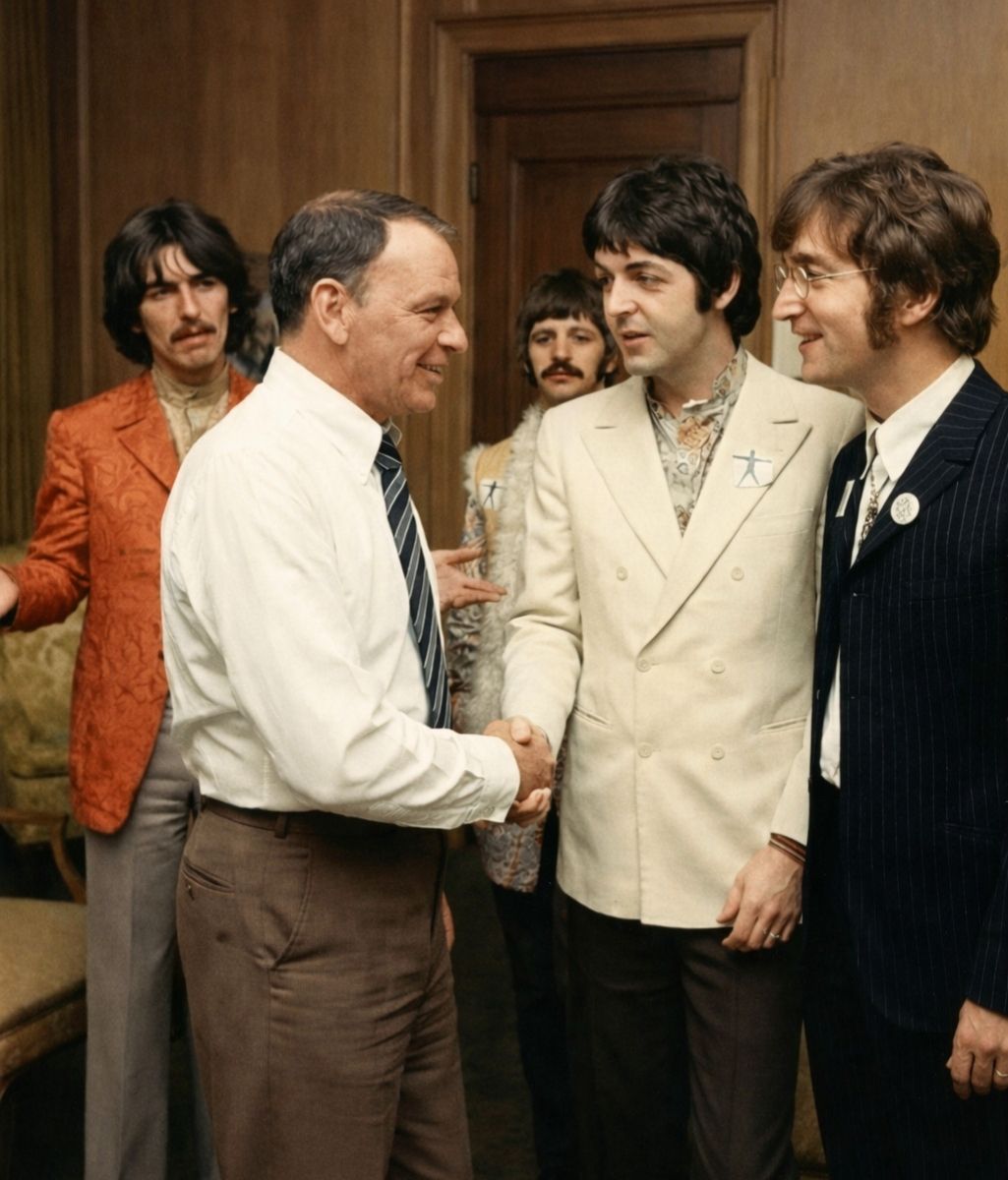
The song traveled quickly beyond the walls of The Beatles. Its melody carried an intimacy that felt timeless. Even Frank Sinatra, long regarded as the guardian of classic romance, recognized its power. Onstage in Las Vegas, beneath chandeliers and applause that rolled like thunder, Sinatra introduced it with reverence.
💬 “The greatest love song of the last fifty years… by Lennon and McCartney.”
The audience responded instantly. The compliment soared. The names echoed. And yet, they were not the right ones.
For more than three decades, Sinatra continued to perform the song, often attaching it to the familiar partnership of John Lennon and Paul McCartney. Whether habit, assumption, or simple oversight, the error persisted. The velvet rooms filled with applause, and the introduction remained unchanged.
Somewhere beyond the spotlight, Harrison listened. There was no public protest. No sharp correction. Those who knew him understood that silence did not signal weakness. It signaled patience. Harrison had spent years being underestimated, his contributions measured against louder voices. “Something” required no defense. The song stood on its own, even when its authorship drifted in the telling.
The irony was subtle but enduring. Sinatra’s praise elevated the song to the highest standard of romantic composition, yet misdirected the credit. Still, the music endured. Listeners felt its sincerity without consulting liner notes. Musicians studied its structure. Couples chose it for moments that demanded honesty rather than spectacle.
Over time, clarity emerged. Interviews, publications, and recordings confirmed what had always been true. George Harrison wrote the melody that Sinatra loved. The quiet Beatle had crafted the very standard that one of America’s most iconic voices embraced night after night.
Mistakes in history often linger longer than they should. Yet truth, when rooted in substance, has its own durability. Harrison never needed to raise his voice to secure his place. His work carried him there.
In the end, the story is not about misattribution alone. It is about endurance. A song born from quiet conviction traveled through decades, through velvet curtains and standing ovations, and returned—finally—to its rightful author. Genius does not insist. It persists. And in time, the world learns to listen more carefully than it once did.
Video