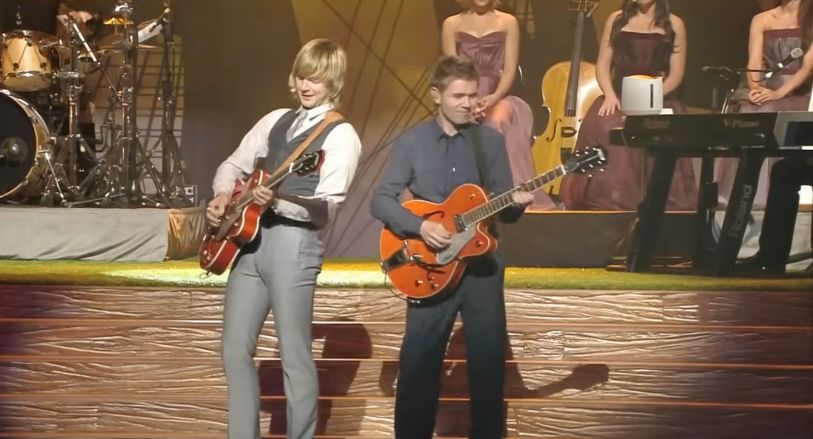
Celtic Thunder’s Keith Harkin and Neil Byrne had fans on their feet during their electrifying live performance of “Whiskey in the Jar”, a timeless Irish ballad that never fails to stir the soul.
Filmed live in Kansas City in 2011, the duo’s guitar work and rich harmonies lit up the stage, reminding audiences why this centuries-old song remains one of Ireland’s most beloved anthems.
Many viewers flooded the comment section to praise the pair’s chemistry and talent, calling it “one of the best performances ever” and “absolutely beautiful.” For countless fans, it brought back the spirit of Celtic Thunder’s golden era and the memory of the late George Donaldson, whose presence remains deeply missed.
Beyond the performance, the song itself carries a remarkable history. “Whiskey in the Jar” tells the tale of Patrick Fleming, a notorious Irish highwayman hanged in 1650. Though he was known for his crimes — robbing both rich and poor — folklore transformed him into a larger-than-life folk hero.
The song recounts a highway robber’s betrayal by his lover, Molly, and his ultimate downfall — themes that resonated with generations facing oppression and hardship.
First emerging in 17th-century Ireland, the tune became a rebel anthem and was later popularized by folk icons like The Dubliners and rock legends Thin Lizzy. Metallica’s gritty cover introduced it to a new generation, while bands like The High Kings and Celtic Thunder have kept its Irish roots alive.

Historian Alan Lomax once noted that songs about highwaymen who defied the crown were adored by common people — they represented defiance, pride, and freedom. In Ireland, where such rebels often stood against English landlords, “Whiskey in the Jar” became a symbol of national spirit.

Over the centuries, the song traveled with Irish emigrants to America, evolving into new forms — even inspiring the Civil War anthem “We’ll Fight for Uncle Sam.” Yet, its heart has never changed.
In Celtic Thunder’s hands, “Whiskey in the Jar” feels both ancient and alive — a bridge between Ireland’s past and present. For many fans, it wasn’t just a performance — it was a reminder of home, pride, and the music that unites generations across oceans.