Opening the Doors with a Roar: Bruce Springsteen’s New Jersey Celebration of Music and Legacy

bruce springsteen

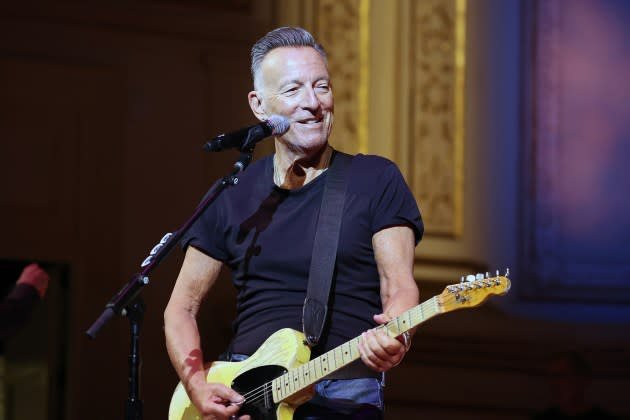
When Bruce Springsteen steps into a spotlight, it’s rarely a quiet moment. But what’s planned for early June in New Jersey goes beyond a typical performance. It’s not just an opening—it’s a statement.

Across two nights, June 4 and 5, a new cultural center dedicated to music and its enduring influence will come to life with a scale that feels more like a festival than a formal debut. And fittingly, it’s Springsteen—New Jersey’s own storyteller—leading the charge.

The lineup alone tells you this isn’t an ordinary event. Artists like Jon Bon Jovi and Public Enemy are set to take part, representing different corners of American music. Rock, hip-hop, and everything in between will share the same stage, not as separate genres, but as chapters of a larger story.

That’s the idea at the heart of the new center.

Rather than focusing on a single artist or era, it aims to reflect a broader musical journey—one that captures how songs evolve alongside culture itself. From protest anthems to stadium rock, from deeply personal ballads to socially charged lyrics, the center positions music as both soundtrack and witness to history.

Executive Director Robert Santelli has emphasized that this project is about connection. While Springsteen’s name naturally draws attention, the mission extends far beyond one career. It’s about recognizing the shared threads that run through American music and the communities it represents.

And there’s perhaps no better place for that story than New Jersey.

For decades, the state has produced artists who speak to working-class realities, cultural diversity, and the restless energy of change. Springsteen himself built his legacy on telling those stories—of small towns, big dreams, and the spaces in between. This center feels like a continuation of that voice, translated into a space where people can gather, listen, and reflect.

But what makes this opening stand out is its tone.

It’s not formal or distant. It’s loud, celebratory, and unapologetically alive. By bringing together artists from different backgrounds and styles, the event creates something closer to a living mixtape—one that doesn’t just look back, but actively engages with the present.

For fans attending, it will likely feel like more than a concert. It’s an experience that moves between nostalgia and discovery, where familiar songs take on new meaning in a shared setting.

And that sense of unity is no accident.

At a time when divisions often dominate headlines, music remains one of the few spaces where differences can coexist without friction. A stage becomes common ground. A song becomes a shared language. This opening event leans into that idea, using performance not just as entertainment, but as a reminder of what connects people.

By the time the final notes fade on June 5, the building itself will have officially opened. But more importantly, it will have already fulfilled its purpose—bringing people together through sound, memory, and meaning.

Because in the end, this isn’t just about honoring music.

It’s about recognizing its power to shape identity, tell stories, and create moments that last long after the stage goes dark.

0 Shares:
Leave a Reply

Your email address will not be published. Required fields are marked *

You May Also Like
Barry-Gibb
Read More

In 1978, Barry Gibb stepped into a moment that music history has never been able to repeat. In the span of just a few breathtaking months, he wrote four consecutive No.1 songs on the U.S. Billboard Hot 100 — each performed by a different artist, shaped in a different musical style, each one unmistakably perfect for its time. It wasn’t just success. It felt like destiny unfolding in real time. Nearly half a century later, that streak still stands untouched. No songwriter has come close. And it leaves behind an almost haunting question: was this pure genius at work, flawless timing, or a once-in-a-lifetime collision of talent, culture, and instinct that could only happen in that era? In today’s world of streaming algorithms, fractured audiences, and fleeting viral hits, could such a record ever be broken? Or has the industry moved too far from moments of singular musical authority? Perhaps that’s the truth that lingers most powerfully — that for one radiant season, Barry Gibb didn’t just write hit songs. He seemed to write the emotional pulse of an entire world, leaving behind an achievement so rare, so perfectly timed, that it may forever remain one of popular music’s most untouchable legends.

Introduction: In the world of popular music, records are often treated as temporary milestones—numbers waiting patiently to be…
paul-mccartney
Read More

How Paul McCartney’s Last-Minute Question at Wembley — “If We Don’t Sing It Together Now, When Do We?” — Scrapped the Planned Finale, Pushed Freddie Mercury, Bono and Bob Geldof Toward a Song No One Expected, No One Rehearsed and Some Thought Was the Wrong Choice, Overrode the Live Aid Running Order in 1985, and Turned a Risky, Unscripted Decision Into One of the Most Talked-About Moments in Music History

That final moment at Live Aid was never meant to happen. According to those backstage at Wembley on…
Noah Bublé
Read More

“May I Sing It to Dad?” Noah Bublé Looked up at Kelly Clarkson and Requested in a Low, Tremulous Voice. “Let’s Make Some Magic, Kiddo,” She Replied With a Gentle and Comforting Smile. Nobody in the Room Knew They Were Going To Witness Something Genuinely Unique at That Very Time. On the Kelly Clarkson Show, What Began as a Delightful Surprise Gradually Evolved Into a Moment That Overshadowed All Else. Noah Took the Microphone and Started Singing His Father’s Well-Known Song—the One That Made Michael Bublé Famous—While Standing Next to Kelly.

In a recent episode of The Kelly Clarkson Show, viewers witnessed a jaw-dropping moment that no one saw coming…
joan-and-paul-simon-
Read More

WHEN HISTORY STOOD STILL Central Park was suffocating in a sea of people. As Paul Simon clasped hands with Art Garfunkel, thousands of phones rose into the air. But then… the spotlight lit up again. A lone figure walked onto the stage — silver hair, worn leather jacket — Don Henley. The crowd went silent. No one could believe it. Three legends — never seen together — now stood just steps apart. No instruments. Just voices. “Hello darkness, my old friend…”…

THE SOUND THAT TIME COULDN’T SILENCE: When Three Legends Turned Central Park Into History’s Stage It began with…