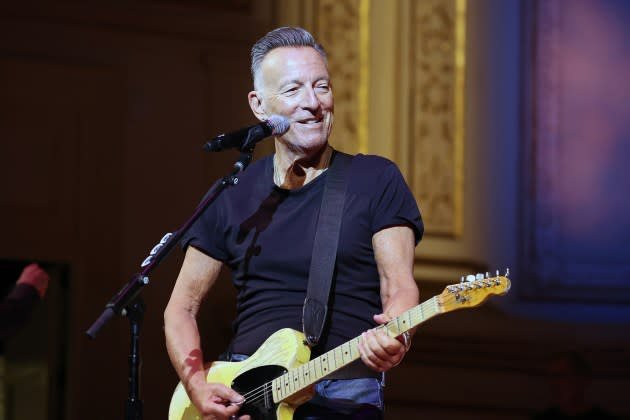
Opening night concerts carry their own kind of electricity—the anticipation, the energy, the sense that anything could happen. But even by those standards, what unfolded in Minneapolis during Bruce Springsteen’s latest tour kickoff was something few could have predicted.

Fans arrived expecting a night filled with classics, deep cuts, and the unmistakable connection Springsteen shares with his audience. What they didn’t expect was a tribute that would transform the evening into a piece of music history.
Midway through the set, the atmosphere began to shift. The familiar rhythm of a Springsteen show gave way to something quieter, more deliberate. Then came the opening notes—instantly recognizable to anyone who knows the legacy of Prince.
“Purple Rain.”
For a moment, the crowd seemed to hold its breath. This wasn’t just another cover—it was a deeply symbolic choice. Minneapolis isn’t just another tour stop; it’s Prince’s hometown, the place where his influence is still woven into the cultural fabric of the city.

Springsteen approached the song with a sense of reverence rather than reinvention. His voice, raw and grounded, carried the melody with a different kind of weight than Prince’s original soaring delivery. It wasn’t about matching the original—it was about honoring it.
And that distinction mattered.
As the performance unfolded, the audience response grew from surprise into something closer to collective emotion. Thousands of fans, many of whom had personal connections to Prince’s music, found themselves sharing in a moment that felt both intimate and monumental.
The E Street Band provided a subtle, respectful backdrop, allowing the song’s emotional core to remain front and center. Guitar lines echoed with restraint, and the arrangement left space for the meaning behind the music to resonate.

It’s not uncommon for artists to pay tribute to those who came before them. But what made this moment stand out was its timing and setting. Opening night is usually about looking forward—introducing a new chapter, setting the tone for what’s to come. Instead, Springsteen chose to pause and look back, acknowledging a legacy that continues to shape the very stage he stood on.
For longtime fans of Springsteen, the choice felt consistent with who he is as an artist. Throughout his career, he has shown a deep respect for musical history, often weaving that awareness into his performances. But even so, this tribute carried a unique emotional charge.

Social media quickly lit up with reactions from those in attendance. Videos began circulating, capturing the moment fans realized what they were hearing. Comments ranged from disbelief to gratitude, with many describing it as a once-in-a-lifetime experience.
For fans of Prince, the tribute held its own significance. Hearing “Purple Rain” performed live in Minneapolis, reinterpreted through another legendary voice, felt like a reminder of just how far-reaching his influence remains.
In the end, the performance wasn’t about comparison. It wasn’t about who sang it better or how it measured against the original. It was about connection—between artists, between generations, and between a city and the music that defines it.
As the final notes faded, the crowd’s reaction said everything. It wasn’t just applause—it was acknowledgment. A shared understanding that they had witnessed something rare: a moment where music became memory, tribute, and celebration all at once.