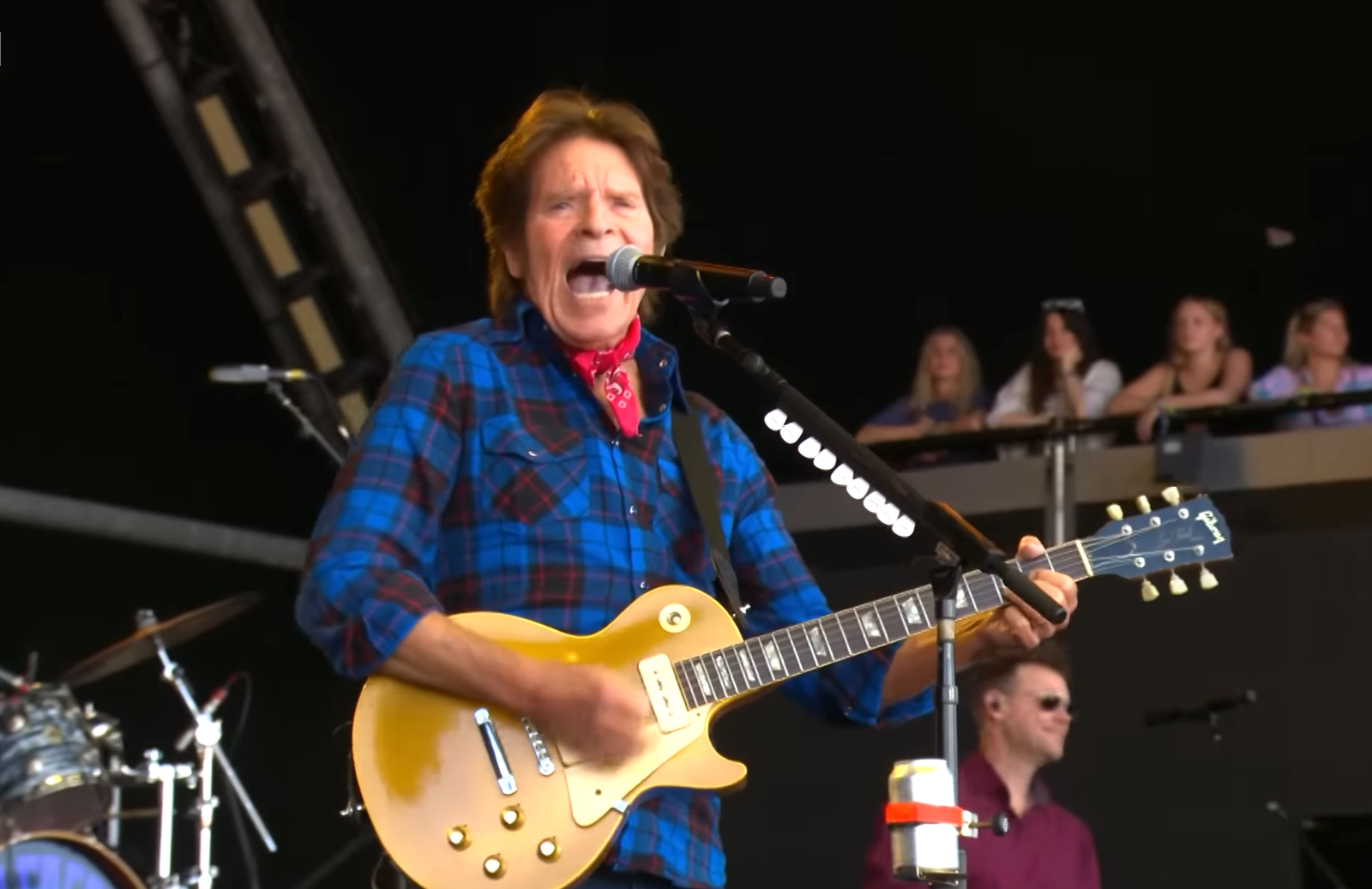
The crowd at BeachLife 2023 erupted as rock legend John Fogerty took the stage, but no one expected the emotional surprise he had in store. As the sun dipped over the ocean, Fogerty strapped on a very special guitar—his long-lost 1969 Rickenbacker 325, missing for 44 years! Lost in the early 1970s during his Creedence Clearwater Revival days, the guitar was finally returned to him in 2022 by a devoted fan who had tracked it down.
When Fogerty strummed the first chords of “Who’ll Stop the Rain,” the crowd cheered—not just for the song, but for the miracle of hearing it played on that same guitar from decades ago. His voice, still strong and full of soul, blended perfectly with the Rickenbacker’s warm, jangly sound. Dressed in his classic plaid shirt, Fogerty closed his eyes and smiled as he played, feeling the history in his hands. Fans sang along, some with tears in their eyes, as the music floated over the beach like a perfect memory come to life.
It was more than just a concert moment—it was a reunion, a celebration of music, and proof that some things, no matter how lost, can still find their way back.
Released in 1970 on Creedence Clearwater Revival’s iconic Cosmo’s Factory album, “Who’ll Stop the Rain” emerged as a hauntingly prescient anthem, blending John Fogerty’s raw, emotive vocals with a deceptively simple acoustic riff and that unmistakable Rickenbacker chime. The song’s wistful lyrics—inspired by Fogerty’s disillusionment after performing at Woodstock—took on new life decades later when he re-recorded it for Fogerty’s Factory (2020), his pandemic-era reimagining of CCR classics with family members joining in harmony.
The track’s legacy reached a crescendo at BeachLife 2023 when Fogerty performed it on his long-lost 1969 Rickenbacker 325 (missing for 44 years before its miraculous return), the very guitar used on the original recording. Every detail—from the song’s rain-soaked metaphors to the way Fogerty’s weathered voice now carries deeper gravitas—connects across eras, proving the track’s enduring power as both a folk-rock masterpiece and a mirror to turbulent times.
Even the production nuances tell a story: the original’s analog warmth (recorded in CCR’s Berkeley warehouse-turned-studio) contrasts with Fogerty’s Factory’s crisp home-studio intimacy, while that shimmering live performance reunited artist, instrument, and audience in one full-circle moment of musical redemption.