John Fogerty’s Performs ‘Who’ll Stop the Rain’ on His Long-Lost Rickenbacker After 44 Years!”

john

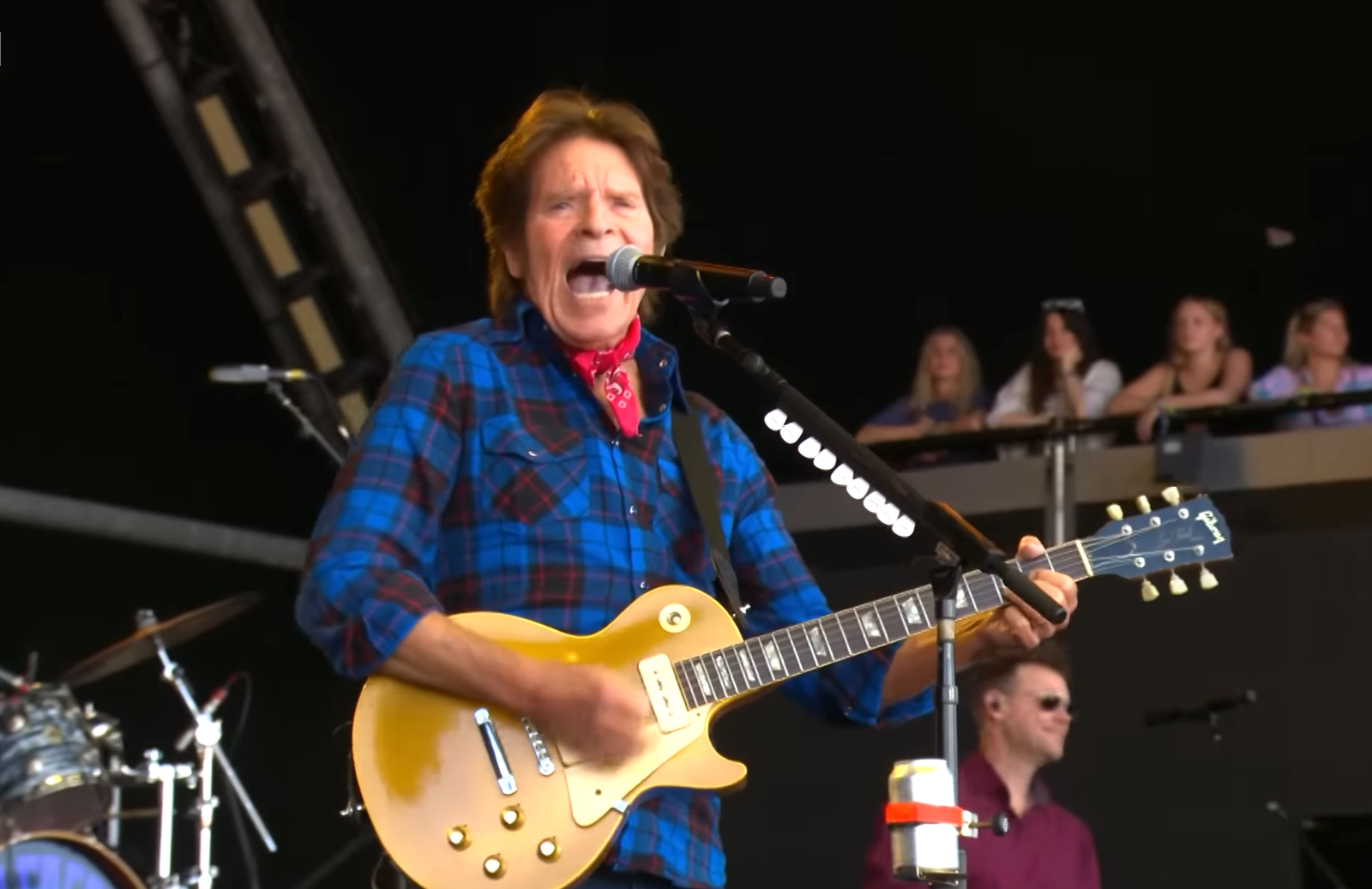
The crowd at BeachLife 2023 erupted as rock legend John Fogerty took the stage, but no one expected the emotional surprise he had in store. As the sun dipped over the ocean, Fogerty strapped on a very special guitar—his long-lost 1969 Rickenbacker 325, missing for 44 years! Lost in the early 1970s during his Creedence Clearwater Revival days, the guitar was finally returned to him in 2022 by a devoted fan who had tracked it down.

When Fogerty strummed the first chords of “Who’ll Stop the Rain,” the crowd cheered—not just for the song, but for the miracle of hearing it played on that same guitar from decades ago. His voice, still strong and full of soul, blended perfectly with the Rickenbacker’s warm, jangly sound. Dressed in his classic plaid shirt, Fogerty closed his eyes and smiled as he played, feeling the history in his hands. Fans sang along, some with tears in their eyes, as the music floated over the beach like a perfect memory come to life.

It was more than just a concert moment—it was a reunion, a celebration of music, and proof that some things, no matter how lost, can still find their way back.


Released in 1970 on Creedence Clearwater Revival’s iconic Cosmo’s Factory album, “Who’ll Stop the Rain” emerged as a hauntingly prescient anthem, blending John Fogerty’s raw, emotive vocals with a deceptively simple acoustic riff and that unmistakable Rickenbacker chime. The song’s wistful lyrics—inspired by Fogerty’s disillusionment after performing at Woodstock—took on new life decades later when he re-recorded it for Fogerty’s Factory (2020), his pandemic-era reimagining of CCR classics with family members joining in harmony.

The track’s legacy reached a crescendo at BeachLife 2023 when Fogerty performed it on his long-lost 1969 Rickenbacker 325 (missing for 44 years before its miraculous return), the very guitar used on the original recording. Every detail—from the song’s rain-soaked metaphors to the way Fogerty’s weathered voice now carries deeper gravitas—connects across eras, proving the track’s enduring power as both a folk-rock masterpiece and a mirror to turbulent times.

Even the production nuances tell a story: the original’s analog warmth (recorded in CCR’s Berkeley warehouse-turned-studio) contrasts with Fogerty’s Factory’s crisp home-studio intimacy, while that shimmering live performance reunited artist, instrument, and audience in one full-circle moment of musical redemption.

0 Shares:
Leave a Reply

Your email address will not be published. Required fields are marked *

You May Also Like
paul
Read More

Paul McCartney finally admits what the world never saw after The Beatles ended. In the trailer for the upcoming Prime Video documentary Man on the Run, Sir Paul hints at a quiet collapse that followed the breakup — a moment when the cheers faded, the band was gone, and something inside him slipped. “I fell very depressed,” he says softly. “But I was very lucky, because I had Linda.” What happened during those days away from the spotlight? And why is Paul only speaking about it now? The answers aren’t loud — but they’re deeply human.

PAUL McCARTNEY ADMITS: “I WAS DEEPLY DEPRESSED AFTER THE BEATLES BROKE UP” In the newly released trailer for…
Freddie
Read More

“I’M TIRED. I’LL FINISH IT TOMORROW.” BUT TOMORROW NEVER CAME. Switzerland, 1991. Freddie Mercury was so frail he could barely stand. He was recording his final song, “Mother Love.” His voice still held the power of a god, but his body was completely shattered. Before the final verse, Freddie turned to Brian May and said: “I need a little rest. I’ll come back and finish it later.” Freddie walked out of the vocal booth and never returned. He passed away just days later. The final verse had to be sung by Brian May. It wasn’t a performance; it was a heartbreaking farewell from the survivor to the legend who was gone.

In the history of rock and roll, there are stories of excess, stories of triumph, and stories of…
Reba McEntire And Dolly Parton
Read More

“SHE SAID IT WOULD HURT TO SING THIS — AND IT DID.” Reba McEntire stepped onto the Grammy stage and admitted softly that this would be a hard song to sing. You could see it in the way she held the mic. The lights felt dimmer. The air heavier. She wasn’t alone. Brandy Clark stood beside her, the one who reshaped the lyrics. Lukas Nelson waited in quiet respect. Behind them, faces and names appeared, one after another. Reba didn’t push her voice. She let it breathe. Honest. Bare. When the final note faded, no one rushed to clap. The silence said more than applause ever could. It felt less like a tribute… and more like standing inside a shared memory that still hasn’t finished speaking.

Reba McEntire Delivers Emotional In Memoriam Performance at the 2026 Grammy Awards The Grammy Awards are a celebration…
paul
Read More

How CMcCartney’s Last-Minute Question at Wembley — “If We Don’t Sing It Together Now, When Do We?” — Scrapped the Planned Finale, Pushed Freddie Mercury, Bono and Bob Geldof Toward a Song No One Expected, No One Rehearsed and Some Thought Was the Wrong Choice, Overrode the Live Aid Running Order in 1985, and Turned a Risky, Unscripted Decision Into One of the Most Talked-About Moments in Music History

That final moment at Live Aid was never meant to happen. According to those backstage at Wembley on…