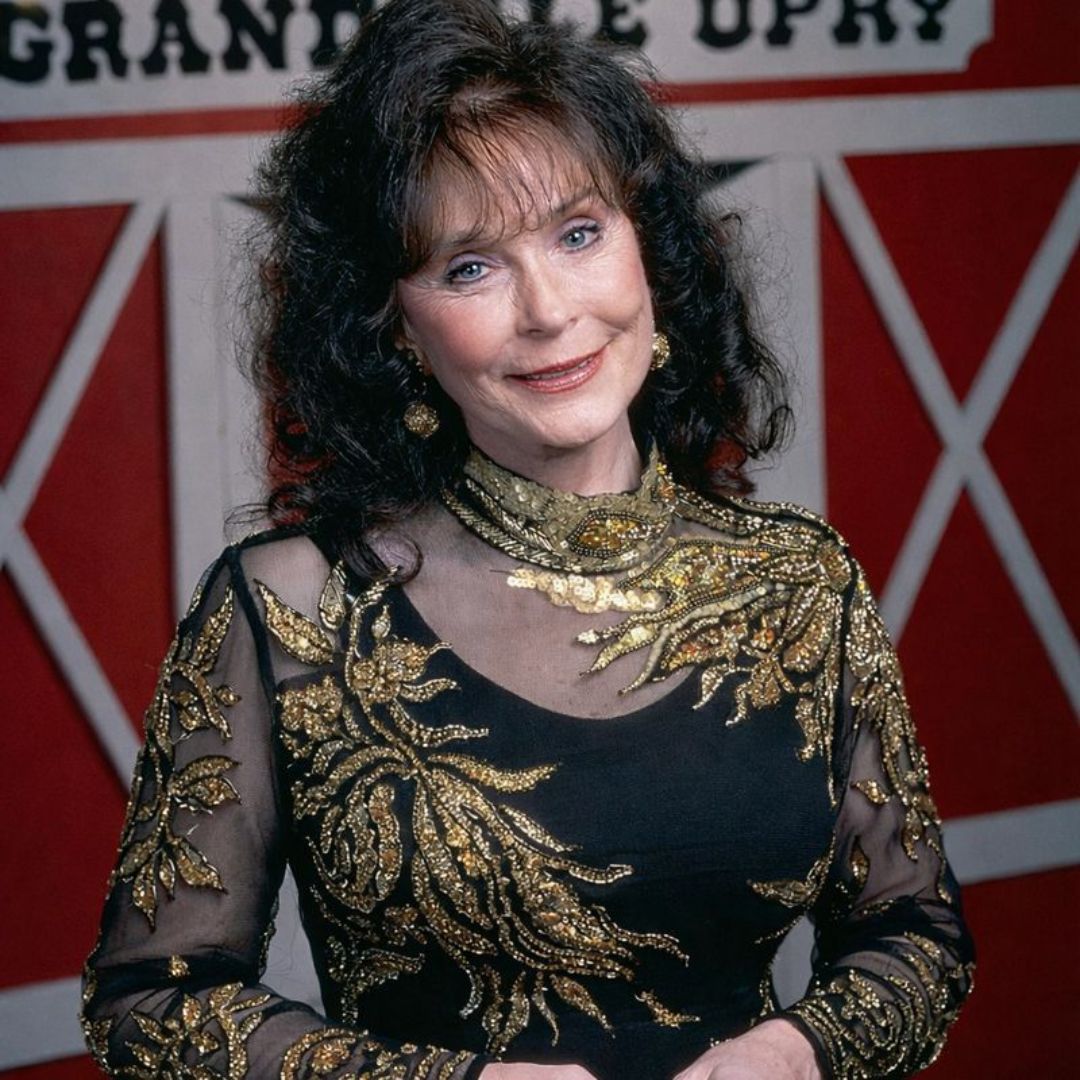
“A FEMINIST ICON WITHOUT A SLOGAN” — Loretta Lynn
She Never Asked to Lead a Movement
Loretta Lynn never walked onstage waving a banner or naming a cause.
She didn’t preach. She didn’t explain herself. And that, more than anything, is what made her dangerous.
In an era when female country singers were expected to sound sweet, grateful, and carefully restrained, Loretta arrived with something far less comfortable: lived truth. She didn’t position herself as a symbol. She simply sang what she knew. And what she knew wasn’t polite.
She sang from kitchens, hospital rooms, cramped bedrooms, and long silences. From places where women worked, endured, loved, and quietly questioned their own limits.
The Things Women Were Told Not to Say
Loretta’s songs carried stories that women recognized instantly—but rarely heard acknowledged. She sang about exhaustion after childbirth, not as a miracle wrapped in sentiment, but as a reality that left women drained and unseen. She sang about anger inside marriage, about power imbalances, jealousy, resentment, and the ache of being expected to endure without complaint.
Most unsettling of all, she sang about choice.
The choice to want more.
The choice to say no.
The choice to speak plainly without apologizing for it.
These weren’t abstract ideas. They were delivered in simple language, sharp humor, and unpolished honesty. Loretta didn’t soften her edges for comfort. She trusted listeners to meet her where she stood.
A Genre That Wasn’t Ready
Country music, at the time, was deeply conservative—both musically and culturally. Women were often written as supportive figures, heartbreakers, or moral anchors, rarely as full narrators of their own dissatisfaction.
Loretta disrupted that balance simply by stepping forward and saying, in effect: this is my life, and I will tell it myself.
The result wasn’t instant celebration. Some radio stations hesitated. A few quietly pulled songs. Executives worried. Critics debated whether she had gone “too far.”
But audiences—especially women—leaned in.
They heard themselves in her lyrics. Not idealized versions. Not cautionary tales. Real women, living real consequences, with real thoughts they had been trained to silence.
The Power of Not Explaining Yourself
What made Loretta’s impact so lasting was what she refused to do.
She never framed her music as instruction.
She never told women how to be strong.
She never labeled her work as political or revolutionary.
By refusing to explain herself, she left no room for dismissal.
She didn’t argue for women’s honesty—she practiced it. And that honesty stood on its own. It couldn’t be debated away as theory or ideology. It existed because it was lived.
In many ways, that silence around intention made her songs louder. Listeners weren’t told what to think. They were invited to feel, remember, and recognize.
So What Did She Dare to Say?
The question isn’t whether Loretta Lynn was a feminist icon by definition. The question is simpler—and more revealing:
What did she say long before others were willing to say it out loud?
She said that motherhood could be overwhelming and unromantic.
She said that marriage could contain love and resentment.
She said that women were allowed to want autonomy without being villains.
She said that speaking honestly was not a betrayal of family, faith, or tradition.
Most importantly, she said that a woman’s inner life mattered—even when it made others uncomfortable.
A Legacy Built Without Slogans
Loretta Lynn didn’t change music by demanding attention. She changed it by refusing to disappear inside it.
Her voice carried something quietly radical: permission. Permission to tell the truth as you lived it. Permission to acknowledge anger, fatigue, desire, and contradiction. Permission to exist fully without asking for approval.
No slogans.
No speeches.
Just songs that opened doors many didn’t even know were locked—until she sang them open.
Video