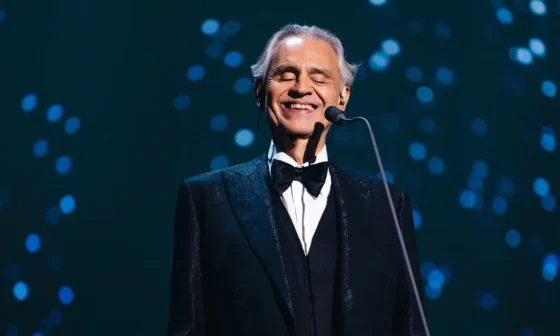
A Serenade Written in Stone: When Ignazio Boschetto Turned the Arena di Verona into a Private Sanctuary
The Arena di Verona, a monumental relic of the Roman Empire, has witnessed gladiator battles and operatic masterpieces for centuries, but rarely has it felt as small and intimate as it did when a single voice called out a name.
Under the vast, star-dusted Italian sky, the ancient amphitheater seemed to shrink, shedding its skin as a public landmark to become a living room for two.
As Ignazio Boschetto, the powerhouse tenor of Il Volo, stood amidst the historic stones, the air was thick with the weight of expectation.
Yet, the grandeur of the setting was quickly eclipsed by a whisper.
When he uttered the words, “This song is for you, Michelle,” the thousands in attendance were no longer just a crowd; they became silent witnesses to a sacred exchange of devotion.
Ignazio Boschetto is a man accustomed to the roar of global crowds, yet in this moment, his stature as an international tenor was entirely eclipsed by his role as a husband.
Having spent years touring the world and performing on the most prestigious stages, Boschetto has mastered the art of the “show.”
However, as he began the first notes of a melody dedicated solely to his wife, Michelle Bertolini, the “performer” vanished.
What remained was a man standing bare before his partner, using the only medium powerful enough to carry his feelings: his voice.
This wasn’t a display of vocal gymnastics or technical prowess; it was a soul being bared through music, proving that even for those who live in the spotlight, the most important audience consists of only one person.
The ancient stones of Verona provided a stark, beautiful contrast to the fragility of the human heart on display during this impromptu tribute.
There is something profoundly poetic about celebrating a modern love within the walls of a structure that has survived for nearly two millennia.
The Arena di Verona usually demands a certain level of theatricality and volume to fill its massive void, but Ignazio chose to fill it with tenderness instead.
The juxtaposition of the cold, unyielding Roman architecture against the warmth of a husband’s gaze created a tableau that felt both timeless and immediate.
It served as a reminder that while empires fall and stones crumble, the human impulse to sing for the one we love remains unchanged across the ages.
When the name “Michelle” left his lips, the atmosphere of the concert shifted from a high-production performance to a vulnerable, whispered confession.
The transition was palpable; the rhythmic clapping and cheering of the audience died down into a reverent hush.
It was as if the crowd collectively held its breath, realizing they were trespassing on a private moment.
This wasn’t part of a scripted encore or a calculated PR move; it was an organic eruption of emotion.
As the melody unfolded, it became clear that the song was not being sung at the audience, but to a woman sitting in the front row, making everyone else in the arena feel like a lucky eavesdropper on a private conversation.
Michelle Bertolini’s presence on stage transformed the musical piece from a mere tribute into a living, breathing dialogue of shared affection.
As the song reached its emotional crescendo, Ignazio reached out for her, and she stepped into the light.
Michelle, a woman used to the public eye as a model and entrepreneur, was visibly stripped of all professional composure, her face reflecting a mixture of awe and overwhelming love.
When she stood beside him, the performance ceased to exist entirely.
There was no choreography, no staged blocking—just a woman moved to tears and a man holding her hand as if it were his only anchor in a shifting world.
Their connection was so magnetic that it pulled the focus away from the stage lights and centered it entirely on the simplicity of their bond.
 In an era where celebrity life is often curated for the lens and polished for social media, the raw emotion shared between the couple felt refreshingly unscripted.
We live in a world of “content,” where every romantic gesture is often filmed with the intent of going viral.
While cameras were certainly rolling in Verona, the energy between Ignazio and Michelle felt shielded from the artificiality of the industry.
The way she looked at him wasn’t for the benefit of the back row; it was the look of a wife seeing the depths of her husband’s heart.
This authenticity resonated deeply with the audience, offering a rare glimpse into a celebrity marriage that prioritizes the “us” over the “them.”
The silence of the audience was perhaps the most profound tribute to the authenticity of the moment, proving that true love requires no translation.
Usually, at a concert of this magnitude, there is a constant hum of movement and digital noise.
Yet, as the couple stood hand-in-hand, the silence was absolute.
It was a silence born of respect—a collective recognition that they were seeing something “real.”
In that stillness, the music seemed to vibrate more clearly against the historic walls.
The crowd understood that they weren’t just watching a singer; they were watching a man honor his vow in the most public, yet most private, way possible.
 Music has always been the language of the soul, but on this night in Verona, it served as the very heartbeat of a marriage.
As the final notes of the dedication drifted into the night air, the message was clear: no matter how large the stage or how bright the lights, the core of Ignazio Boschetto’s world is anchored in his life with Michelle.
The song ended, but the resonance of the moment lingered long after the couple left the stage.
It was a night where history met the present, and where a man’s voice proved that the most powerful thing one can do with a gift is to give it away to the person who matters most.
As the final echoes faded into the cool Italian night, what remained was not just the memory of a beautiful song, but the enduring reminder that love remains the greatest spectacle of all.
People will remember the music and the setting, but most of all, they will remember the way two people looked at each other when they thought no one else was watching.
In the heart of an ancient arena built for spectacle, Ignazio and Michelle showed the world that the most spectacular thing of all is simply being known, being seen, and being loved.