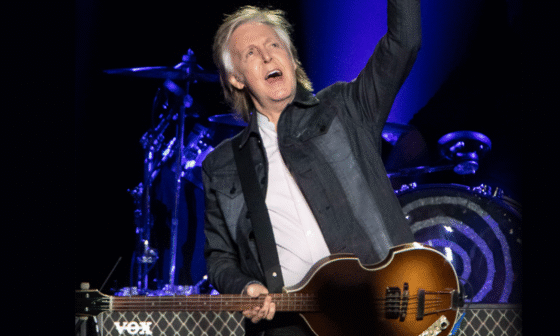
There are moments in music when history doesn’t just echo—it evolves. The recent collaboration between Paul McCartney and his son James McCartney feels like one of those rare instances, where legacy and individuality meet in perfect balance.
For decades, Paul McCartney has stood as one of the defining voices of modern music, his work shaping generations of listeners and musicians alike. From his groundbreaking years with The Beatles to his expansive solo career, his melodic sensibility has always been unmistakable. Yet this new chapter is different. It isn’t about revisiting past glories—it’s about connection, family, and creative continuity.

James McCartney, while inevitably linked to his father’s immense legacy, has spent years carving out his own musical identity. His style leans toward the reflective and atmospheric, often exploring introspection with a quieter intensity. Where Paul’s music often radiates outward with bright hooks and universal appeal, James tends to draw listeners inward, inviting them into a more personal space.
Their collaboration brings these two approaches together in a way that feels natural rather than forced. The track unfolds gently, allowing each voice to breathe. Paul’s familiar warmth provides a sense of grounding, while James introduces a subtle emotional depth that gives the song its modern edge. It’s not a clash of generations—it’s a conversation.
What makes this moment especially compelling is its authenticity. There’s no sense of spectacle or grand reinvention here. Instead, the performance feels intimate, almost as if listeners are being invited into a private exchange. The harmonies don’t just blend—they reveal a shared musical language that has clearly been passed down, reshaped, and rediscovered.
For longtime fans of Paul McCartney, the collaboration offers something both comforting and new. His voice, still rich with character, carries the weight of decades of songwriting history. Yet alongside James, it takes on a slightly different role—less of a spotlight, more of a partnership. It’s a reminder that even icons continue to grow, especially when creating alongside those closest to them.

For James, the moment feels equally significant. Collaborating with a parent of such stature could easily overshadow an artist’s individuality, but here it does the opposite. His presence is distinct and assured, suggesting an artist who understands both where he comes from and where he wants to go.
In a broader sense, the song speaks to the idea of musical inheritance—not as something fixed, but as something living. Melodies, instincts, and sensibilities are passed from one generation to the next, but they don’t remain unchanged. They evolve, shaped by new experiences and perspectives.
This collaboration captures that evolution beautifully. It doesn’t try to recreate the past, nor does it reject it. Instead, it acknowledges it, builds upon it, and moves forward.
For listeners, the result is more than just a new release. It’s a reminder of music’s unique ability to connect people—not only across audiences, but across time and family. In this case, the bond between father and son becomes something we can all hear and feel, carried through every note.
And in that sense, the McCartney legacy isn’t just continuing—it’s being rewritten, one shared song at a time.