A Soundtrack of a Nation: Inside the Star-Studded Opening of the Bruce Springsteen Center

bruce springsteen

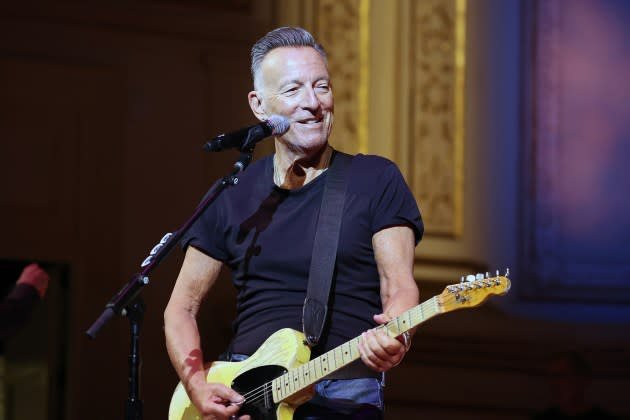
There are concerts, and then there are moments that feel larger than music itself—occasions where songs become a lens through which history, culture, and identity come into focus. That is the ambition behind “Music America: The Songs That Shaped Us,” a two-night event set to افتتاح the Bruce Springsteen Center for American Music in New Jersey this June.

Taking place on June 4 and 5, the celebration gathers an extraordinary lineup of artists whose careers span genres, generations, and cultural movements. At the center of it all is Bruce Springsteen, an artist whose own catalog has long reflected the stories and struggles of everyday America. But this event is not about a single voice—it’s about the chorus.

Joining him are iconic figures like Jon Bon Jovi and Jackson Browne, whose songwriting helped define eras of rock music, alongside groundbreaking acts such as Public Enemy, whose work brought political urgency into hip-hop’s mainstream consciousness. The lineup continues to stretch across styles with the soulful resonance of Mavis Staples, the electrifying blues of Gary Clark Jr., and the country storytelling of Kenny Chesney and Rosanne Cash.

Adding further texture is Trombone Shorty, whose New Orleans roots bring a vibrant sense of tradition and innovation, while Steven Van Zandt and his Disciples of Soul anchor the performances as the house band, ensuring a cohesive musical thread throughout the evenings.

What sets this event apart is its structure. Rather than simply showcasing individual hits, each artist will interpret songs that have helped define American music across decades. These performances will be paired with narration, offering audiences context—stories about where the songs came from, what they meant at the time, and why they still resonate today. It’s a format that transforms a concert into something closer to a living documentary.

The timing is significant. Scheduled just days before the Center’s official opening on June 7, the concerts act as both a preview and a statement of purpose. The Bruce Springsteen Center for American Music is envisioned as more than a museum; it aims to be a space where music is explored as a cultural force—one that reflects social change, tells untold stories, and connects communities.

In that sense, “Music America” feels like the perfect introduction. It doesn’t just look back at the past; it bridges it with the present, showing how different genres and voices are part of a shared narrative. From rock and soul to hip-hop and country, the event underscores a simple but powerful idea: American music is not one story, but many, woven together over time.

For those attending, the experience promises more than standout performances. It offers a chance to hear familiar songs in a new light—to understand not just how they sound, but why they matter. And in doing so, it captures something essential about music itself: its ability to bring people together, to spark reflection, and to endure long after the final note fades.

As the lights go down and the first chords ring out, this won’t just be the start of a concert. It will mark the beginning of a new space dedicated to preserving and celebrating the soundtrack of a nation.

0 Shares:
Leave a Reply

Your email address will not be published. Required fields are marked *

You May Also Like
Paul McCartney
Read More

“THE BRITISH INVASION DIDN’T JUST CHANGE MUSIC — IT NEARLY ERASED NEIL SEDAKA.” Before The Beatles stormed American radio in 1964, Neil Sedaka was already a hit machine. Songs like “Calendar Girl,” “Happy Birthday Sweet Sixteen,” and “Breaking Up Is Hard to Do” had made him one of pop’s most dependable stars. Then the British Invasion arrived. Almost overnight, the charts changed. Sedaka’s sound faded from radio, and for years it seemed as if one of America’s most successful songwriters had vanished from the spotlight. But he never stopped writing. Sedaka moved to London, started again in smaller venues, and kept composing while the music world raced in new directions. By the mid-1970s, the comeback was undeniable — helped in part by artists like Elton John, who helped bring his songs back to a new generation. In the end, Sedaka and Paul McCartney came to represent the same timeless craft: melody, piano, and the quiet discipline of songwriting. Sometimes the music sounds like it belongs to one era or another. But the best melodies are different. The melody sounded like it belonged to neither of them — and both of them at once.

“Scroll down to the end of the article to listen to music.” When the Sound of Pop Suddenly…
Tyler Joseph
Read More

The room already knew the riff before a single note was played — and that was exactly the point. When Twenty One Pilots walked onto the Rock & Roll Hall of Fame stage to honor The White Stripes with “Seven Nation Army,” there was a collective sense of anticipation, the kind that says don’t mess this up. What followed wasn’t imitation. It was transformation. Tyler Joseph took a breath, leaned toward the mic, and quietly set the tone. “This song belongs to everyone now,” he said, almost under his breath — a line that felt less like a declaration and more like permission. Then the opening pulse began, not blasted, but teased — a low, coiled tension that made the room lean in.

Inside the Performance That Had Fans Calling It One of the Most Thrilling Moments of Rock & Roll…
Reba
Read More

LAST NIGHT AT THE GRAND OLE OPRY… something far bigger than a concert unfolded. Carrie Underwood didn’t just sing — she seemed to summon spirits. From the tender ache that echoed Patsy Cline, to the blazing strength reminiscent of Reba, and finally a soul-rattling rendition of Martina McBride’s “A Broken Wing,” Carrie wasn’t performing — she was channeling something sacred.

THE NIGHT THE OPRY BECAME HOLY GROUND — Carrie Underwood’s Performance That Left Legends Weeping and a Room…
andrea bocelli
Read More

ANDREA BOCELLI DELIVERS A STUNNING ‘NESSUN DORMA’ AT THE OLYMPIC WINTER GAMES MILANO CORTINA 2026 — A MOMENT THAT LEFT THE STADIUM HOLDING ITS BREATH. As the opening ceremony of the Olympic Winter Games Milano Cortina 2026 unfolded in spectacular fashion, it was the voice of Andrea Bocelli that brought the night to an emotional standstill. Stepping onto the world stage under a hush that felt almost reverent, Bocelli launched into his iconic rendition of “Nessun Dorma,” delivering each note with a quiet intensity that echoed far beyond the arena. The performance built slowly, deliberately, until the final soaring lines landed with breathtaking force — transforming a ceremonial moment into something timeless and deeply human. Viewers around the globe described goosebumps, tears, and stunned silence, as the aria’s themes of hope and triumph seemed to perfectly capture the spirit of the Games themselves. Long after the last note faded, applause thundered through the venue, with many already calling it one of the defining moments of the ceremony — and asking whether any opening could ever top what they had just witnessed…

Andrea Bocelli Delivers Powerful Performance of His Iconic ‘Nessun Dorma’ at the Opening Ceremony of the Olympic Winter…