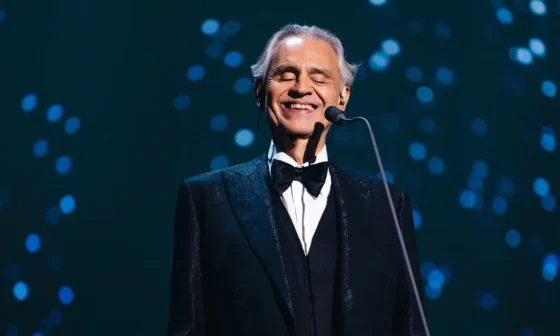
There are songs that never lose their place in the hearts of listeners, no matter how many times they are performed. Can’t Help Falling in Love is one of them—a melody that has traveled across generations, carried by voices that each bring something new to its timeless message. In his rendition, Gianluca Ginoble approaches the song with a sense of restraint and sincerity that sets it apart.
From the opening note, there is a noticeable calm in his delivery. Rather than leaning into grand gestures, Ginoble allows the simplicity of the melody to guide the performance. His voice, warm and controlled, moves effortlessly through each phrase, giving the lyrics space to resonate. It’s a style that doesn’t demand attention—it earns it.

What makes this interpretation particularly compelling is its emotional balance. The song itself is built on a quiet vulnerability, and Ginoble embraces that quality without overstatement. Each line feels measured, as though carefully placed to preserve the song’s original intimacy while adding a personal touch.
Listeners often describe the performance as immersive. There’s a sense that time slows down, even if only for a few minutes. The outside world fades, replaced by a focus on the interplay between voice and melody. It’s not about complexity or reinvention—it’s about connection.

Part of this effect comes from Ginoble’s ability to maintain clarity throughout the performance. Every note is deliberate, every transition smooth. There are no abrupt shifts or distractions, just a steady unfolding of the song’s emotional arc. This consistency allows listeners to settle into the music, experiencing it as a continuous, flowing moment.

The legacy of “Can’t Help Falling in Love” carries a certain expectation. With its history tied to legendary interpretations, any new version faces the challenge of honoring the original while offering something distinct. Ginoble meets that challenge by focusing on nuance rather than scale. He doesn’t try to outshine the past—he adds to it.
Fans have responded strongly to this approach. Many note that the performance feels less like a staged event and more like a personal expression, as if the song is being shared rather than performed. That distinction, subtle as it may seem, makes a lasting difference.

In an era where music often competes for attention through spectacle, this rendition stands as a reminder of the power of simplicity. A single voice, a familiar melody, and a genuine emotional core can be enough to create something memorable.
And that’s ultimately what defines this performance. It doesn’t rely on dramatic flourishes or reinterpretation for impact. Instead, it invites listeners into a quiet, reflective space—one where love, in all its softness and strength, is allowed to speak for itself.