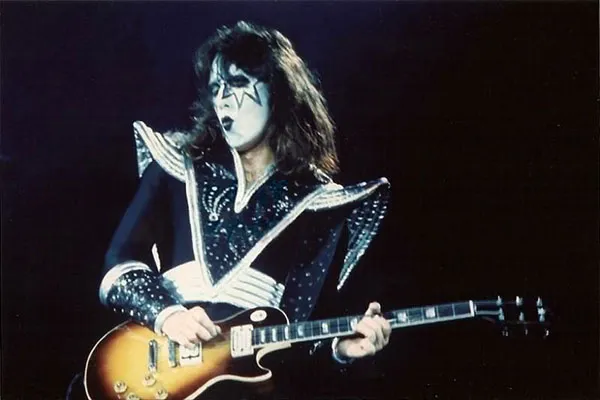
Fifty years ago, a 24-year-old Ace Frehley stepped onto the Winterland Ballroom stage in San Francisco and unleashed a performance that would become one of the most electrifying chapters in KISS history. It was 1975, the year KISS was transforming from a gritty club act into rock mythology. And Ace, the enigmatic “Spaceman,” was at the heart of it—his Les Paul guitar roaring through the venue like a live wire.
Now, thanks to a stunning HD color restoration, that moment doesn’t just live again—it pulses with new life. For longtime fans, this isn’t just archival footage. It’s a resurrection. A sonic time capsule that captures the danger, thrill, and freedom of a young guitarist who played like his soul was on fire.
“Parasite,” the track Ace wrote for KISS’s 1974 album Hotter Than Hell, was a beast live. Its grinding riff and relentless pace made it one of the band’s heaviest songs, and at Winterland, it became a showcase for Ace’s raw power. Though Gene Simmons handled vocals, the song was unmistakably Ace’s creation. And on that night, his guitar didn’t just play—it screamed, howled, and bled emotion.
The newly restored footage reveals every detail: Ace’s sly grin, the sweat glistening on his brow, the way he hunched over his guitar like it was an extension of his body. His playing was unpolished, unpredictable, and utterly magnetic. Every note felt like it could explode. And that unpredictability—that edge—is what made it unforgettable.
Watching it now, the performance hits harder. With Ace Frehley no longer with us, this isn’t just a concert—it’s a farewell. A final blaze of glory from a guitarist who helped shape the sound and spirit of one of rock’s most theatrical bands. His passing casts a bittersweet shadow over the footage, turning every riff into a tribute, every solo into a goodbye.
The Winterland show was part of KISS’s early ascent, a time when the band was still experimenting with their identity. The makeup, the pyrotechnics, the larger-than-life personas—they were all taking shape. But even amid the spectacle, Ace stood out. He was the quiet storm, the mysterious force whose guitar spoke louder than any firework.
The HD restoration adds a layer of intimacy to the chaos. Originally filmed in black and white, the footage has been meticulously colorized and remastered, revealing textures and tones that were previously lost. The lighting, the crowd, the stage—all come into sharper focus, making the performance feel immediate and visceral. It’s not just nostalgia—it’s immersion.
For fans who grew up with KISS, this footage is sacred. It’s the kind of performance that made you believe in rock ’n’ roll’s power to shake the soul. And for newer audiences, it’s a revelation—a glimpse into a time when music was raw, dangerous, and alive.
Ace’s legacy lives in every frame. His influence on guitarists, his contribution to KISS’s sound, and his fearless approach to performance are all on display. He didn’t play to impress—he played to ignite. And that fire still burns.
“Parasite” itself has become a cult favorite, often cited as one of KISS’s most underrated tracks. Its aggressive tone and stripped-down structure make it a perfect vehicle for Ace’s style. And at Winterland, it reached its full potential—a sonic assault that left the crowd stunned.
The remastered video has sparked renewed appreciation for Ace’s artistry. Shared widely across platforms like YouTube, TikTok, and Vimeo, it’s drawing millions of views and heartfelt tributes. Fans are rediscovering the magic of that night, and younger listeners are learning why Ace Frehley was more than just a member of KISS—he was a force.
In the end, this performance isn’t just a piece of rock history. It’s a reminder of what live music can be when it’s fearless and unfiltered. It’s a tribute to a guitarist who didn’t just play—he roared. And it’s a farewell carved in sound, echoing through the strings of a Les Paul that once carried the voltage of Ace Frehley’s soul.