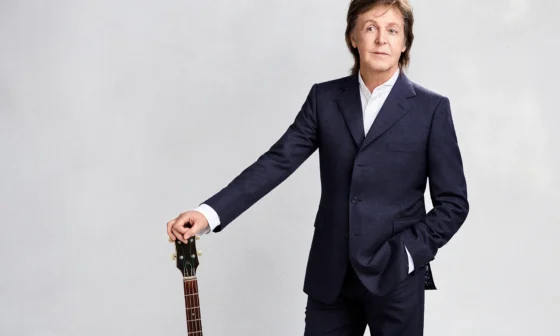
The morning after Magical Mystery Tour was torn apart by the British press, Paul McCartney didn’t hide. There was no spin, no distancing, no attempt to soften what had just happened. Instead, he returned to his St. John’s Wood home with his father Jim at his side and did something far rarer than damage control.
He faced it.
The BBC broadcast of Magical Mystery Tour on Boxing Day 1967 had been met with confusion, ridicule, and outright hostility. Critics searched desperately for meaning, for structure, for a plot that simply wasn’t there — and in failing to find one, declared the film a disaster. Headlines were merciless. The Beatles, it seemed, had finally misstepped.
Paul didn’t deny it.
“We boobed,” he admitted, a line Don Short would report the next morning in the Daily Mirror. But even in concession, McCartney’s response was characteristically sharp, self-aware, and quietly defiant. “But the Queen’s speech wasn’t a gas either.”
It wasn’t arrogance. It was perspective.
“Aren’t we entitled to have a flop?” he asked, voicing what few artists at the peak of their power ever dare to say out loud. Magical Mystery Tour wasn’t just their first critical failure — it was their first moment of public vulnerability. And Paul knew exactly why it hurt. “It’s hard because it’s our first, but we’ll get used to the idea.”
The real fracture, he explained, wasn’t between the Beatles and their audience — it was between intention and expectation.
“Everyone was looking for a plot,” Paul said. “But purposely, it wasn’t there.”
That single sentence reveals the core misunderstanding that doomed the film. Critics approached Magical Mystery Tour as cinema. The Beatles approached it as an experiment — closer to a moving collage than a story. A stream of images. A psychedelic sketchbook. A playful refusal to obey rules they’d already mastered.
“We did it as a series of disconnected, unconnected events,” Paul explained plainly. “They were not meant to have any depth.”
To a press culture trained to analyze and dissect, this was unforgivable. Depth was demanded. Meaning was expected. And when none was offered, frustration turned to mockery. But for the Beatles, “magical” didn’t mean symbolic or profound.
“It was our interpretation of ‘magical,’” Paul said. “And to us that meant we could do anything.”
That freedom — the very thing that fueled their greatest creative leaps — became the film’s greatest liability. The audience wasn’t ready to follow them there. Not yet.
In hindsight, Magical Mystery Tour wasn’t a failure of imagination. It was a failure of timing. Many of its ideas — non-linear storytelling, surreal visuals, anti-plot structure — would later become familiar territory in music videos and experimental film. But in 1967, presented without explanation on national television, it felt alien.
Paul understood this instinctively. And rather than retreat, he absorbed the lesson.
The Beatles didn’t apologize for the experiment. They didn’t explain it away. They accepted the flop, learned from it, and moved on — wiser, tougher, and less concerned with approval. Within months, they would channel that clarity into music that once again redefined popular culture.
Magical Mystery Tour may have stumbled on screen, but the moment Paul faced the backlash with honesty marked something important: the Beatles had crossed into a phase where failure was no longer fatal.
It was simply part of the journey.
And as McCartney implied that day in St. John’s Wood, the freedom to fail might be the most magical thing of all.