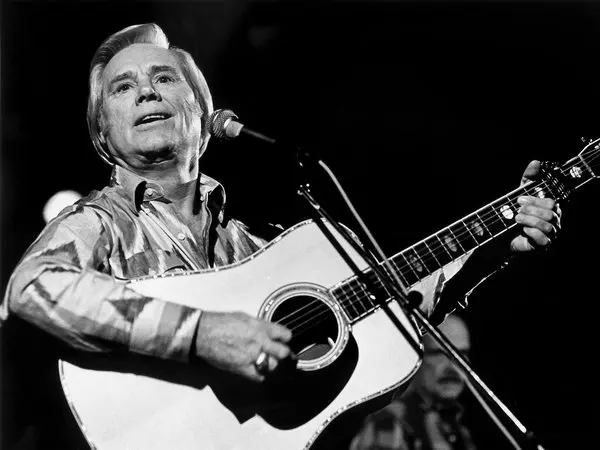
On April 6, 2013, in Knoxville, Tennessee, George Jones walked onto a stage that would quietly become part of music history.
He didn’t look like a legend that night.
He looked human.
Delicate. Weathered. Carrying the visible weight of a life lived hard and honest. But when the lights hit him, something else rose to the surface — not strength in the physical sense, but will. The kind that doesn’t come from the body. The kind that comes from a lifetime of keeping promises to a crowd, to a song, to a calling.
Accounts still differ about what happened behind the curtain.
Some say medics urged him not to perform.
Others say George had already made up his mind.
What’s certain is this: once he stepped into that light, there was no turning back.
His voice wavered at first. Not with fear — with age. With mileage. With the cost of decades spent telling the truth through music. Then, slowly, something familiar happened. The voice didn’t just stabilize.
It remembered itself.
Each line sounded like it was being pulled from deep inside a lifetime. Not polished. Not perfect. But real. The kind of singing that doesn’t try to impress — it tries to honor.
The audience didn’t know.
To them, it was another George Jones show. Another night with a legend.
But George knew.
He sang like a man keeping a private promise. Like someone who understood this might be the last time he would stand in that sacred space between stage and crowd. He didn’t rush. He didn’t save anything. He gave it the way only someone at the end of a road can — completely.
Not for headlines.
Not for history.
But for the people who had listened to him their entire lives.
What they witnessed wasn’t just a performance.
It was a man emptying the last of what he had into the songs that made him — and that he had made in return.
When the night ended, no one clapped for a farewell.
But history would.
George Jones didn’t just leave the stage that night.
He finished his promise.