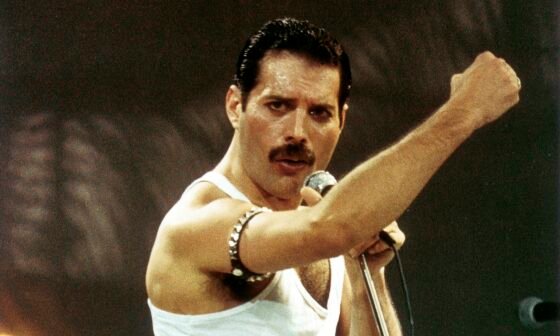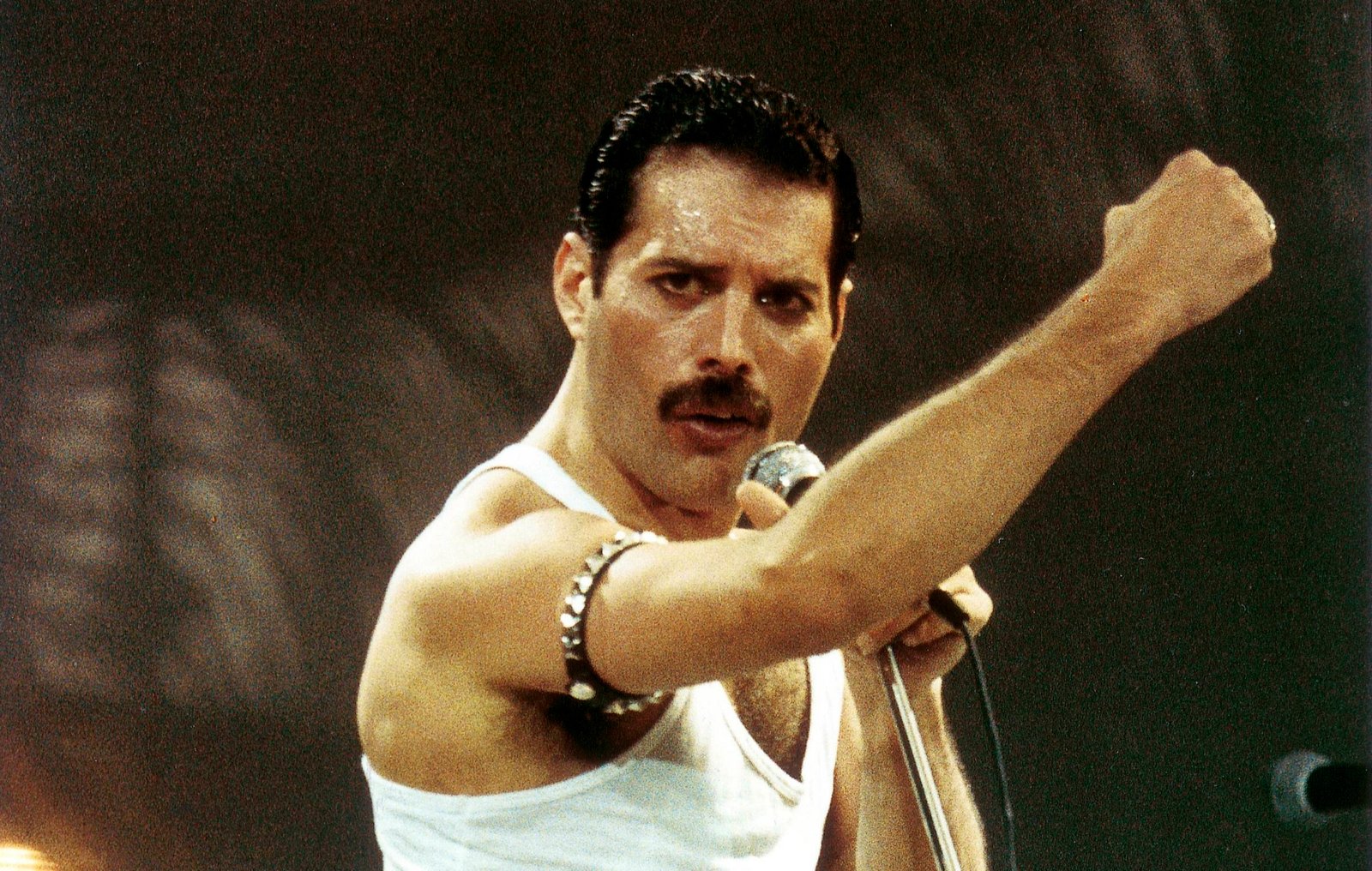

April 20, 1992. London was draped in a grey sky, but inside Wembley Stadium, the air was electric. Seventy-two thousand people had packed the stands, and over a billion more were watching from their living rooms across the globe.
They were there for the music, yes. They were there for The Freddie Mercury Tribute Concert. But beneath the roar of the crowd and the heavy bass lines, there was a collective wound that hadn’t healed. Freddie was gone. The showman who could hold the world in the palm of his hand had slipped away just months prior, leaving a silence that felt too loud to bear.
The lineup was legendary—Metallica, George Michael, Elton John. But everyone was waiting for one specific moment. The moment the “Starman” would take the stage.
The Weight of the Green Suit
When David Bowie stepped out, the atmosphere shifted. Dressed in a sharp, pale green suit, saxophone around his neck, he didn’t look like a rock star coming to party. He looked like a man on a mission. He looked like a man walking into a storm.
He was joined by Annie Lennox, looking fierce and ghostly with blackened eyes. Together, they launched into “Under Pressure”—the song Bowie and Mercury had crafted together in a wine-fueled haze years ago in Switzerland.
The performance was frantic. It was powerful. Annie screamed the high notes, channeling the spirit of Freddie, while Bowie held the low ground, his voice cool and steady. But those watching closely could see something behind Bowie’s mismatched eyes. It wasn’t just performance art. It was grief.
As the song reached its crescendo, the crowd was in a frenzy. This was what they wanted: the noise, the spectacle, the defiance of death through rock and roll.
But David Bowie had a different ending in mind.
The Silence That Shook the World
As the final notes of “Under Pressure” faded, the band prepared to transition. The crowd cheered, expecting another hit, another anthem.
Instead, Bowie walked to the center of the stage. He didn’t bow. He didn’t shout, “Hello Wembley!”
He looked out at the sea of faces, a vast ocean of humanity stretching to the horizon. Then, slowly, deliberately, he sank to his knees.
A hush rippled through the stadium. Was he hurt? Was this part of the act?
Bowie brought his hands together. He closed his eyes. And into the microphone, his voice trembling not with fear, but with an emotion too raw to name, he began to speak.
“Our Father, who art in heaven, hallowed be thy name…”
He was reciting the Lord’s Prayer.
In the history of Rock & Roll—a genre built on rebellion, noise, and excess—this was the most shocking thing anyone had ever done. He stripped away the lights, the ego, and the noise. For sixty seconds, the coolest man on the planet became a vulnerable child asking for comfort.
The Promise Behind the Prayer
Why did he do it? For decades, critics called it “strange” or “uncomfortable.” But those who knew the bond between the giants of that era understood the truth.
Legend has it that in the days leading up to the concert, Bowie was struggling. He felt that the noise of the tribute—the fireworks, the screaming fans—was drowning out the man they were supposed to be honoring. He realized that Freddie, for all his bombast and operatic flair, was human. A human who had suffered.
Bowie needed to break the “fourth wall.” He needed to remind 72,000 people that this wasn’t just a concert; it was a funeral.
There is a story, perhaps apocryphal, perhaps true, that Bowie felt a sudden, overwhelming urge in the dressing room. A realization that the only way to reach Freddie—wherever he was—was not through a speaker stack, but through silence.
When he knelt, he wasn’t performing for the cameras. He was saying goodbye to a friend.
More Than Just Rock & Roll
As Bowie stood up, wiped a tear from his cheek, and walked off stage, the stadium remained in a state of stunned reverence. He had turned a rock concert into a cathedral.
That moment taught the world a lesson that still resonates today: True strength isn’t about how loud you can scream; it’s about how brave you can be in your silence.
Freddie Mercury was the Master of the Stage. But on that grey afternoon in London, David Bowie became the Master of the Heart. He showed us that even heroes bleed, even legends pray, and sometimes, the most “Rock & Roll” thing you can do is drop your guard and let the world see you cry.