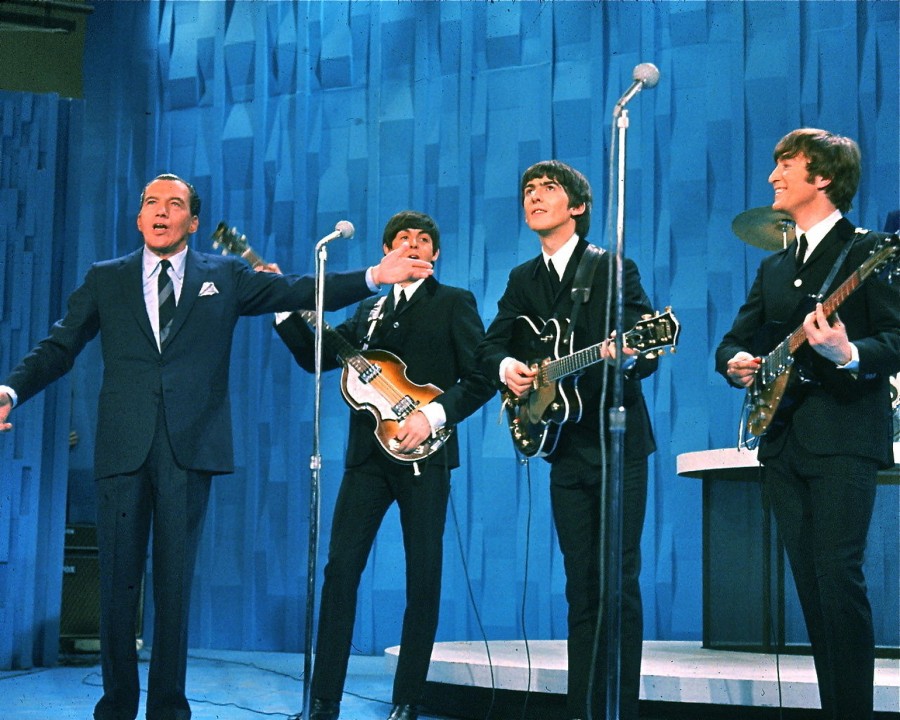
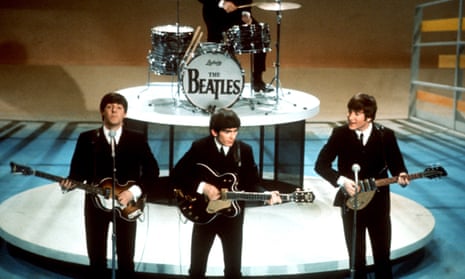
On a cold February evening in 1964, something extraordinary happened inside a television studio in New York. It lasted only a few minutes, but its impact would ripple across decades. When The Beatles stepped onto the stage of The Ed Sullivan Show, they didn’t just perform — they transformed the cultural landscape overnight.
An estimated 73 million Americans tuned in that night. Families gathered around their televisions, not fully aware they were about to witness history in real time. What followed was unlike anything the country had seen before.
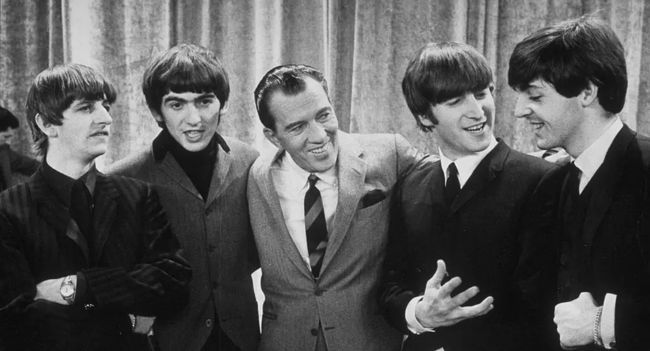
From the moment the band appeared, the atmosphere shifted. The audience erupted into screams so loud they nearly drowned out the music. Teenagers cried, laughed, and reached toward the stage as if trying to hold onto something they instinctively knew was important. It wasn’t just excitement — it was a release, a moment of collective emotion that captured the spirit of a generation.
At the center of it all were four young men whose presence felt entirely new. John Lennon, Paul McCartney, George Harrison, and Ringo Starr brought more than songs — they brought a shift in attitude. Their style, from the now-iconic haircuts to their tailored suits, challenged existing norms. Their sound — melodic, energetic, and deeply infectious — hinted at a new direction for popular music.
But what made that night so powerful wasn’t just the performance itself. It was what it represented.
America in the early 1960s was still rooted in tradition, particularly in its entertainment. The Beatles arrived as something different — fresh, slightly rebellious, and undeniably magnetic. They gave young people a new language of expression, one that felt modern and entirely their own.

In the days that followed, the impact was immediate. Record sales surged. Radio stations shifted their playlists. Fashion began to change. A wave of British artists soon followed, launching what would later be known as the British Invasion. The idea of what a “superstar” could be expanded almost overnight.
Looking back now, it’s easy to see that moment as inevitable — as if The Beatles were always destined to conquer the world. But at the time, nothing was certain. That single performance served as a tipping point, turning curiosity into obsession and popularity into phenomenon.
What’s remarkable is how alive it still feels today. Watch the footage, and the energy hasn’t faded. The camera shakes slightly, the screams remain piercing, and the band’s charisma cuts through the decades. It doesn’t feel distant or preserved — it feels immediate.
More than sixty years later, that night continues to raise an intriguing question: what would modern pop culture look like without it?
Many of today’s biggest artists — across genres and continents — build on a foundation that The Beatles helped establish. The blending of music and image, the connection between artist and audience, the idea of global fandom — all of it traces back, in some way, to moments like this.
The performance on The Ed Sullivan Show wasn’t just a milestone. It was a beginning.
A few songs. A few minutes. And a cultural shift that never truly ended.