There is a specific kind of tension that fills a room when Bruce Springsteen steps to a microphone without a guitar strapped to his back. Usually, at star-studded Los Angeles galas, the atmosphere is one of polished gratitude—celebrities thank their agents, executives toast their successes, and the applause is as rhythmic as a metronome. But earlier this month, the air in the room changed.

Springsteen was there to accept a Lifetime Impact Award, an honor meant to summarize decades of stadium-filling anthems and blue-collar poetry. The audience—a “who’s who” of billionaires, network heads, and silver-screen icons—expected a stroll down memory lane. Instead, they got a sermon.
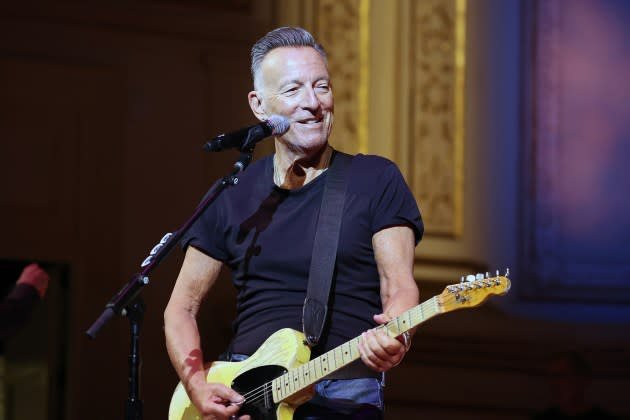
Stepping into the spotlight, Bruce didn’t lean on the teleprompter. He spoke with the gravelly, unvarnished honesty of a man who has spent fifty years as America’s unofficial musical ambassador. He bypassed the usual industry platitudes, choosing instead to address the “dazzling world of dreams” they were all sitting in, contrasted against the “hell breaking loose” in the streets outside. It wasn’t a standard acceptance speech; it was a “Monster” manifesto of sorts—a plea for empathy and a return to the country’s highest ideals.

The “shocking act of generosity” the headlines are buzzing about wasn’t just a monetary donation—though Bruce is famously charitable—but a generosity of spirit. In a room where “brand management” usually reigns supreme, he gave the elite something they rarely encounter: the unfiltered truth. He spoke of the “sacred American promise” and the responsibility of those with a voice to use it for those who have been silenced.
The climax of the evening came when he transitioned from words to music. Closing the night with a three-song acoustic set that included “Land of Hope and Dreams,” the Boss turned a corporate fundraiser into a revival tent. He wasn’t playing for the executives in the front row; he was playing for the ideals he believes they should represent.

For music fans, it was a vintage Springsteen moment. It served as a reminder that Bruce has never been a “legacy act” content to sit on a shelf. Whether he is calling out political corruption or demanding more from his peers, he remains a “chilling” force because he refuses to be comfortable. As the elite stood for a lingering ovation, it was clear that while they gave him a trophy, he gave them something much more valuable: a mirror.
In an industry often paralyzed by its own image, Bruce Springsteen proved once again that the most nuclear thing an artist can do is tell the truth.