The Morgan house stood on the edge of Willow Creek, Virginia — white panels fading into a tired gray, porch railing chipped from summers long gone, and windchimes still singing the same old melody they did the evening we left home one by one.
I used to think houses were just wood, paint, nails.
But it turns out — houses breathe.
They remember who walked out angry, who walked out broken, who never walked back.
My name is Ethan Morgan, second of three.
Middle — meaning peacemaker, meaning forgotten, meaning the voice no one heard until I raised it into a storm.
My older brother, Caleb, was the pride of our father — football star, straight-A student, the son who could do no wrong until he suddenly could.
My younger sister, Riley, sweet and bright and too soft for the world, was the only light left when everything burned down inside our family walls.
Our parents — Michael and Linda Morgan — were once the couple neighbors envied. A picture-perfect family in church pews every Sunday, barbecues on summer Fridays, a Christmas tree so bright the whole street glowed.
Funny how no one sees rot under polished wood.
CHAPTER I: THE DINNER WE DIDN’T DESERVE
Seven years since we sat at that table.
Seven years since Caleb walked out after throwing his High School State Championship ring onto the counter and shouting, “I didn’t want your dream, Dad.”
Seven years since I left through the same doorway in silence with a bag and walls around my heart thicker than concrete.
Seven years since Riley escaped to college to breathe without hearing arguments through doors.
But tonight — we were here.
Not because we healed.
Because life forced us to.
Mom was turning 60. Riley organized a surprise visit, booked flights, arranged schedules, lied to each of us separately, then dropped us into the same living room like gasoline and match.
When I walked in, my heart stuttered.
The house looked almost the same — picture frames of us as kids on the hallway wall, Dad’s old leather recliner, that blue ceramic bowl Riley made in 8th grade sitting crooked on the coffee table.
But something was different too.
Quiet.
Too quiet.
No laughter.
No warmth.
Just years.
Dad was the first to speak.
“You look good, son,” he said, handshake firm, voice stiff.
Mom hugged me like she was afraid I’d disappear again. Caleb stood behind her, older, sharper around the eyes, the pride gone — or buried deep.
Riley came last from the kitchen, flour on her shirt, ponytail loose, smile tremoring but brave.
“Dinner’s ready,” she whispered.
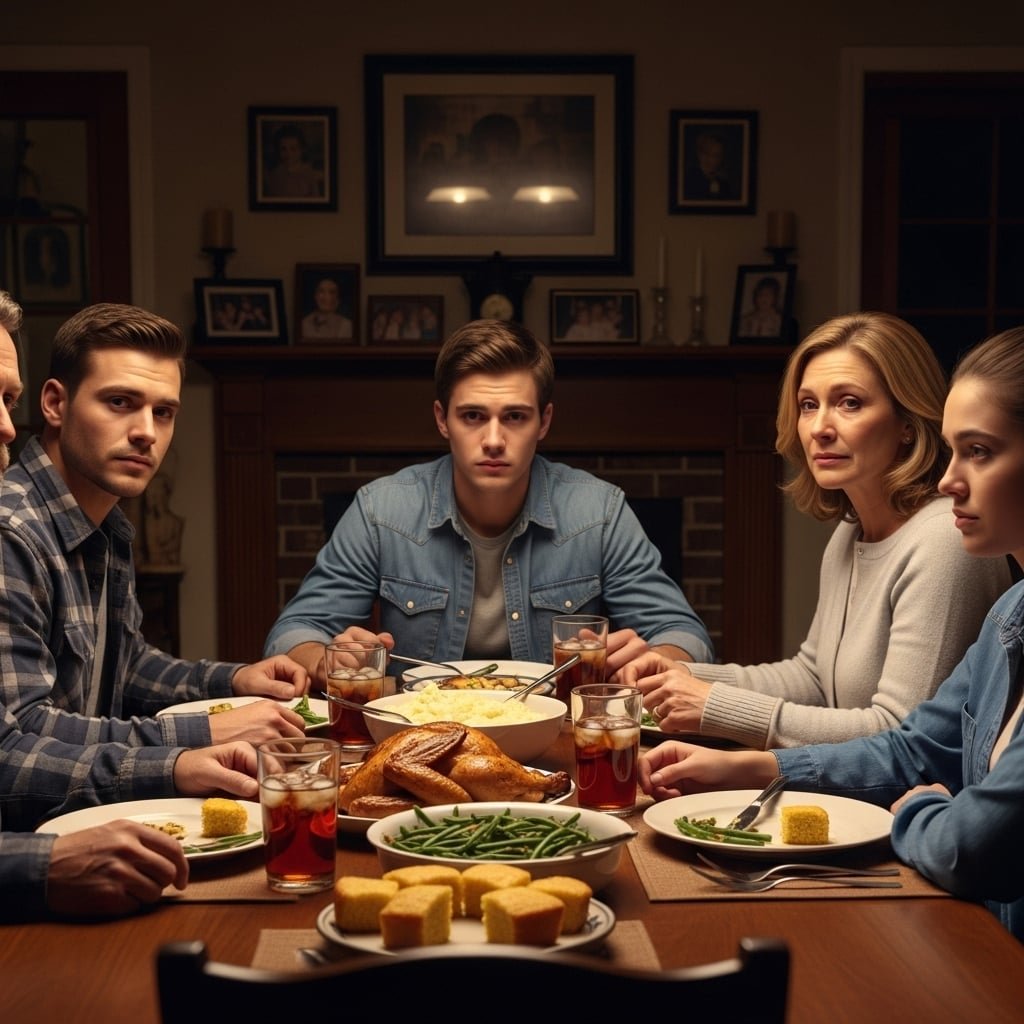
We sat — five people who shared blood and history but not peace.
Chicken roast, mashed potatoes, green bean casserole, cornbread — Mom cooked like she wanted to feed years we lost.
We ate in silence broken only by silverware and hearts pounding.
Then Riley set down her fork.
“After dinner,” she began softly, “I want all of us to say something we’ve never said — something we needed to. We can’t pretend forever.”
Dad’s jaw worked like he was grinding words he didn’t want to swallow.
Caleb stared at his plate.
Mom’s eyes glistened like glass about to break.
I looked around — this wasn’t a birthday.
This was a reckoning.
None of us knew whether we were having dinner —
or digging up a grave.
CHAPTER II: THE MATCH THAT ALWAYS WAITED FOR A SPARK
It started small — as disasters do.
Caleb commented the potatoes were too salty.
Mom flinched. “Really? I followed the same recipe…”
“You always say that,” he muttered. “Everything is always perfect to you.”
The room froze — not because of the words, but because of what lay beneath.
I stepped in — too fast, too raw.
“Man, not everything needs to be a critique. Or is that just a habit now?”
His eyes snapped to mine.
“You got something you want to say, Ethan?”
So it started — fire to gasoline.
“You walked away,” I said. “You left when Mom and Dad needed us most.”
Caleb shot back instantly.
“You left too.”
“But I didn’t slam the door like a grenade,” I snapped.
“And you think disappearing quietly is better?” Caleb’s laugh was bitter.
“You were always the one who said nothing. Silence hurts too, Ethan. Sometimes worse.”
He was right.
God, he was right.
But pain doesn’t listen to logic — it listens to memory.
Dad finally stood, voice cutting like gravel.
“Enough.”
But the dam had already cracked.
We weren’t arguing about dinner.
We were screaming years.
CHAPTER III: THE NIGHT EVERYTHING SPILLED OPEN
Riley wiped her tears, stood, and shook.
“We’re doing this,” she whispered.
“No more pretending.”
She turned on the little recorder Dad used to tape his bluegrass music — symbolism loud and cruel.
No escape. No mute button. No forgetting.
Caleb spoke first — unbelievably.
“I hated you, Dad,” he said, tone brittle.
“You pushed me. Football, grades, scouts — everything. I lived your dream, not mine. When I quit before nationals you didn’t speak to me for a month. You don’t know what that does to a kid.”
Dad flinched.
A wound decades fresh.
“I thought you were wasting your potential,” Dad whispered.
“I was wrong. I know now. I wanted you to succeed where I failed. Maybe I pushed too hard. Maybe I didn’t see you — I only saw what I wished I could’ve been.”
Caleb’s eyes glassed — first crack in armor.
Then me.
“I felt invisible,” I said — voice low, shaking.
“All praise went to Caleb — the prodigy. Riley was the angel who held everyone together. And me? I was just… there. Not special. Not disappointing. Just forgettable. I spent years wondering if you’d notice if I disappeared.”
Mom covered her mouth — shoulders trembling.
“You were never invisible,” she cried.
But her words were late.
Years too late.
Then Riley — sweet Riley — shattered.
“You two think you got hurt the most?”
Her voice cracked like freezing branches.
“I was the kid who stayed. I watched this family rot. I watched Mom cry when she thought nobody saw. I watched Dad stare into an empty garage like he was mourning a life that never happened. I was the peacemaker, the emotional medic, the one who taped everything together until I ran out of tape.”
Silence thundered.
None of us were victims.
We were casualties.
CHAPTER IV: WHEN A FAMILY FINALLY LOOKS AT ITS OWN RUINS
Later — after tears and ten minutes of breathing like drowning survivors — we moved to the living room.
Fireplace warm.
Old family photos spread over the rug Riley laid out like confession pieces.
Dad took his seat slowly, hands shaking.
“When I lost my job at the plant,” he began, voice fragile, “I felt like less of a man. I pushed Caleb because I wanted one of us to win at life. I withdrew from Ethan because I didn’t know how to love without teaching. I leaned on Riley because she never complained. Your mother was the only reason we didn’t collapse then — and I wasn’t strong enough for her either.”
Mom held his hand, tears soft as forgiveness.
“I tried to hold us together,” she admitted.
“But I was holding cracks, not people. I hid problems instead of facing them. I thought silence was peace. It wasn’t. Silence is where resentment grows.”
We listened — not to respond, but to understand.
And Ethan spoke — the boy who once vanished inside his own home.
“I don’t need perfection,” I whispered.
“I just need to be seen.”
Mom crossed the room and hugged me like she was hugging seven missing years in one breath.
Caleb rested a hand on my back.
Riley cried through her smile.
We weren’t healed.
But we finally stopped pretending we didn’t bleed.
CHAPTER V: A BRAND-NEW MORGEN MORNING
Morning sunlight poured across the kitchen — warm, forgiving.
Caleb made French toast — Dad’s old Sunday recipe.
I brewed coffee — Mom’s favorite vanilla roast.
Riley dusted powdered sugar over breakfast like memories falling soft instead of sharp.
We sat — this time without tension.
Without winners or losers.
Just people learning how to love.
Dad suggested rebuilding the old treehouse out back.
Caleb grinned — for real.
Riley squealed.
I nodded.
Fixing wood is easier than fixing hearts —
but sometimes doing one repairs the other.
We worked until sunset — joking, arguing lightly, sweating under Virginia sky like we used to before pride grew teeth.
When it stood again — crooked but standing — so were we.
That night we didn’t say “we’re healed.”
We said something better:
“Let’s not disappear again.”
And that is how a broken American family stopped breaking.
Not by forgetting the pain —
but by finally speaking it.
Not by erasing the past —
but by building again anyway.
Because love isn’t perfection.
Love is trying again.