Why Steve Perry Will Always Be Rock’s Greatest Voice
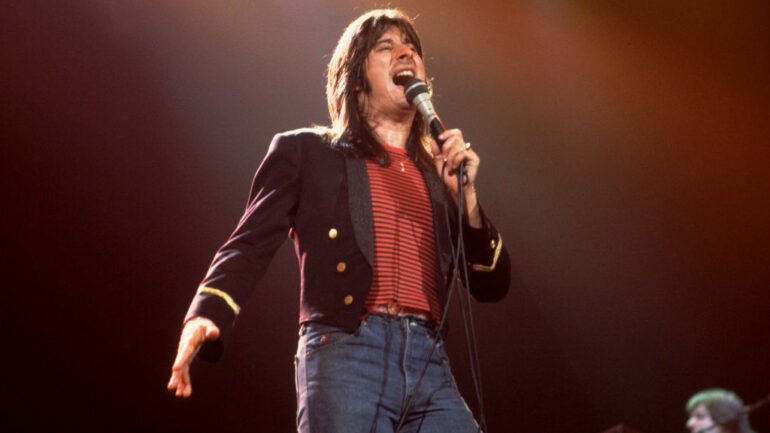
Steve Perry didn’t just sing—he summoned. With a voice that could soar above arenas and shatter hearts in the same breath, he became the very soul of Journey and the eternal benchmark for every rock frontman that followed. But his story isn’t just about glory—it’s about walking away at the peak, leaving fans devastated, bandmates bitter, and the legend frozen in time. To this day, his haunting voice echoes like a ghost across generations, untouchable, unreplaceable, and forever crowned as rock’s ultimate sound of passion and pain.

Steve Perry was the lead singer of pop rock band Journey from 1977 to 1987. He is known for having a wide vocal range, which can be heard on such popular hits as “Don’t Stop Believin’” and “Oh Sherrie.”
Who Is Steve Perry?
Steve Perry played in several bands before joining Journey in 1977. The band achieved tremendous pop rock success with its 1981 album Escape, which featured the now-classic “Don’t Stop Believin’.” As the group’s lead singer, Perry became one of the era’s most famous singers. He also had some hits on his own, including “Oh Sherrie.” Perry left Journey in 1987, and except for a brief reunion, he remains a solo artist.
Early Life
The son of Portuguese parents, Steve Perry grew up in California. He was around 10 years old when, during a car trip with his mother, he discovered his career path; after listening to Sam Cooke on the radio, the young Perry decided he wanted to be a singer.
While attending high school in Lemoore, California, Perry played drums in the marching band. He tried college for a while, performing in the choir, but eventually abandoned school for his musical dreams. Hoping to break into the business, he moved to Los Angeles for a time. There, he worked a number of jobs, including singing on commercials and serving as an engineer in a recording studio. All the while, Perry played with a number of different groups as a vocalist and drummer. He seemed to be on the edge of a breakthrough with the group Alien Project, when it suddenly disbanded — tragically, one of its members was killed in a car crash.
Journey: “Oh Sherrie” and “Don’t Stop Believin’”
In 1977, Perry caught his big break, landing a gig as the vocalist for Journey, which began performing as a jazz rock group in the early 1970s, in San Francisco. With Perry on board, the band moved more toward mainstream rock, and began to see some chart success with the first album with Perry, 1978’s Infinity. The band’s ode to San Francisco, “Lights,” became a minor hit as did “Wheel in the Sky” and “Anytime.”

Journey broken into the Top 20 with “Lovin’, Touchin’, Squeezin’” on their next album, Evolution (1979). Buoyed by such hits as “Open Arms,” “Who’s Crying Now” and “Don’t Stop Believin’,” Escape (1981) became the band’s first No. 1 album, selling more than 7 million copies. While the band was hugely popular with music fans, many critics were less than kind.
By the early 1980s, Journey had emerged as one of rock’s top acts. Perry proved that while he may have been short in stature, he possessed one of the era’s biggest and most versatile voices. He was equally adept at ballads, such as “Open Arms,” and at rock anthems, such as “Any Way You Want It.” Behind the scenes, Perry helped write these songs and many of the band’s other hits. He penned their most enduring song, “Don’t Stop Believin’,” with guitarist Neal Schon and keyboardist Jonathan Cain.
Journey continued to be one of the era’s top-selling acts, with 1983’s Frontiers. The album featured such songs as “Separate Ways (Worlds Apart)” and “Faithfully.” To support the recording, the band undertook an extensive world tour. Around that time, Journey also became the first band to license their music and likenesses for a video game.
With 1986’s Raised on Radio, Journey enjoyed another wave of success. However, Perry was ready to part ways with his bandmates. Perry left the band in 1987 after the album tour. In a statement to People magazine, Perry explained: “I had a job burnout after 10 years in Journey. I had to let my feet hit the ground, and I had to find a passion for singing again.” Perry was also struggling with some personal issues at the time; his mother had become very sick, and he spent much of his time caring for her before her death.
Perry reunited with Journey in 1996, for the reunion album Trial By Fire, which reached as high as the No. 3 on the album charts. But health problems soon sidelined the famous singer—a hip condition, which led to hip replacement surgery—and his bandmates decided to continue on without him.
Solo Projects
While still with Journey, Perry released his first solo album, Street Talk (1984). The recording sold more than 2 million copies, helped along by the hit single, “Oh Sherrie.” Burnt out after splitting with Journey, Perry took some time out before working on his next project.
Nearly a decade later, Perry re-emerged on the pop-rock scene with 1994’s For the Love of Strange Medicine. While the album was well-received—one ballad, “You Better Wait,” was a Top 10 hit—Perry failed to reach the same level of success that he had previously enjoyed. In 1998, he provided two songs for the soundtrack of Quest for Camelot, an animated film. Perry also released Greatest Hits + Five Unreleased that same year.
Recent Years
While he has largely stayed out of the spotlight, Perry continues to be heard in movies and on television. His songs are often chosen for soundtracks, and Journey’s “Don’t Stop Believin’” even played during the closing moments of the hit crime-drama series The Sopranos in 2007. In 2009, a cover version of the song was done for the hit high school musical show Glee, which introduced a new generation to Perry’s work.
According to several reports, Perry began working on new material around 2010. He even built a studio in his home, which is located north of San Diego, California. “I’m finishing that room up and I’ve written a whole bunch of ideas and directions, all over the map, in the last two, three years,” Perry told Billboard in 2012.
In 2014, Perry broke from his self-imposed exile from the concert stage. He appeared with the Eels at several of their shows. According to The Hollywood Reporter, Perry explained that “I’ve done the 20-year hermit thing, and it’s overrated.” His return to performing “has to do with a lot of changes in my life, including losing my girlfriend a year ago and her wish to hear me sing again” — referring to his romance with Kellie Nash, who died in late 2012 from cancer.
Although Perry and his old bandmates had long since ventured in separate directions, the group did reunite for their induction into the Rock and Roll Hall of Fame in April 2017.
In the meantime, the singer began recording again. On August 15, 2018, he released his first new song in 20 years, the ballad “No Erasin.” The track arrived ahead of his new album, Traces, his first full-length studio recording since For the Love of Strange Medicine in 1994.
Regardless of what the future holds, Perry has already earned a place in rock history. Rolling Stone magazine named him one of music’s top 100 singers. According to American Idol judge and former Journey bassist, Randy Jackson, Perry’s voice is one of kind. “Other than Robert Plant, there’s no singer in rock that even came close to Steve Perry,” Jackson said. “The power, the range, the tone—he created his own style. He mixed a little Motown, a little Everly Brothers, a little Zeppelin.