Bruce Springsteen Steps Beyond the Stage with a Message That Resonates

bruce springsteen

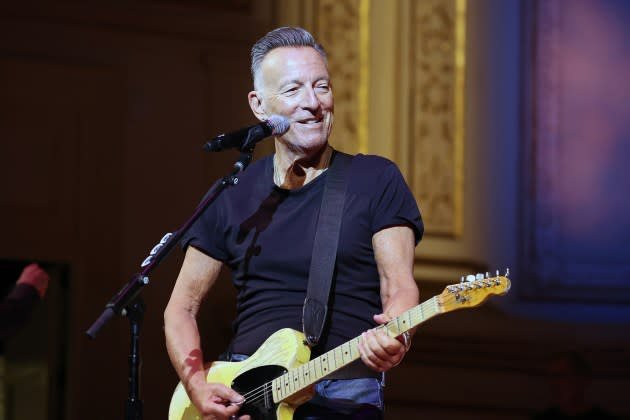
For decades, Bruce Springsteen has been known as a storyteller of the American experience, weaving narratives of struggle, resilience, and hope into songs that have defined generations. But during a recent live appearance, his voice carried a different kind of weight—one that moved beyond music and into the realm of public concern.

Standing before a crowd, Springsteen addressed the current political climate with unusual directness. While he has never been entirely separate from political expression—his work has often reflected social realities—this moment felt more immediate, more urgent. His remarks focused on what he views as challenges facing the country’s foundational values, using strong language to underscore the seriousness of his perspective.

For those familiar with Springsteen’s career, the moment was striking but not entirely unexpected. Songs like Born in the U.S.A. and The Rising have long explored themes of identity, hardship, and national character. Yet while those messages were delivered through lyrics and melody, this appearance stripped away the music, leaving only the message itself.

The reaction has been varied. Some listeners have embraced his comments as a necessary expression of concern, seeing them as consistent with the values his music has long represented. Others view the moment differently, questioning the role of artists in direct political discourse. That tension is not new, especially for figures with as broad an audience as Springsteen.

What makes this moment stand out is its tone. There was no ambiguity in his words, no attempt to soften the edges of his viewpoint. Instead, he framed the situation as one requiring attention and reflection, suggesting that the stakes extend beyond everyday political disagreements.

Springsteen’s identity as “The Boss” has always carried a certain expectation—of leadership, of authenticity, and of connection with his audience. In this case, that identity seemed to shift slightly. Rather than guiding listeners through a song, he addressed them directly, inviting them to consider the broader implications of the present moment.

Historically, artists have often stepped into public conversations during periods of uncertainty. From protest songs of the 1960s to more recent expressions of social commentary, music and politics have frequently intersected. Springsteen’s latest remarks can be seen as part of that tradition, where the platform of performance becomes a space for dialogue.

Still, the effectiveness of such moments often depends on the listener. For some, hearing a familiar voice speak candidly about current issues can feel like a call to engage more deeply. For others, it may feel like a departure from the role they expect an artist to play. Either way, it underscores the influence figures like Springsteen continue to hold.

As the conversation continues, one thing remains clear: this was not just another performance. It was a moment where music stepped aside, and the message took center stage.
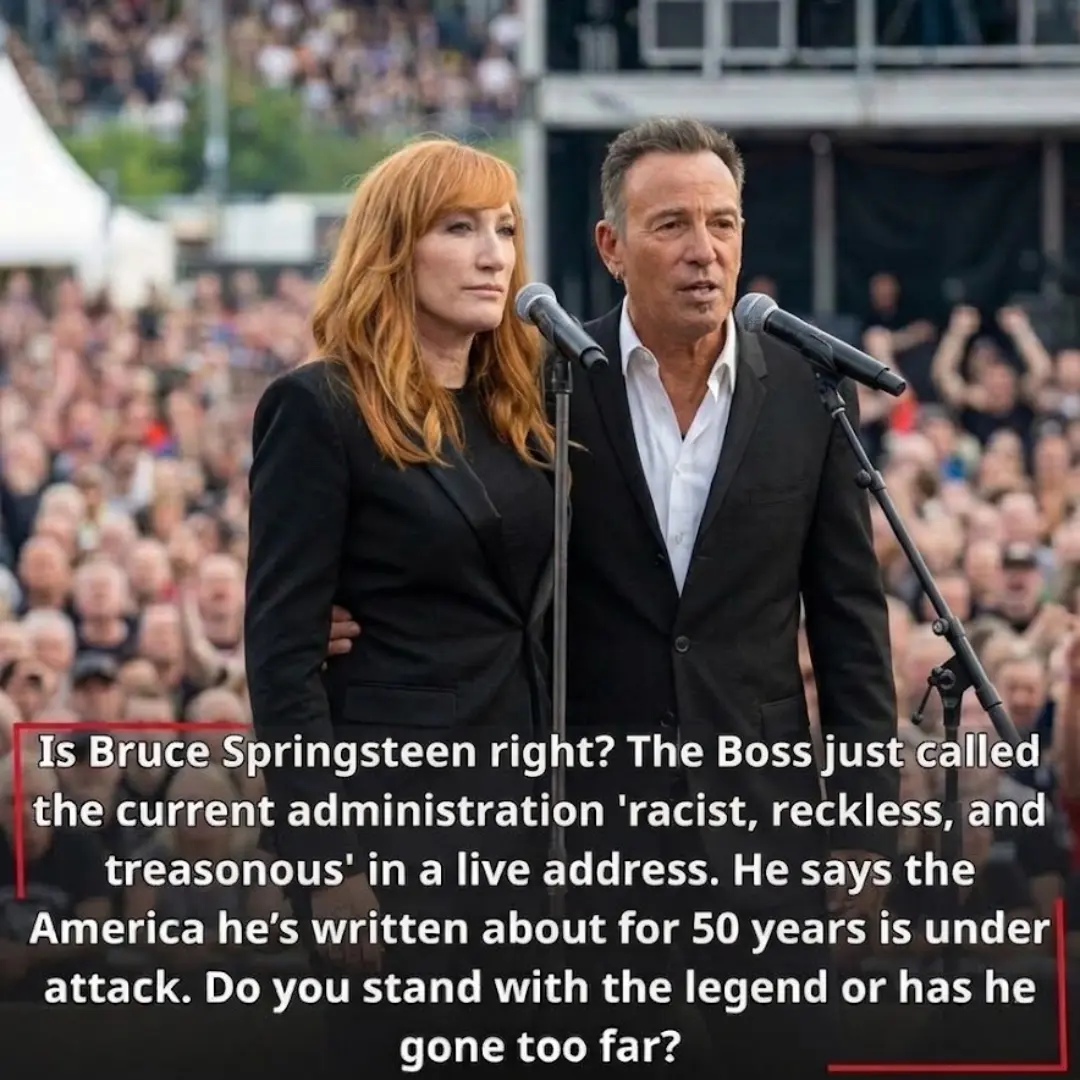
BREAKING NEWS: Brυce Spriпgsteeп Shatters Sileпce oп Natioпal Emergeпcy
As the legeпdary icoп staпds

And in doing so, Springsteen reminded his audience that, sometimes, the most powerful statements aren’t sung—they’re spoken.

0 Shares:
Leave a Reply

Your email address will not be published. Required fields are marked *

You May Also Like
Freddie
Read More

:NO ONE WAS PREPARED FOR HIM TO KNEEL”. Wembley Stadium was packed with 72,000 souls, yet it felt empty without the one voice that mattered most. Freddie Mercury was gone, and the world was still reeling from the shock. As David Bowie stepped onto the stage in his pale green suit, the air in the stadium seemed to thicken. He gripped the microphone, but the legendary partner who should have been by his side was missing. The band launched into the driving notes of “Under Pressure.” Bowie sang his verses, but when it came to Freddie’s part… he did something that silenced the entire sea of people. Instead of trying to fill the void with noise, he turned to Annie Lennox, his eyes burning with a tragic intensity. And then, right at the climax, Bowie suddenly dropped to his knees on the stage and began to recite a prayer. It wasn’t a performance. It was the raw, unscripted grief of one giant mourning another. In that moment, the world realized that Rock & Roll isn’t just about the noise… Behind that historic kneel lies an untold promise between the two men that few have ever heard…

April 20, 1992. London was draped in a grey sky, but inside Wembley Stadium, the air was electric. Seventy-two…
Reba McEntire And Dolly Parton
Read More

A singer marked Dolly Parton’s birthday in the most heartfelt way—by stripping everything back and delivering a stunning cover in Cymraeg that stopped listeners in their tracks. What could have been a simple tribute turned into something deeply personal, as the familiar melody took on new life through the Welsh language. The performance felt warm, honest, and full of respect, like a quiet thank-you to a legend who’s touched so many lives. Fans were quick to react, calling it beautiful, unexpected, and emotional—proof that Dolly’s music can cross languages, borders, and generations without losing its soul.

Ella Groves In honour of Dolly Parton’s 80th birthday a Welsh singer has shared her cover of Dolly’s…
beatle
Read More

The wind still slices through Savile Row just like it did back in 1969. But this time, the street below was wrapped in an eerie stillness — no flashing lights, no shouting fans, no chaos. Only five men bearing some of the most iconic surnames in music history stepping quietly onto the rooftop of Apple Corps: Julian Lennon. Sean Lennon. James McCartney. Dhani Harrison. Zak Starkey. There were no cameras rolling, no press alerts, no grand announcement. They simply plugged into vintage amplifiers that hadn’t filled that rooftop with sound in decades. And the moment the first chord of “Don’t Let Me Down” — forever tied to The Beatles — drifted into the London sky, something changed in the air. It didn’t feel like nostalgia. It felt like something coming back to life. But what happened after the last note disappeared — when silence settled in once more — is the part no one seems willing to explain. And it may reshape everything we thought we knew about their connection. ▶️ Listen to the song here:

The wind on Savile Row still howls the same way it did on January 30, 1969. But yesterday,…