Public moments of tension often unfold online, sparked by a single post or comment that quickly gains momentum. Recently, one such moment began on Truth Social, where a widely shared image and remark set off a wave of reactions across the United States. What might have remained a fleeting exchange instead grew into a broader cultural discussion—one that drew in public figures, commentators, and audiences far beyond its original context.
At the center of the conversation was Bruce Springsteen, an artist whose career has long intersected with themes of identity, resilience, and the American experience. Known for his connection with audiences and his willingness to address social issues, Springsteen found himself part of a rapidly evolving public debate.

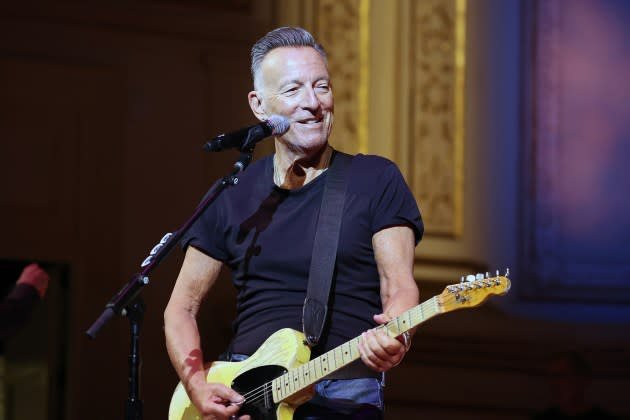
As online reactions intensified, attention shifted from the digital space to the physical stage. In San Francisco, Springsteen appeared before a packed audience, stepping into a setting that has defined much of his career. Yet this performance carried a different kind of anticipation. It wasn’t just about the music—it was about how, or if, the moment outside the arena would shape what happened inside.
From the beginning, the energy in the room was unmistakable. Fans responded not only to the familiar sound of his songs but also to the context surrounding the performance. At 76, Springsteen brought the same intensity that has characterized his decades-long career, delivering a set that stretched across hours. The endurance alone was notable, but it was the atmosphere that set the night apart.

Each song seemed to carry an added layer of meaning. Tracks that once reflected personal stories or broader social themes now felt connected to the present moment. The audience, aware of the ongoing discourse, listened with a heightened sense of attention. It created a dynamic where music and context became intertwined, each influencing how the other was received.
Springsteen did not rely on direct confrontation or explicit commentary throughout the performance. Instead, the response unfolded through tone, presence, and the cumulative effect of the music itself. It was a reminder of how artists often communicate—less through direct rebuttal and more through expression that invites interpretation.
As the concert progressed, the sense of anticipation grew. Many in the audience seemed to expect a defining statement or gesture, something that would directly address the broader conversation. When a quieter, more reflective moment finally arrived, it shifted the mood. Rather than escalating tension, it introduced a pause—an opportunity for reflection amid the intensity.
That moment resonated beyond the venue. It was shared, discussed, and interpreted in various ways, becoming part of the larger narrative that had been unfolding since the initial post. For some, it represented restraint and thoughtfulness; for others, it carried its own kind of message about how public figures navigate scrutiny.
What this episode ultimately highlights is the evolving relationship between artists, audiences, and public discourse. In an age where digital interactions can quickly shape national conversations, the role of live performance takes on new significance. It becomes not just a space for entertainment, but a setting where broader cultural moments can be felt and processed in real time.
For Bruce Springsteen, the night in San Francisco was another chapter in a career defined by connection and expression. But it also served as a reminder that, sometimes, the most powerful responses are not the loudest ones.
They are the ones that leave space—for thought, for interpretation, and for the audience to decide what the moment truly means.