Carrie Underwood had one final song to sing, and it was one of the most difficult choices imaginable for a night devoted to Dolly Parton’s extraordinary legacy. As the American Idol winner reached the closing moments of “I Will Always Love You” during the CMA’s October 21 tribute special, her emotional delivery brought the evening to a powerful conclusion. But beyond the tears, the performance highlighted something remarkable about Parton’s music: a song written decades ago for a very different reason has become a lasting connection between artists, generations, and some of country music’s most unforgettable moments.
Underwood closed “CMA Presents I Will Always Love You: A Celebration of Dolly Parton” with a performance that placed the spotlight on one of the most recognizable songs in American music. Dressed in a flowing white gown, she sang before a backdrop featuring pink butterfly wings, delivering the kind of soaring vocal performance audiences have come to expect from the country superstar. As the song approached its conclusion, Underwood appeared visibly emotional, and the moment became even more meaningful when other performers and guests joined her onstage for the finale.
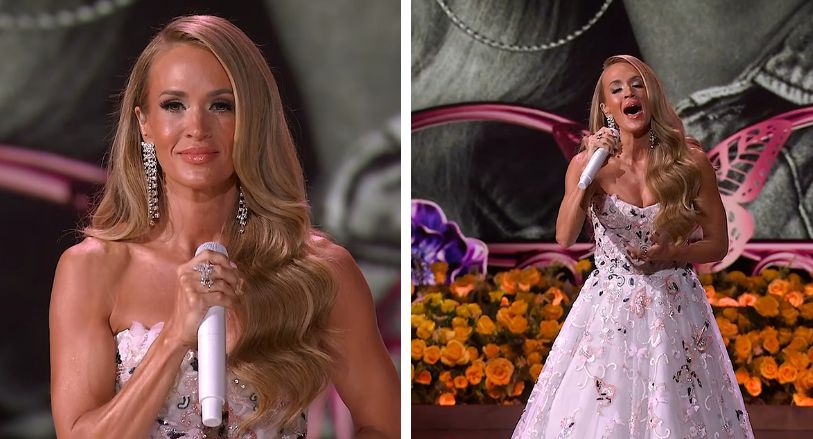
The setting made the performance particularly significant. The two-hour special, broadcast on ABC and Disney+, brought together artists including Reba McEntire, Vince Gill, Ella Langley, Lainey Wilson, Darius Rucker, Zac Brown, and Carly Pearce. Each contributed to a celebration of Parton’s life, songwriting, and influence, creating an evening that reached beyond a collection of familiar hits. For Underwood, the closing performance offered an opportunity to honor an artist whose music had been part of her own journey for years.
What makes the moment especially compelling, however, is the history of the song itself. “I Will Always Love You” is often associated with Whitney Houston’s powerhouse rendition from the 1992 film “The Bodyguard.” That version introduced the song to an enormous international audience and helped turn it into one of the defining ballads of its era. Yet the story began long before Houston recorded it, and the original circumstances reveal a very different side of Parton’s songwriting.
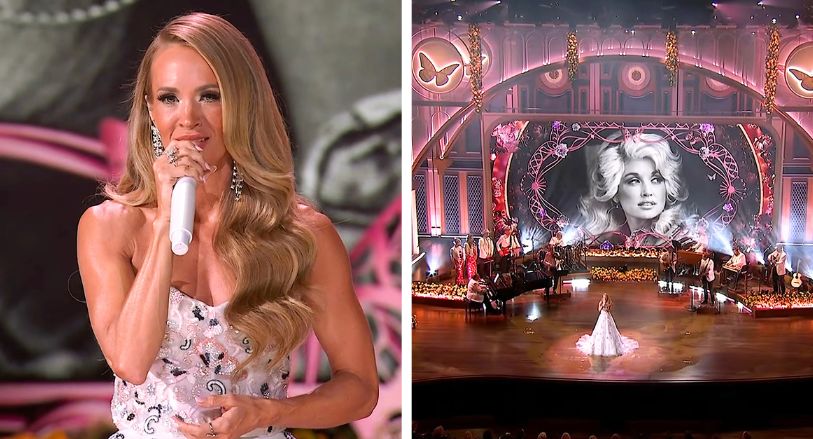
Parton wrote “I Will Always Love You” in 1973 as a farewell to Porter Wagoner, the country entertainer who had given her an important career opportunity by bringing her onto his television show. Their professional partnership had helped establish Parton as a major country music star, but she eventually wanted to move forward independently. Rather than allowing the end of their working relationship to become a bitter public dispute, she put her feelings into a song that expressed gratitude, affection, and the need to follow a different path.
That origin gives the lyrics a meaning that extends well beyond romantic heartbreak. The song was about recognizing what another person had contributed while accepting that two people might need to move in different directions. Parton reportedly used the song to communicate her feelings to Wagoner, who was deeply moved by it. The story has become an essential part of the track’s history, demonstrating how a personal moment can become the foundation for a piece of music that eventually belongs to millions of listeners.
The song also proved that its emotional power did not depend on one particular arrangement or performer. Parton recorded her original version in the 1970s and later revisited it, while Houston transformed it into a dramatic pop ballad nearly two decades later. Both interpretations became important in their own right, and the contrast between them illustrates the flexibility of great songwriting. One artist can deliver a song with understated country warmth, while another can turn it into a soaring vocal showcase without losing the feeling at its center.
Underwood’s performance belongs to another chapter in that story. Known for her powerful voice and country roots, she has spent much of her career balancing traditional influences with the demands of contemporary country music. Her rendition of Parton’s classic brought those qualities together, placing her own vocal strengths in service of a song whose history is already deeply familiar to audiences. The challenge was not simply to hit the big notes. It was to make the performance feel personal while honoring a composition that has been interpreted by some of the most celebrated singers in modern music.

Underwood also had a direct musical connection to Parton long before the tribute special. The two performed “I Will Always Love You” together in 2009, creating a memorable meeting between an established country legend and a younger star whose career was still developing. That earlier appearance gives the 2026 finale an additional dimension: Underwood was not approaching the song as an admirer with no personal history, but as someone who had already shared the stage with its writer.
Their paths crossed again through “Forever Country,” the 2016 recording that brought together music from several generations of country artists in a celebration of the genre’s history. The project included music associated with Parton and other foundational figures, while also featuring contemporary performers such as Underwood. These connections help explain why the tribute carried more than symbolic significance. Parton was not simply an artist whose music Underwood admired from a distance; she was part of a wider country music community that Underwood had helped represent throughout her own career.
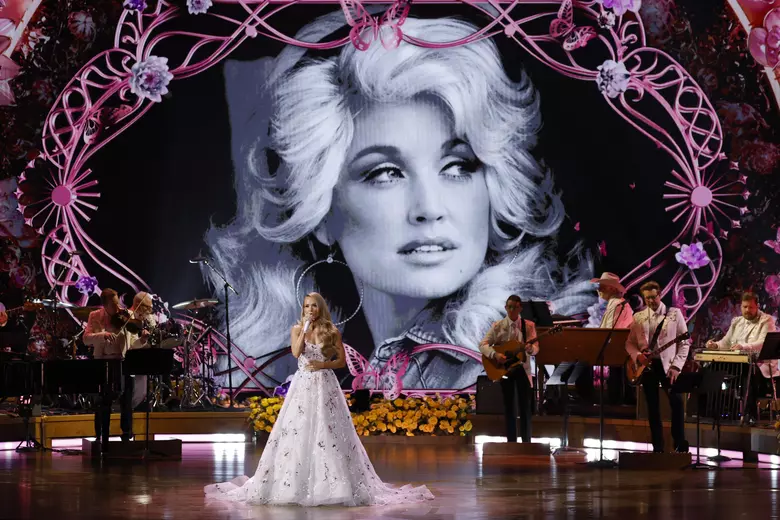
The response to the finale also revealed how differently people can experience an emotional performance. Some viewers praised Underwood’s vocal power and the visible feeling she brought to the song, describing the performance as an especially fitting conclusion to the evening. Others questioned whether she had actually broken down, arguing that she had simply delivered a beautiful and heartfelt rendition. Those different interpretations are worth considering because they reflect an important distinction between what an audience sees and what a performer is experiencing internally.
A singer can appear emotional without losing control of a performance, and a technically strong delivery does not necessarily mean the moment lacks feeling. Underwood has built a career on commanding vocals, but the purpose of a tribute is different from that of a competition performance. There is no score to chase and no rival to outperform. Instead, the challenge is to honor the person and the music while allowing the audience to connect with the meaning behind the song.
That is why the decision to close the special with “I Will Always Love You” made so much sense. The song is instantly recognizable, but its history gives it layers of meaning that a familiar melody alone cannot provide. It began as a farewell between professional collaborators, became a defining moment for Whitney Houston, and continued to find new life through artists who brought their own experiences to it. Underwood’s rendition added another chapter without needing to replace the interpretations that came before.
Parton’s influence has always extended beyond her own recordings. Her songwriting has allowed other artists to find their voices, while her generosity and work supporting children through Dolly Parton’s Imagination Library have expanded her impact beyond entertainment. The CMA special also directed proceeds toward the literacy initiative, connecting the evening’s musical celebration with a cause closely associated with Parton’s life and work.
In the end, Underwood’s performance was not simply about whether she became tearful or whether every note was delivered perfectly. It was about the remarkable staying power of a song that has carried different meanings for different people across more than five decades. The strongest tributes do not merely reproduce the past; they remind audiences why a piece of music mattered in the first place and allow it to mean something new.
What do you think made Carrie Underwood’s performance so memorable: her powerful vocals, her personal connection to Dolly Parton, or the extraordinary history behind “I Will Always Love You”? And which artist’s version of the classic remains your favorite?