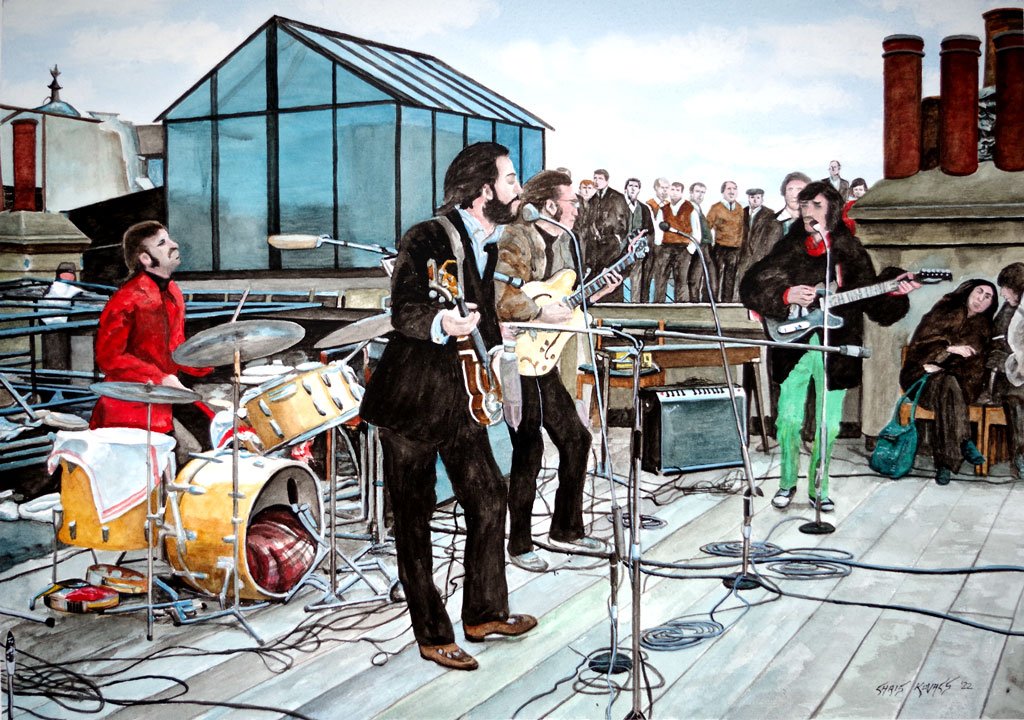
There are certain places in music history that seem frozen in time. A rooftop in London is one of them—a space forever linked to the final live performance of The Beatles. For decades, it has existed more as memory than reality, a symbol of an ending that became legend.
But recently, something shifted.
On that same skyline, under an open sky that once carried the sound of a generation-defining band, four new figures appeared: James McCartney, Sean Lennon, Dhani Harrison, and Zak Starkey. Not as a tribute act, not as an attempt to recreate what had been, but as something quieter and more meaningful—a continuation.

For those who know the history, the symbolism is impossible to ignore. Each of them carries a connection to the original band: sons of Paul McCartney, John Lennon, George Harrison, and Ringo Starr. But what unfolded wasn’t about stepping into their fathers’ shadows. It was about standing alongside them—acknowledging the past without being defined by it.
The atmosphere, by all accounts, was different from the charged energy of 1969. There was no sense of rebellion against the moment, no urgency to make a statement. Instead, there was a kind of calm confidence. The kind that comes from knowing exactly what something means, without needing to explain it.

People in London stopped, looked up, and listened. Not out of nostalgia alone, but out of curiosity—what does this sound like now? What does this legacy become when it passes into new hands?
The answer wasn’t a perfect echo. It wasn’t meant to be. Each musician brought their own voice, their own influences, their own way of approaching the moment. And yet, there was something undeniably connected running through it—a thread that tied past to present without forcing them together.
James McCartney’s presence carried a quiet familiarity, a reflection of melodic instinct shaped by years of proximity to one of music’s greatest songwriters. Sean Lennon brought an introspective edge, blending experimental sensibilities with emotional depth. Dhani Harrison added a sense of atmosphere, his style shaped as much by modern soundscapes as by the spiritual undertones associated with his father’s work. And Zak Starkey, with his seasoned experience behind the drums, grounded it all with a rhythm that felt both steady and alive.
Together, they didn’t recreate a moment—they reframed it.
That distinction matters. Because music history is often treated as something fixed, something to be revisited but never changed. What happened on that rooftop suggested something else entirely: that legacy isn’t about preservation alone. It’s about evolution.
As the sound drifted across the city, it carried more than notes. It carried memory, yes—but also possibility. The idea that even the most iconic chapters in music don’t have to remain closed. They can be revisited, reshaped, and reimagined by those who understand them from the inside out.
And for a brief moment, as London looked up and listened, it became clear that this wasn’t about the past returning.
It was about it moving forward.