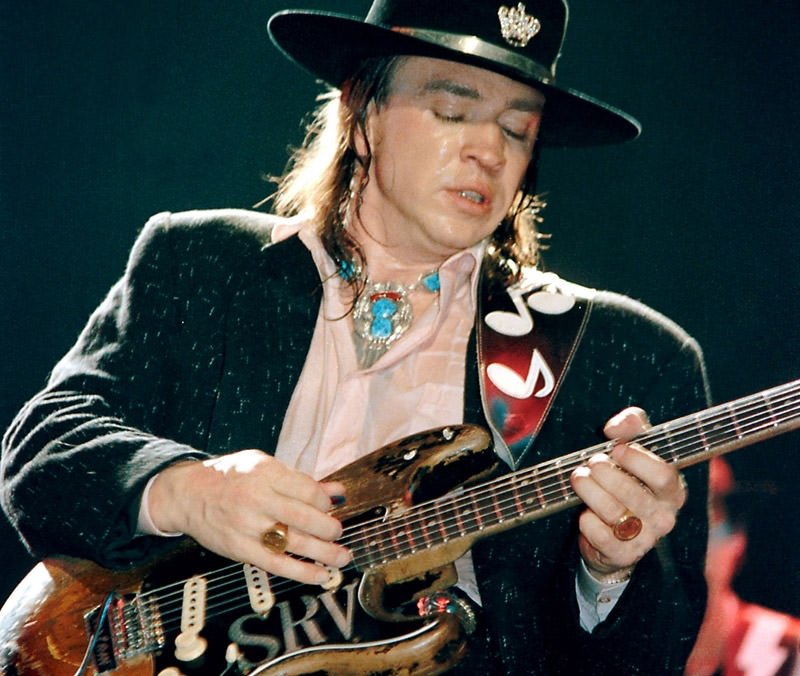
Stevie Ray Vaughan – The Texas Tornado Who Changed My Life
The first time I heard Stevie Ray Vaughan, it didn’t feel like I was just listening to music.
It felt like someone had plugged a lightning bolt into a Stratocaster and pointed it straight at my chest.
I still remember it like it was yesterday—
“Texas Flood” came on the stereo, and suddenly I understood what the blues could really be.
Stevie didn’t just play guitar. He opened up his soul and let it sing.
Born to Burn – A Texas Bluesman Like No Other
Stevie Ray Vaughan was born in Dallas, Texas, in 1954, and by the time he was a teenager, he was already bending strings like they owed him money.
He grew up worshipping Albert King, Jimi Hendrix, and his big brother Jimmie Vaughan, but when Stevie hit the stage, he didn’t sound like anyone else.
He played with the ferocity of a rock star, the precision of a jazz cat, and the feel of a deep Delta bluesman.
And he did it all with a beat-up Fender Stratocaster named Number One, heavier strings than most mortal hands can handle, and more soul than should fit into one human being.
The Sound: Texas Blues on Fire
SRV’s sound is iconic. The moment you hear it, you know.
- 🎸 Massive tone, soaked in overdrive, but clear as a bell.
- 🎤 That husky voice, perfect for singing heartbreak and redemption.
- 🎶 Songs that felt both timeless and brand new.
He could rip a solo that melted your face—and then turn around and play a slow blues so tender it broke your heart.
Nobody had his phrasing, his attack, or that unmistakable vibrato.
The Albums That Changed Everything
If you’re just diving into Stevie Ray Vaughan, these albums are mandatory listening:
- 💿 Texas Flood (1983) – His debut. Rough, raw, and absolutely electric.
- 🎧 Couldn’t Stand the Weather (1984) – A perfect mix of blues, rock, and Texas swagger.
- 🔥 Soul to Soul (1985) – Funky, experimental, and bold.
- 🎙️ In Step (1989) – His comeback after sobriety. Deep, clear, and next level.
- 📀 Live Alive (1986) – Captures SRV in full, fiery flight.
And don’t skip the Live at El Mocambo concert—one of the greatest live performances ever captured on film. Period.
Seeing Stevie (If You Were Lucky)
I wasn’t lucky enough to see Stevie Ray Vaughan in person—but I’ve talked to people who did.
They say the same thing every time:
He played like he was trying to save your soul—and maybe his own.
He’d tear through “Voodoo Child” or “Pride and Joy” with sweat flying and fingers blazing.
Then he’d drop to his knees and let the last note ring out like a prayer.
He didn’t hold back. Not for a second.
Why Stevie Still Matters
It’s been decades since we lost SRV in that tragic helicopter crash in 1990, but his impact?
Still echoing.
- He brought blues back to the mainstream in the ’80s.
- He inspired a generation of guitarists—from John Mayer to Kenny Wayne Shepherd to Kingfish.
- He proved that feel will always matter more than flash.
And more than anything else, he played with passion—the kind you can’t fake, can’t teach, and can’t forget.
Where to Start If You’re New
Your Stevie Ray Vaughan starter kit:
- 🎧 Texas Flood – The blueprint.
- 💿 In Step – His most mature work.
- 🎙️ Live at El Mocambo – Pure fire.
- 📺 YouTube: Search “Stevie Ray Vaughan Lenny” or “Stevie Ray Vaughan live solo” and prepare to feel something real.
Final Thoughts
Stevie Ray Vaughan didn’t just play the blues—he poured every ounce of himself into every note.
And even though he’s been gone since 1990, I still hear his music everywhere—in guitar shops, in playlists, in my own heart.
He’s the reason I fell in love with the Stratocaster.
He’s the reason I believe that music can save lives.
🎸💙🔥
“The blues is all about feeling. If I don’t feel it, I can’t play it.”
—Stevie Ray Vaughan
Amen, Stevie. We feel it. Every time.
Video