It’s hard to imagine Times Square as anything other than loud. The constant flow of traffic, glowing screens, and overlapping voices define it as one of the busiest places in the world. But every so often, something unexpected cuts through that noise—and for a brief moment, everything changes.
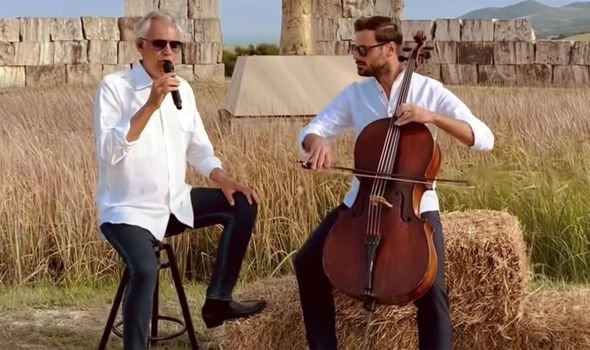
That’s what happened when Andrea Bocelli and HAUSER came together for a performance that few who witnessed it are likely to forget.
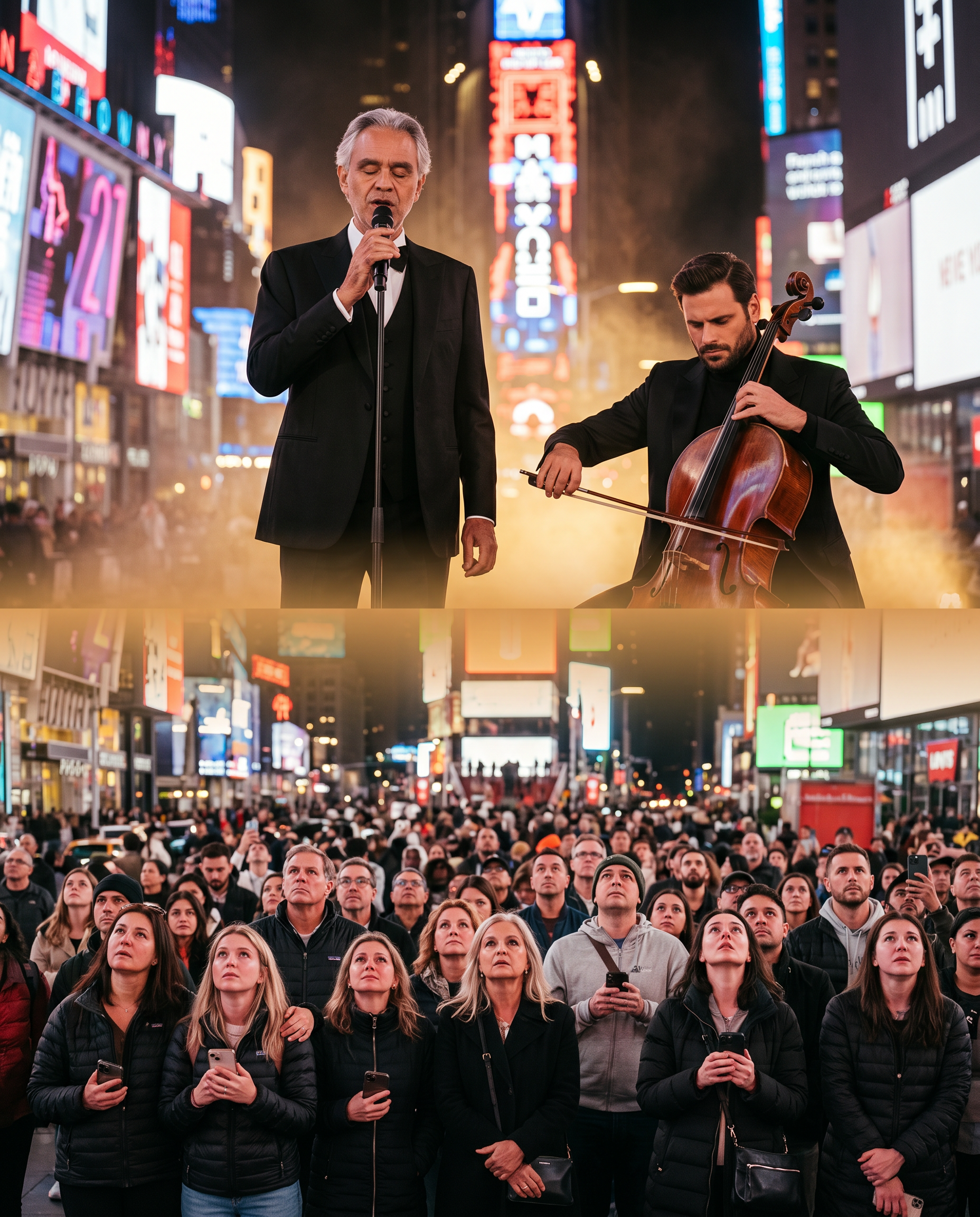
There was no elaborate setup suggesting what was about to unfold. People moved through the square as they always do—tourists pausing for photos, locals navigating through crowds, the city continuing at its usual relentless pace. Then Bocelli stepped forward, HAUSER positioned his cello, and the first notes of “Melodramma” began.
From the start, it was clear this wouldn’t be a typical rendition. The tempo felt more deliberate, the phrasing more reflective. Bocelli’s voice, known worldwide for its clarity and emotional depth, carried across the open space with surprising intimacy. Alongside him, HAUSER’s cello added a layer of texture that felt almost conversational—responding, echoing, and at times anticipating the vocal line.
What happened next is what people continue to talk about.
Gradually, the movement in the square slowed. Conversations quieted. Some people stopped mid-step, turning toward the sound. Others lowered their phones—not to record, but simply to listen. It wasn’t silence in the literal sense, but the usual chaos softened into something more focused.
Performing classical or operatic music in a space like Times Square is always a risk. The environment isn’t designed for nuance, and subtlety can easily be lost. Yet that contrast is precisely what made the moment stand out. The performance didn’t try to compete with the city—it reshaped how the space felt.
“Melodramma,” already an emotional piece, took on new meaning in that setting. The combination of voice and cello created a sense of tension and release that resonated even with those unfamiliar with the song. It wasn’t just about technical skill; it was about connection.
For Bocelli, moments like this are part of a long career defined by bringing classical music into unexpected places. For HAUSER, known for pushing the boundaries of the cello’s role in modern performance, the collaboration felt equally natural. Together, they found a balance that allowed each element to stand out while still serving the whole.
As the performance drew to a close, there was a brief pause—one of those rare moments where a crowd collectively holds its reaction. Then came the response: applause, cheers, and a return to motion. The city resumed its rhythm, but something had shifted, however briefly.
Not every performance is meant to be remembered in the same way. Some entertain, others impress. And then there are those that alter how a place feels, even if only for a few minutes.
On that day in Times Square, music didn’t just fill the air—it changed it.