Some collaborations feel inevitable. Others arrive as a surprise—and end up redefining the song itself. When Ed Sheeran joined forces with Andrea Bocelli for “Perfect Symphony,” it quickly became clear this was more than a simple duet. It was a meeting of two musical worlds, each bringing out something new in the other.
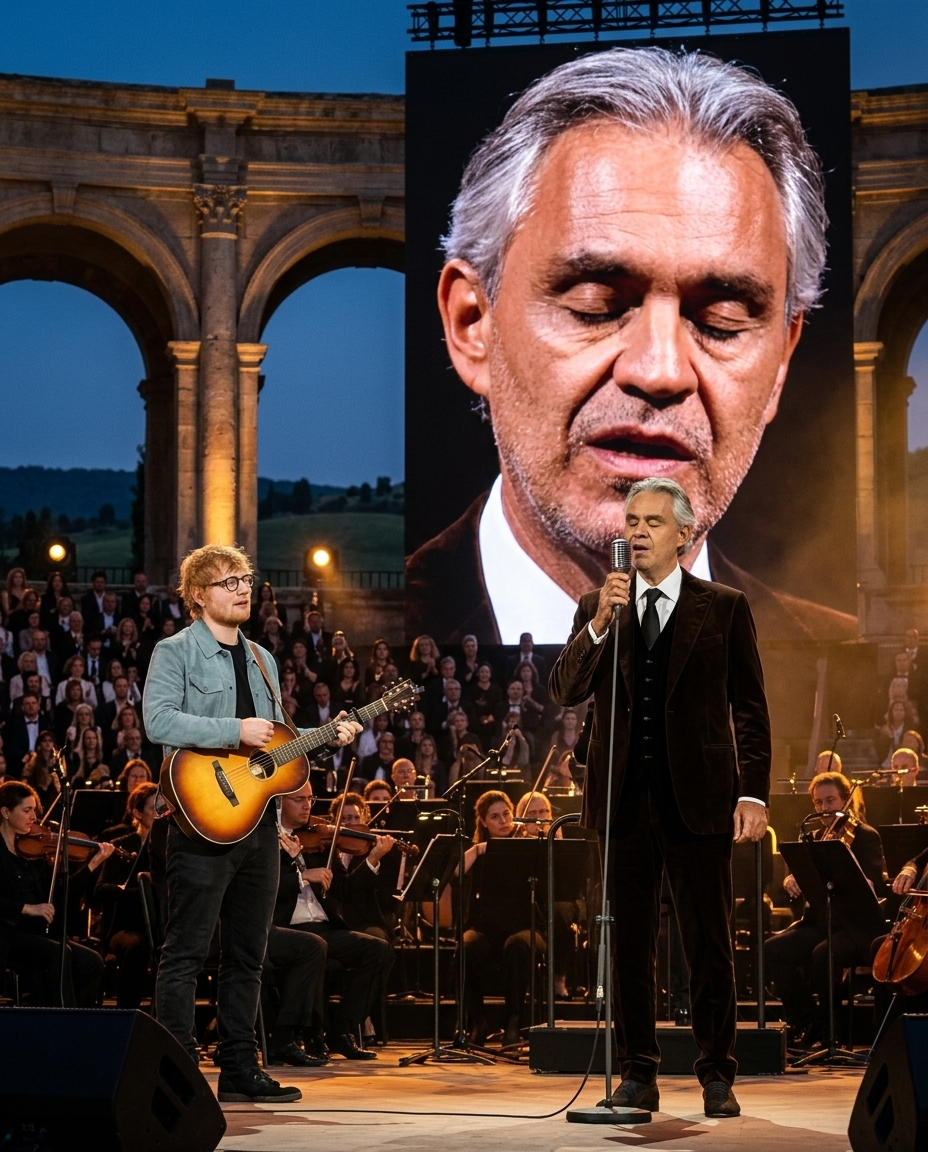
The story begins not on a massive stage, but in a far more intimate setting: Bocelli’s home in Tuscany. Surrounded by quiet and history, Sheeran picked up his guitar and began the now-familiar opening chords of “Perfect.” It’s a song already known for its simplicity and emotional pull, but in that room, it was about to take on a different life.
When Bocelli began to sing, the atmosphere changed instantly. His voice—rich, resonant, and unmistakably classical—didn’t just complement the song; it transformed it. Sheeran’s reaction in the studio footage says a lot. Rather than continuing to play through, he pauses, watching and listening, as though fully aware that something special is unfolding in real time.
Bocelli’s journey as an artist has long been defined by resilience and mastery. Having lost his sight at the age of 12, he went on to become one of the most recognized tenors in the world, selling millions of records and bridging the gap between opera and popular music. His voice carries not only technical brilliance but a sense of depth that listeners often describe as deeply moving.
For Sheeran, whose strength lies in songwriting and emotional connection, the collaboration offered a chance to see his work through a different lens. “Perfect,” originally a soft, acoustic love song, expands in “Perfect Symphony” into something grander—without losing its intimacy.
That balance became even more apparent when the pair brought the song to a live audience at Wembley Stadium. In front of tens of thousands, the performance could have easily leaned into spectacle. Instead, it retained the same emotional core that defined the studio recording.
Sheeran’s English verses and Bocelli’s Italian lines create a dialogue rather than a competition. Each voice has its own space, its own identity, yet together they form something cohesive. It’s a reminder that music doesn’t need uniformity to feel unified.
As the final note faded into the night, the crowd responded with the kind of applause that comes from more than just appreciation—it comes from recognition. Recognition that they had witnessed something rare.
Sheeran’s quiet remark afterward captured that feeling in simple terms: moments like this don’t come around often. And he’s right. Not every collaboration manages to bridge genres, languages, and audiences so seamlessly.
“Perfect Symphony” endures not just because of its beauty, but because of what it represents—a meeting point between styles, generations, and perspectives. It shows how a song can evolve when placed in the hands of different artists, each bringing their own story and voice.
And in the end, it leaves listeners with something lasting: the sense that music, at its best, doesn’t just fill space—it changes how that space feels.