There are performances that entertain, and then there are moments that enter history without asking permission.
On that night at London Stadium, no one arrived expecting the latter.
The Rolling Stones had already given the crowd everything they came for — swagger, grit, decades of rock carved into muscle memory. The roar of tens of thousands felt familiar, almost routine for a band that helped invent the very idea of stadium music. And yet, somewhere between anticipation and nostalgia, time quietly shifted.
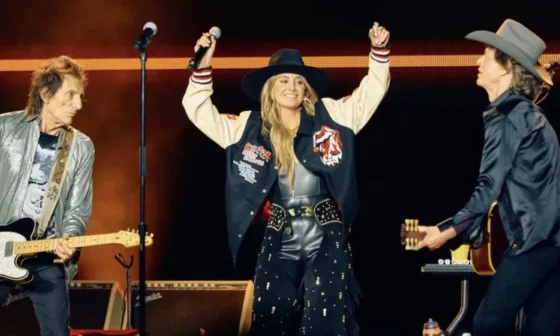
Then Mick Jagger stepped forward and spoke a name.
Florence Welch.
The stadium stirred — curious, excited — but unaware of what was about to unfold.
A Song Older Than Most of the Crowd
“Wild Horses” has always been a song that moves differently. Written in 1971, it carries the ache of restraint, of love that stays even when everything else pulls away. It’s not loud. It doesn’t beg for attention. It waits.
As the first notes drifted into the open air, the stadium softened. Conversations stopped. Phones lowered. Something in the atmosphere changed — as if 60,000 people collectively leaned closer.
Then Florence Welch began to sing.
Two Voices From Different Worlds, Meeting in One Truth
Mick Jagger’s voice, weathered by decades of survival, carried the weight of lived experience — not polished, not perfect, but deeply human. When Florence joined him, her voice didn’t overpower or compete. It hovered. Lifted. Wrapped around the melody like mist.
It was not a duet built on spectacle.
It was communion.
Florence didn’t sing over the song — she sang into it, honoring its fragility while expanding its emotional reach. Her ethereal tone met Mick’s grounded delivery in a place where age no longer mattered — only honesty did.
Generations folded into one another.
Charlie Watts, Still and Steady
Behind them, Charlie Watts sat quietly at the drums.
There were no flourishes.
No dramatics.
Just presence.
His rhythm was subtle, restrained — the kind of playing that doesn’t announce itself but holds everything together. At the time, no one understood what it truly was.
In retrospect, it feels unmistakable.
A quiet farewell.
A final anchoring of the band’s heartbeat.
A moment of stillness before absence.
Charlie wasn’t drawing attention to himself — he never did. But in that song, his steadiness felt almost sacred. As if he was ensuring the moment stayed intact, undisturbed.
A Stadium Holding Its Breath
What made the performance extraordinary wasn’t perfection — it was awareness.
Somewhere mid-song, the crowd realized they weren’t just watching a collaboration. They were witnessing something unrepeatable. Not because of rarity, but because of timing.
The right song.
The right voices.
The right night.
The right silence.
People didn’t scream. They didn’t clap between lines. They listened — truly listened — as if afraid that even breath might break the spell.
More Than a Performance
When the final note faded, applause came slowly — almost cautiously — before swelling into something massive and emotional. Not celebration, but gratitude.
Because deep down, everyone understood:
This was not nostalgia.
This was not revival.
This was living history.
A 1971 ballad reborn through new breath.
A band nearing the edges of its journey.
A voice from a new generation stepping respectfully into a legacy — not to claim it, but to honor it.
Why It Can Never Be Repeated
You could gather the same artists.
You could play the same song.
You could fill the same stadium.
But you would never recreate that moment.
Because moments like this depend on time — on who people are right then, on what hasn’t yet been lost, and on what no one knows is ending.
That night, “Wild Horses” wasn’t just performed.
It was shared across decades.
It was held by a crowd.
It was released into memory.
And when it was over, time quietly resumed — leaving behind the unmistakable feeling that something rare had just passed through the world.