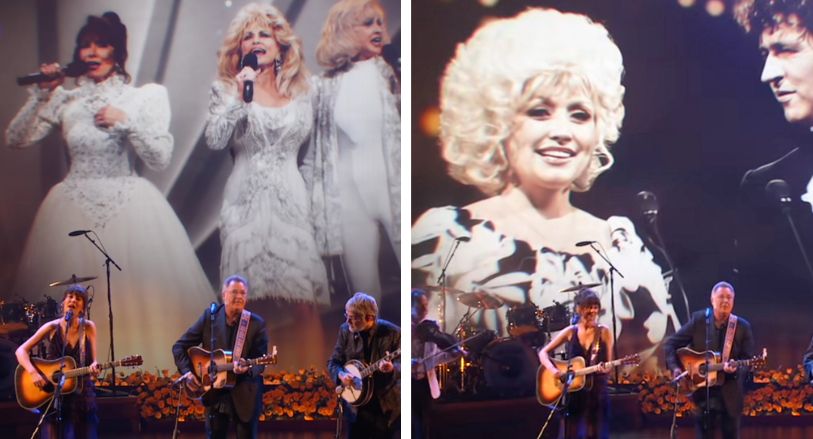
Vince Gill has spent decades singing alongside some of country music’s most celebrated voices, but one musical memory involving Dolly Parton clearly held a special place in his heart. When Gill joined Ricky Skaggs, Béla Fleck, and Molly Tuttle to open the CMA’s October 21 tribute to Parton, the performance carried the weight of a friendship built over years of music, shared memories, and mutual respect. Their choice of “A Few Old Memories” set the tone for an evening celebrating an artist whose influence extended far beyond the songs she recorded.
The special, “CMA Presents I Will Always Love You: A Celebration of Dolly Parton,” brought together performers from country music, bluegrass, and Broadway for a two-hour celebration at Belmont University’s Fisher Center for the Performing Arts in Nashville. Gill was among the artists who helped honor Parton’s remarkable career, joining a lineup that included Carrie Underwood, Lainey Wilson, Ella Langley, Brad Paisley, Reba McEntire, and many others. Yet Gill’s participation carried an especially personal significance because his connection to Parton extended well beyond the stage.
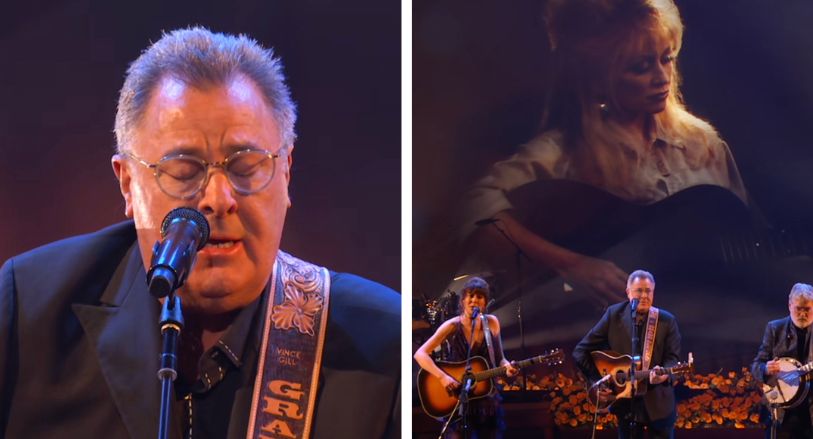
Opening the program with “A Few Old Memories” was a fitting choice for a celebration built around the enduring power of music and friendship. The song, associated with bluegrass singer-songwriter Hazel Dickens, offered an opportunity for the musicians to bring their individual talents together while reflecting on the memories that connect people over time. Gill’s voice blended with the distinctive instrumental styles of Skaggs, Fleck, and Tuttle, creating an opening that celebrated the musical traditions Parton herself had helped bring to a worldwide audience.
The performance also highlighted an important part of Gill’s own musical identity. Although he is widely recognized for his smooth vocals and remarkable guitar playing, he has long been respected across country and bluegrass circles for his ability to collaborate with other musicians. Sharing the stage with Skaggs, Fleck, and Tuttle brought together performers with different strengths, reinforcing the idea that a tribute can be powerful without relying solely on familiar chart-topping hits.
Gill returned later in the special, joining Lainey Wilson in support of her performance of “Train, Train.” His involvement throughout the evening reflected the breadth of his musical relationships and his willingness to celebrate artists whose work has shaped country music across generations. But it is his history with Parton that provides the most revealing context for his appearance.
One of their most memorable collaborations came in 1995, when Gill and Parton recorded “I Will Always Love You” together. Parton had written the song decades earlier, and it had already become a major hit in its original country version before Whitney Houston transformed it into an international pop phenomenon in 1992. Gill’s duet with Parton offered another interpretation, bringing their voices together in a performance that emphasized the song’s emotional restraint as much as its vocal power.
The recording reached No. 15 on Billboard’s Hot Country Songs chart and earned the pair the Country Music Association Award for Vocal Event of the Year. It also received a Grammy nomination, adding another significant achievement to a collaboration that was memorable for more than its commercial success. Their voices complemented one another naturally, allowing the song’s emotional core to remain at the center of the performance.
For Gill, the experience became a treasured memory. Following Parton’s death on August 25, he shared footage of their duet and wrote about the extraordinary feeling of singing the song with her. He recalled that one of the most beautiful sounds he had ever heard was the moment they sang the final note together during their CMA Awards performance. It was a deeply personal reflection that revealed how music can preserve a moment long after the performance itself has ended.

That memory also helps explain why Gill’s participation in the October tribute meant so much. The relationship between a singer and a song can change over time, particularly when the music becomes connected to someone important in their life. A duet that once represented the joy of making music together can later become a way to remember that person. For Gill, “I Will Always Love You” was not simply another celebrated recording in his catalogue; it was a reminder of a friendship he clearly valued.
His response to Parton’s passing was not limited to words or archival footage. On August 27, just two days after her death, Gill performed “I Will Always Love You” during a concert at the Midland Theatre in Kansas City. The timing made the performance especially poignant, as he returned to a song associated with one of their most memorable collaborations while the loss was still fresh. Footage from the concert showed the emotional weight of the moment as he sang the familiar ballad.

The decision to revisit the song so soon after her death demonstrated the role music can play in expressing grief. Some feelings are difficult to put into ordinary conversation, particularly when a person has been part of your life for decades. Returning to a shared song can offer a way to acknowledge the loss while holding on to something that remains. For Gill, the song provided a connection to a moment in his life that would always belong to him and Parton.
Parton’s influence on Gill and other musicians is also a reminder that her legacy cannot be measured solely through record sales, awards, or the size of her audience. She built a reputation as a songwriter whose compositions could be interpreted in different ways, allowing other performers to bring their own experiences to the material. “I Will Always Love You” is perhaps the clearest example of that gift, having been recorded by artists with vastly different vocal styles while retaining its emotional force.
The CMA tribute celebrated that wider influence through performances spanning multiple genres and generations. Alongside the live music, the special honored Parton’s work as an entertainer, entrepreneur, and humanitarian. Proceeds from the event were designated to support Dolly Parton’s Imagination Library, her book-gifting initiative that encourages early childhood literacy. The charitable element reflected a side of Parton’s legacy that was every bit as important as her achievements onstage.
Gill’s appearance was particularly fitting because his own career has been built around musical generosity. He has frequently collaborated with artists across styles, demonstrating a deep appreciation for the craft of songwriting and the importance of listening to other performers. His tribute to Parton reflected that same spirit: rather than focusing only on his own accomplishments, he helped create a musical moment that celebrated the community she inspired.
Ultimately, Gill’s performance with Skaggs, Fleck, and Tuttle was about more than opening a television special. It offered a reminder that the strongest musical tributes often come from people who have personal memories to share, whether through a duet recorded years ago or a song performed in the immediate aftermath of a loss. Gill’s recollections of singing with Parton give audiences a glimpse of the friendship behind the music, making his contribution to the tribute especially meaningful.
And perhaps that is why his memory of their final note together remains so powerful. A song can last for generations, but the moments surrounding its creation belong to the people who experienced them. Gill’s story shows how those moments can continue to resonate long after the applause has faded.
What do you find most moving about Vince Gill’s tribute to Dolly Parton: his memories of their award-winning duet, his emotional concert performance just days after her passing, or the way he helped open the CMA celebration with fellow musicians? Which of their musical moments will you remember most?