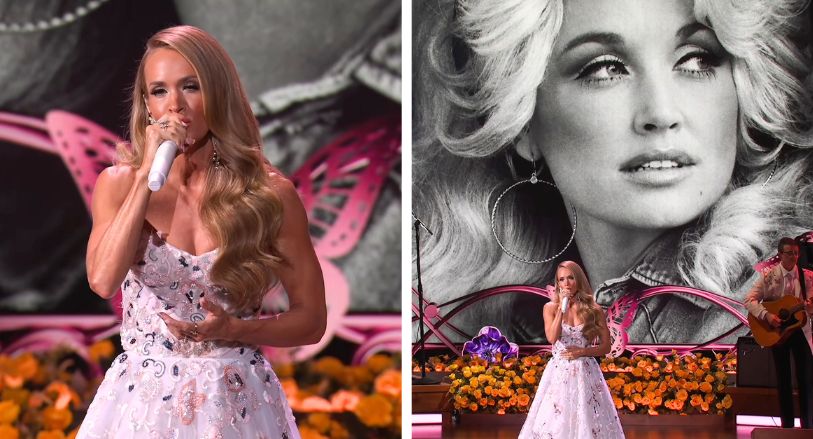
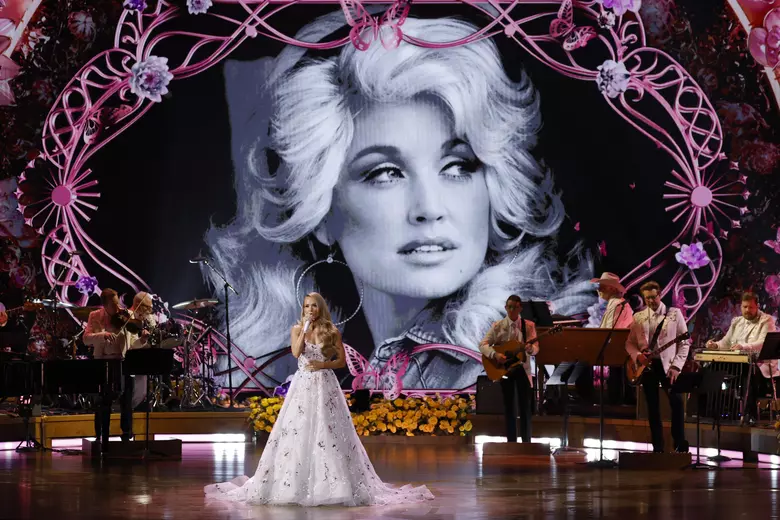
Carrie Underwood had an enormous challenge when she stepped onto the stage to honor Dolly Parton: how do you sing one of country music’s most beloved farewell songs when the woman who made it famous is the person everyone has gathered to remember? Her performance of “I Will Always Love You” brought the celebration to a powerful close, but it was the combination of a simple arrangement, a flowing white dress, and butterflies surrounding her that gave the moment an especially poignant quality.
The performance took place on Wednesday, October 21, during CMA Presents I Will Always Love You: A Celebration of Dolly Parton. Underwood chose to let the song carry the emotion rather than relying on an elaborate musical production, delivering her interpretation of the classic before other performers joined her near the finale. The result was a fitting conclusion to a program celebrating Parton’s extraordinary influence on country music.
For Underwood, the song was more than an opportunity to showcase her vocal power. “I Will Always Love You” is one of those rare compositions that audiences recognize within moments, yet every new performance invites comparisons with the versions that have become part of music history. Singing it at a celebration of Parton meant honoring both the songwriter’s original vision and the emotional legacy the song has acquired over the decades.
Viewers quickly responded to Underwood’s rendition, with some describing it as breathtaking and others calling it the standout performance of the evening. Several particularly appreciated her decision to keep the arrangement relatively restrained, arguing that the straightforward approach allowed the song’s emotional message to remain at the center. Rather than attempting to make the ballad unrecognizable, Underwood offered a tribute that respected the qualities that made it so enduring.
The visual details surrounding Underwood also became part of the conversation. Her flowing white gown complemented the soft stage design, while a butterfly appearing behind her caught the attention of viewers who saw it as a fitting symbol of remembrance. Although the butterfly was part of the staging rather than evidence of anything supernatural, its appearance added another layer of meaning for people reflecting on Parton’s life and music.

The choice of song was significant for another reason: “I Will Always Love You” has one of the most remarkable histories in modern popular music. Parton wrote it in 1973 as a farewell to Porter Wagoner, her longtime professional partner, when she decided to leave his television show and pursue her own career. Rather than ending their working relationship with anger or resentment, she expressed her gratitude through a song that acknowledged the importance of their time together while accepting that their paths needed to separate.
That history gives the ballad a meaning that can sometimes be overshadowed by its later success. Before it became an international pop phenomenon, it was a deeply personal country song written by a woman navigating a major turning point in her professional life. Parton’s original recording reached No. 1 on the Billboard Hot Country Songs chart in 1974, establishing the song as a major success in its own right.
Nearly two decades later, Whitney Houston introduced the composition to a new generation through her recording for the 1992 film “The Bodyguard.” Her version became a global hit, transforming the song into a defining power ballad and creating a second musical legacy that continues to influence how audiences hear it. For many listeners, Houston’s soaring interpretation became the benchmark against which subsequent performances would inevitably be measured.
That history explains why reactions to Underwood’s performance were not entirely unanimous. While many viewers praised her interpretation, others argued that Parton’s original version could never be surpassed. Some brought Houston into the discussion, insisting that her recording remained the definitive version for them. Those comparisons are understandable, given the extraordinary success of both recordings, but they also illustrate how a single composition can carry different emotional meanings for different generations.
There is no need to declare one version the ultimate winner. Parton’s recording carries the intimacy of the original farewell, while Houston’s interpretation emphasizes the song’s dramatic vocal possibilities. Underwood’s rendition, meanwhile, took place in a setting defined by remembrance, making the emotional context as important as the notes themselves.
That distinction matters when evaluating a tribute. A performance honoring a songwriter is not necessarily meant to replace the original or compete with every famous recording that followed. Its purpose is to recognize the person behind the music and help audiences reconnect with what made the song meaningful in the first place. Underwood’s restrained approach appeared to resonate with viewers who wanted the closing number to feel like a celebration of Parton rather than a showcase designed to overshadow her.
The larger special offered several other reminders of Parton’s reach across country music. Zac Brown performed “Butterfly” alongside Parton’s recorded vocals, while Ella Langley delivered her interpretation of “Jolene.” Brad Paisley, Vince Gill, Reba McEntire, and numerous other performers also participated in the celebration, bringing different musical backgrounds and personal connections to the evening. The variety of performances demonstrated how Parton’s catalog continues to inspire artists with very different styles.

The event also honored a part of Parton’s legacy that extends beyond her recordings. Proceeds from the celebration were designated to benefit Dolly Parton’s Imagination Library, the literacy initiative that provides free books to children. That commitment connected the evening’s musical celebration with one of Parton’s most enduring philanthropic efforts, ensuring that the event recognized not only the songs she created but also the opportunities she helped make possible for young readers.

Ultimately, Underwood’s performance succeeded because it brought together a familiar song, a meaningful occasion, and a visual presentation that encouraged viewers to reflect on the woman being honored. The white dress and butterfly helped establish the atmosphere, but the song’s history gave the moment its deeper significance. It was a farewell written decades ago that had since become a worldwide anthem, now serving as a musical expression of gratitude for the artist whose voice first brought it to life.
In my view, the most fitting tribute was not necessarily the performance with the biggest vocal flourish or the most elaborate staging. It was the one that reminded people why Parton’s songwriting has endured across generations. Underwood had a difficult song to sing precisely because so many listeners already had their own personal connection to it, and her decision to keep the interpretation focused on the melody and emotion offered a respectful way to close the celebration.
The debate over Parton, Houston, and Underwood will probably continue whenever another major artist takes on the ballad. But perhaps that is part of the song’s remarkable legacy: it can accommodate different voices and interpretations without losing the emotion at its core. Every version adds another chapter to a story that began with Parton saying goodbye to a longtime collaborator and grew into one of the most recognizable songs in popular music.
So, when you think about Carrie Underwood’s tribute, what mattered most to you: her decision to keep the arrangement simple, the butterfly imagery that made the stage feel especially poignant, or the emotional weight of hearing Dolly Parton’s signature song close a celebration of her life and career?