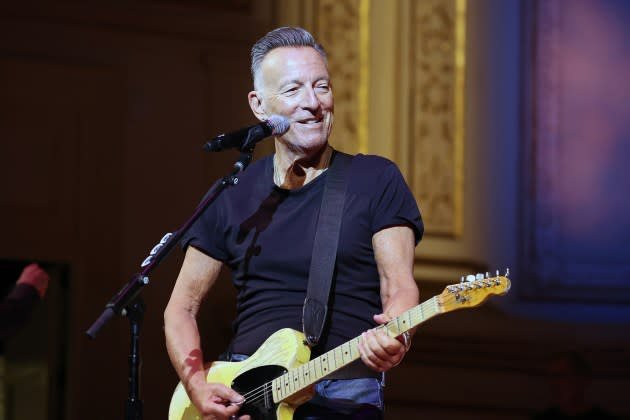
When Bruce Springsteen stepped onto the stage to open his 2026 tour, it didn’t feel like the start of a routine concert. It felt like the beginning of something deliberate—something carefully constructed to say more than any single song could carry on its own.
From the first notes, it was clear this would be a different kind of night.
The opening choice alone set the tone. “War,” a track not performed live in over two decades, arrived with urgency and weight. It wasn’t just a surprise—it was a statement. The crowd, caught between shock and recognition, responded instantly, as if they understood that this setlist was going to ask something of them.
What followed was a journey through time.

Across 27 songs, Springsteen traced the arc of his career, weaving together decades of music into a single, cohesive experience. Tracks from Born in the U.S.A. carried their familiar intensity, while songs from The Rising brought a different kind of emotional depth. Each transition felt intentional, less like a playlist and more like chapters in a larger story.
But what made the night stand out wasn’t just the selection—it was the way it was delivered.
Springsteen has long been known for his ability to connect with an audience, but here, that connection felt heightened. Between songs, in the way he phrased a lyric or held a note just a moment longer, there was a sense that he wasn’t simply revisiting his catalog. He was reinterpreting it in real time, allowing each song to take on new meaning.
As the set moved forward, the energy in the venue continued to build. By the time he reached “Streets of Minneapolis,” the crowd was fully immersed—no longer just watching, but participating. Then came a tribute to “Purple Rain,” a moment that shifted the atmosphere entirely. Voices rose together, filling the space in a way that blurred the line between performer and audience.
It was one of those rare moments where a concert becomes something shared rather than observed.
And yet, even in those collective highs, there was a sense of purpose behind everything. Springsteen wasn’t chasing nostalgia. He wasn’t relying on familiarity alone. Instead, he seemed to be using these songs—some decades old—to speak to the present moment.
That’s what gave the performance its emotional weight.
When the night finally drew toward its close with “Chimes of Freedom,” the mood shifted again. The energy softened, but the intensity remained. It felt less like an ending and more like a reflection—a quiet acknowledgment of everything that had come before.
For longtime fans, the show offered something deeper than a greatest-hits experience. It was a reminder of why Springsteen’s music has endured: not just because of its sound, but because of its ability to evolve, to remain relevant, and to connect across generations.
And if this opening night is any indication, the 2026 tour is not simply about revisiting the past.
It’s about reshaping it—night by night, song by song.
Because when Bruce Springsteen takes the stage, it’s never just a performance.
It’s a conversation.